We again have had a series of near early summer type weather, but hang on, it is Virginia in the springtime. Yesterday 78 and warm at night. Today 81 and 39 at night. Thursday 43 and 28 at night. Then we have several days of typical spring weather followed by a couple days of deep freeze with nights in the teens. If you don’t like the weather, stick around for 24 hours, it will flip flop.
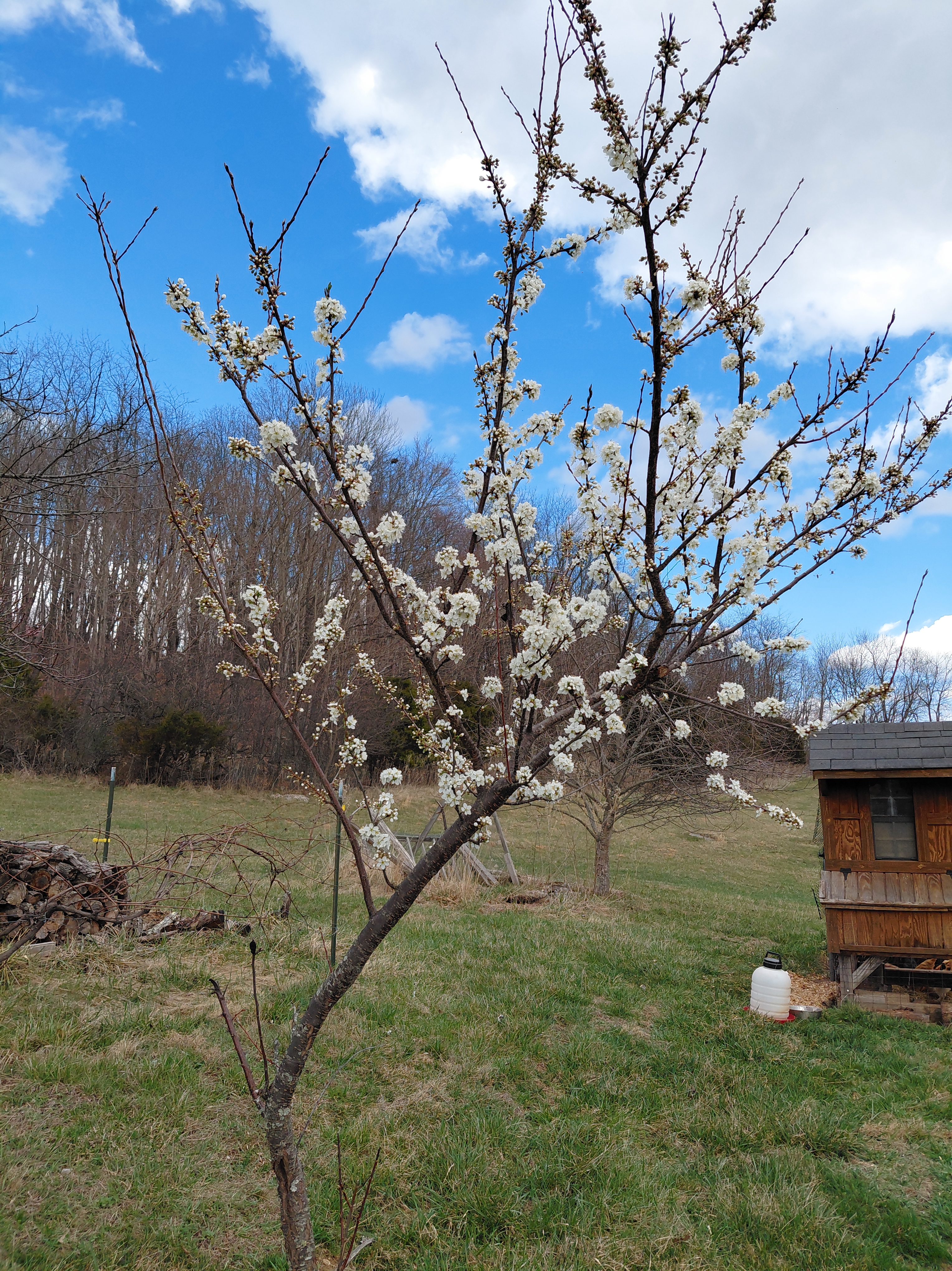
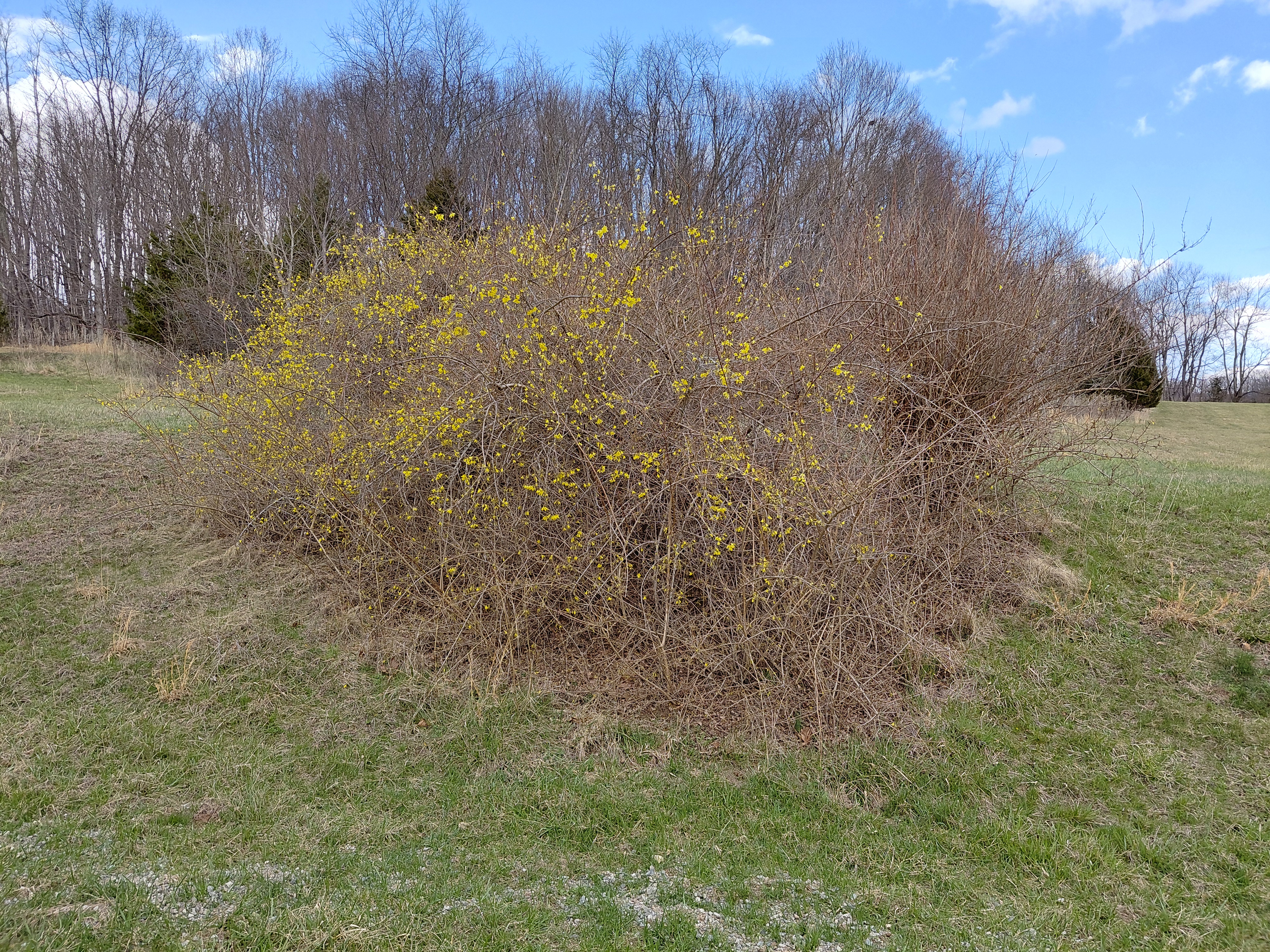
The Forsythia is beginning to bloom, if it freezes, we will lose the pretty yellow blooms but no harm done. The plum is in full white bloom and a freeze will mean no plums this early summer. I may take a sheet out to cover it Thursday and next week when it is again cold and hope to salvage some fruit.
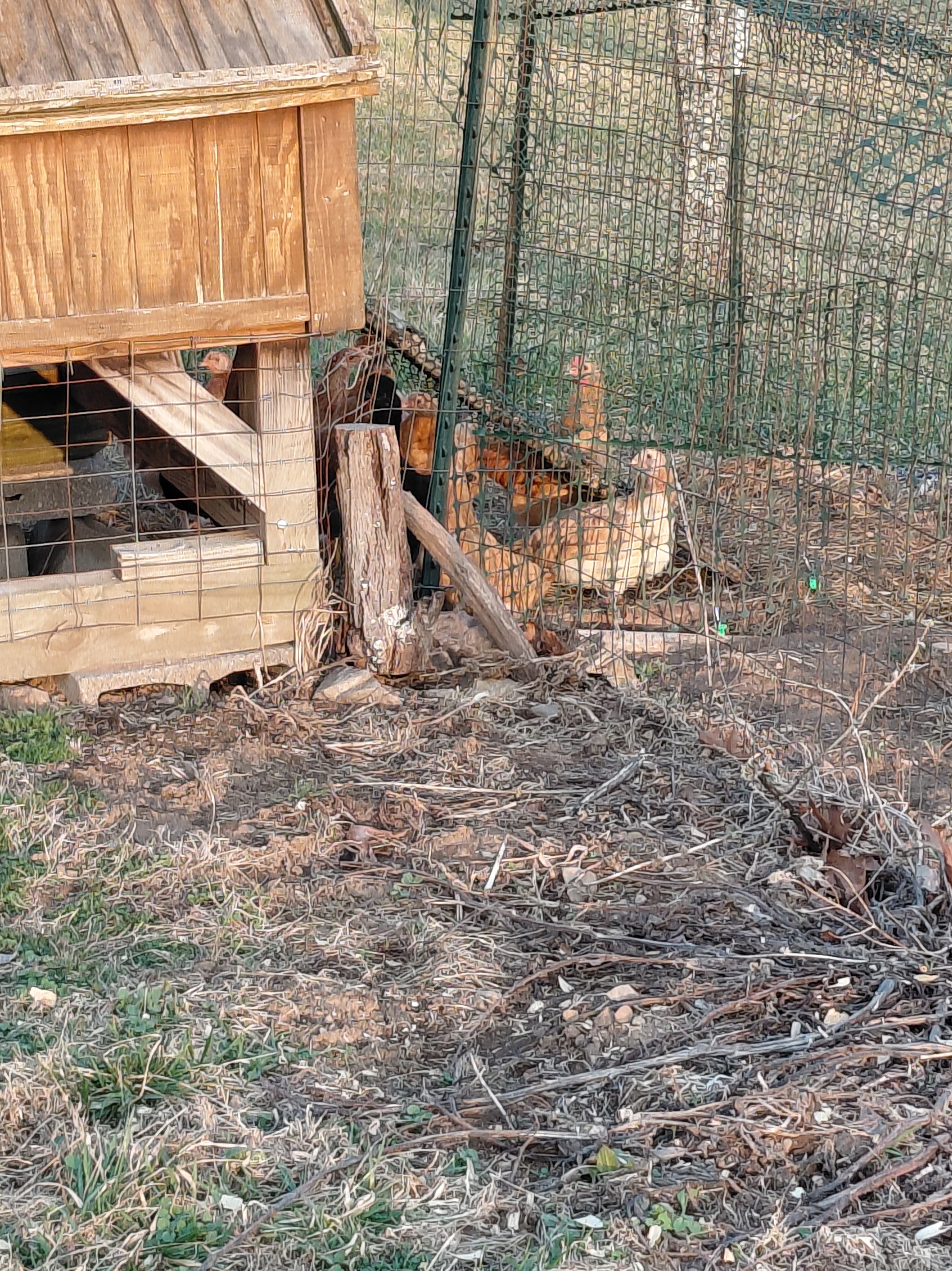
The pullets have finally figured out the outdoors and going back in by themselves at night. I only had one night of catching all ten and one night of catching one. Yesterday, the cover of the tunnel was refastened. The end needs some work, but it should only take me an hour or so to finish the work and another few minutes to secure some areas that don’t quite reach the soil line, then they will be given access to more space.
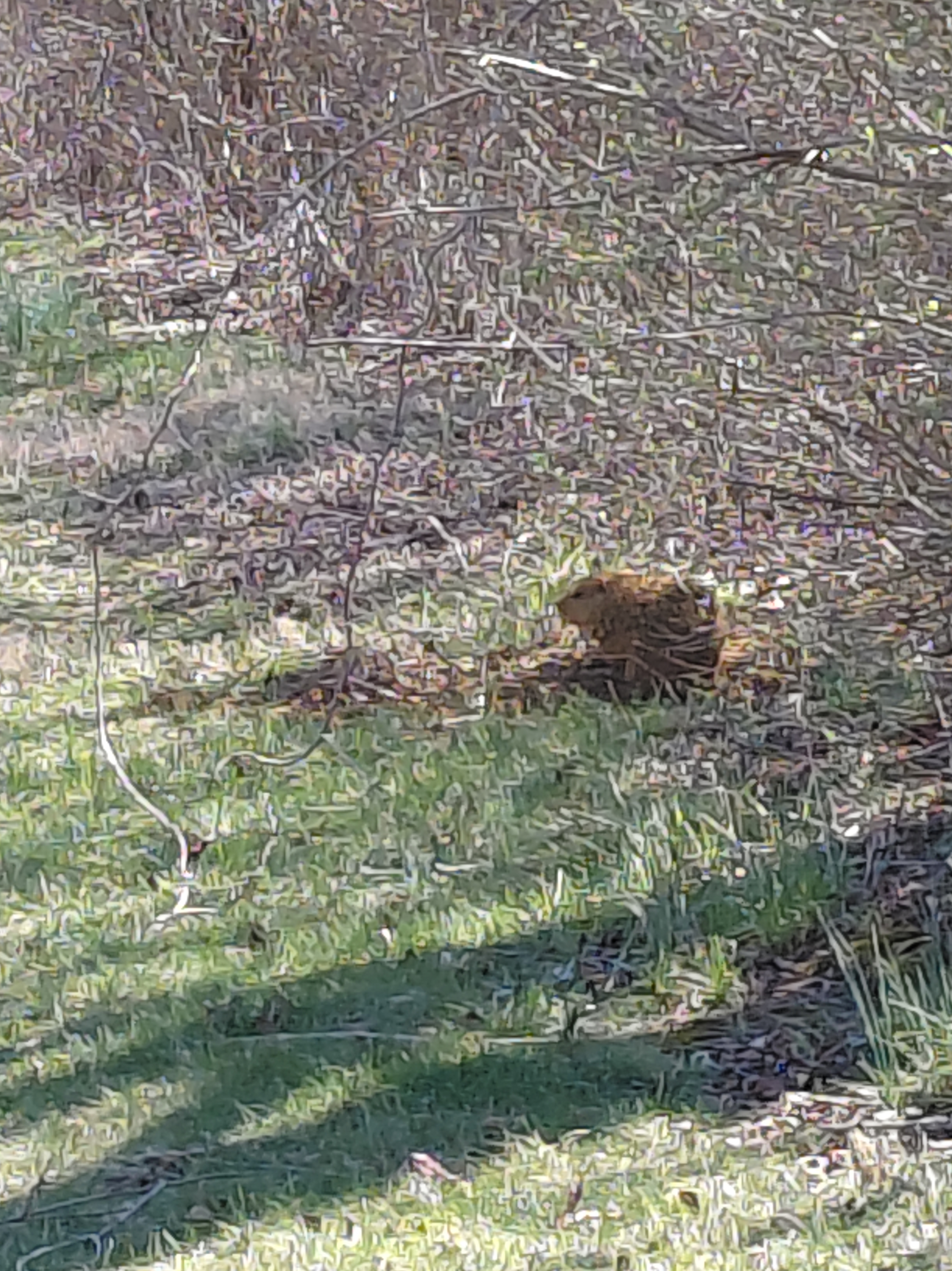
On our daily walk, we saw two woodchucks, aka ground hogs, aka whistle pigs that have burrows on the edge of the trail. Both were out sunning, of course darting back into the burrow as we approached.
It is the season where a few flowers from the yard can be brought in to adorn the table. Now there are daffodils and forsythia. The bearded iris and daylilies are showing and the autumn joy is showing green. It needs to warm up a bit more before the wildflower, zinnea, marigold, and bachelor button seed can be sown.
Most of my blog/journal postings fit that description anyway, but that title hasn’t been used in a while.
Two of the pullets were getting braver and leaving the coop. Unfortunately, the other 8 aren’t following and peer pressure hits and the two go back inside. A couple days ago, now that we have a series of spring days, they were forced out, with some scratch and some water in the pen so they get accustomed to being outdoors. This resulted in having to catch all 10 and walk them back up the ramp to the popdoor at dusk. Yesterday, only one appeared and never left the ramp. Today was coop cleaning day as they had made quite a mess of it in the few weeks they have been in it and my efforts with the snow shovel chased them all out into the pen. The coop is clean, they have a container full of food and another of water, however, as dusk approaches, not a single one has gone back into the coop. When it gets a bit darker, if they still haven’t figured it out on their own, another catch and up the ramp session will occur.
And with the warmer dryer days ahead, planning on getting the tunnel around the garden secured so they can expand their territory if they ever start coming out on their own.
If it was up to me, the television would rarely be turned on. Hubby knows that and generally only turns it on late in the evening or after I have gone to bed. However, there is a series in it’s second season that does interest me. The series is “Doc.” As we don’t watch series shows for the most part, a characteristic of this show bothers me and I don’t know if it is typical of series in general or if this is an anomaly. The show is an hour. The content is probably only 15-20 minutes of that hour and the remaining 40-45 minutes is commercials, often repeated. This is not an exageration. For every 4-5 minutes of content, there are 8-10 minutes of ads. It has become so irritating that I may stop watching it entirely. It is bad enough with movies, even in theaters now, you get the commercials seen on TV at the beginning. At least they don’t interrupt the flow of the movie in a theater with inserted ads. When you pay an arm and a leg to have TV in your home through satellite or cable (we live in the mountains and antennas are basically useless), it is annoying to have that much of the show time not actually the show.
The itch to start seeds for the garden is strong. The average last frost date here is around Mother’s Day, so 6 weeks prior wouldn’t be until near April 1, a long 3 weeks away. The seed is ready, the LED lighted starting boxes clean, but the date is too early. In the past, I have succumbed to the temptation then struggled to keep the seedlings from getting too leggy or outgrowing the starting pots. This often results in then purchasing starter plants at the nursery closer to planting time. Maybe the urge can be tamped down by preparing beds and repairing fences. And peas can probably be started in the ground now.
Earlier this week, I got my new hearing aids. Because my right ear canal is not straight, or even close to straight, the audiologist suggested trying a custom mold so the aid stays in place. In numerous tries, she could only insert it correctly twice and I have yet to be able to accomplish it. Another appointment has been scheduled for Monday to discuss this with her and other options. If I am going to constantly have to be adjusting it, the dome like I had before and on my left aid may be the only option. At least that doesn’t make my ear canal sore while trying to insert it.
We have 5 more days of spring like weather before we return to seasonable March weather. At least there is no snow in the two week forecast, that is a win in my book.
Blogs are developed for several reasons. Mine is basically a journal. I have tried paper journalling, however, writing is much slower than I think or type, so the blog evolved. If my thought are deeper than I wish to share, there is a private typed journal that occassionally I use.
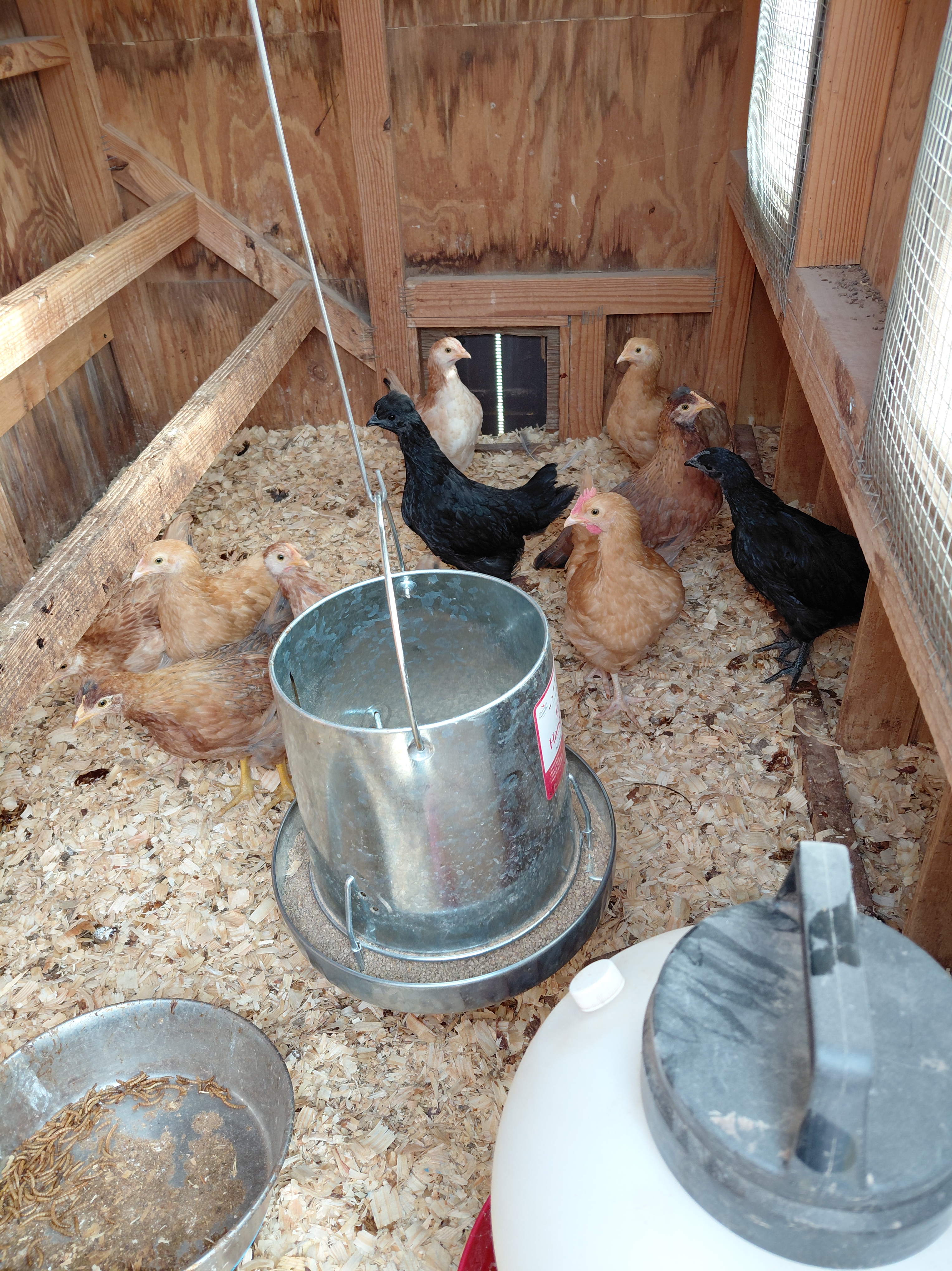
This week has been full of life. After our Anniversary dinner last weekend, we have had a busy but usual week. With the chick teenagers now in the coop, daily trips over to check on them and carrying a plastic cup with a handful of dried mealworms as a treat. The cup is shaken from the garage to the coop and as the door is opened and the treat poured into a small dish. The idea, to train them that the noise, the yellow cup, and me mean a treat so that when they begin to free range, they will come when called with the treat cup. It is about time to let them into the run, so most of a bale of hay has been spread in the run, areas of the fence that either had a broken wire or not tight to the ground were reinforced, and the battery operated pop door reset for times, but still wedged shut. We have two days of winter wet starting tonight with rain, turning to snow tomorrow into Monday night, so the door will remain closed for a couple more days. I don’t want to have to be out there in snow and cold to encourage any of them that don’t find their way back inside the coop as night falls. They are looking like small chickens now, less awkward.
The two black ones are Mystic Onyx breed, one I had never seen before. They are a cross of Silkies and meat birds, medium sized, gentle nature, black legs, beaks, combs, and feathers. One of these has feathered feet and a head tuft more like a Silkie.
We had several beautiful days this week where we could take our daily walk outdoors on the rails to trails trail. The mid section still hasn’t reopened from bridge repair, but is supposed to reopen in the next couple of weeks. Getting outdoors encourages a longer walk than when we walk indoors in the mall. We have managed a couple of 3 mile walks this week. When the weather warms a bit more and the spring flowers are showing more, we will extend the walk to the Hahn Garden on campus.
With the nice day today, we made it back to our routine with breakfast followed by the local Saturday Farmer’s Market for the first time in several weeks. Being able to get some fresh greens, radishes, bread, and a small roast is wonderful.
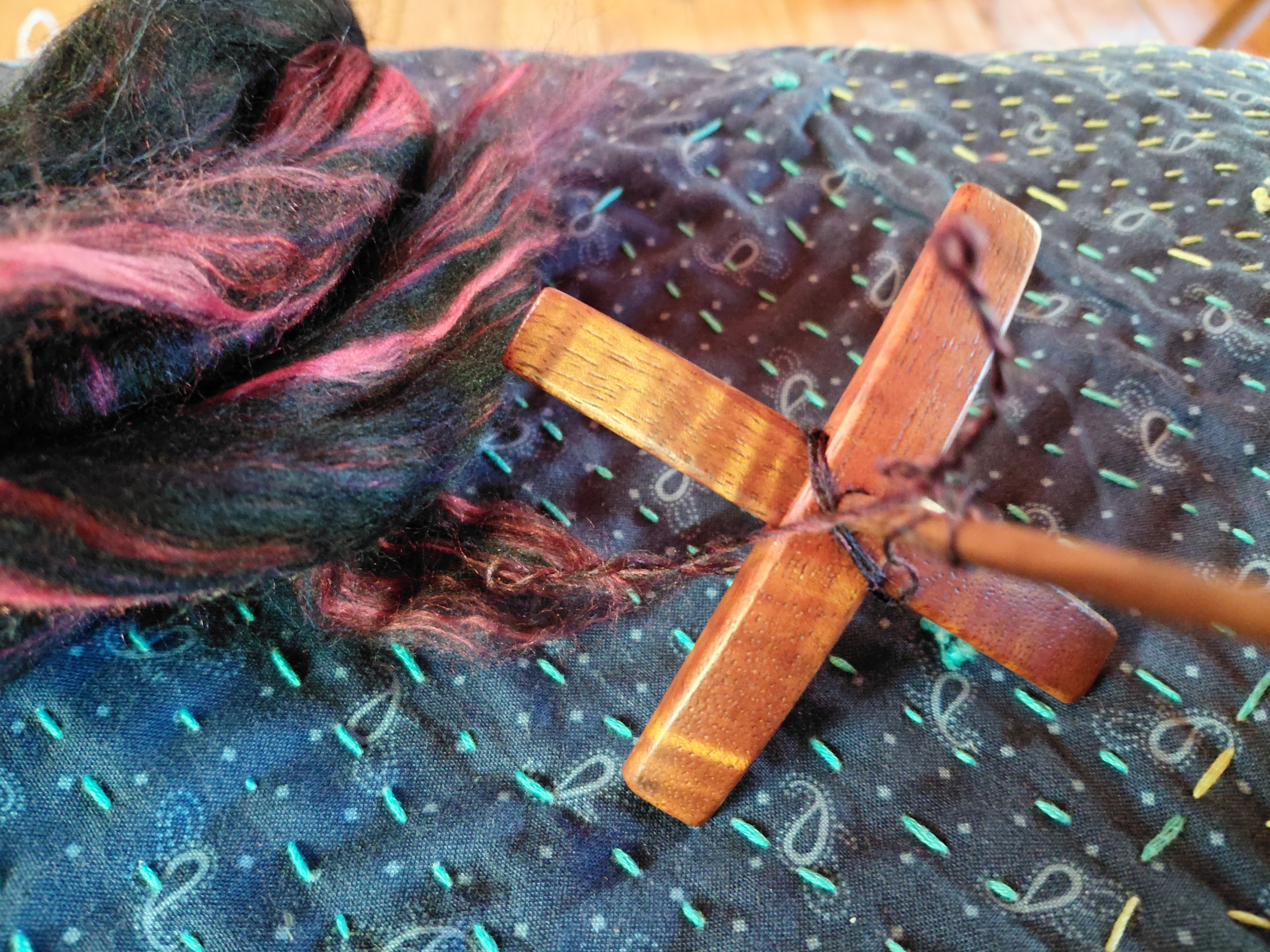
The new spindle has been the spindle of choice this week. It is Koa wood, hubby selected as a reminder of our trip last November to Kaua’i.
I love the smaller spindles, this one is a bit larger than 3 of mine, but still small enough for travel and tucking in my daily bag, but large enough to hold more spun fiber.
The hydroponic garden has 6 young herb plants sprouted. Soon they will be large enough to begin to enjoy some fresh herbs in cooking and salads. Our favorite garden center reopens next weekend and seeds needed for this year ‘s garden can be purchased. There are some left over seeds from last year, but not enough peas or beans, and after the raccoons got all of the sweet corn, I will go back to planting popcorn instead. The brightly colored popcorn can be used for fall decorating and popping and the raccoons don’t seem to like it as well. Last year I tried to cover the unplanted areas with pumpkins and failed. I don’t want to deal with the weed load this year, so a plan needs to be developed. Maybe gourds that can be used also for fall decorating and shared with daughter. If that fails, the line trimmer will have to be used more frequently as the garden fencing hasn’t been moved.
Spring can’t come soon enough, we are tired of the cold and the ridiculously high energy bills.
When I began college nearly 60 years ago, I was unsure the direction in which to go careerwise. One of my early classes was a General Biology class with a great professor and having followed a wonderful high school biology teacher, I ended up majoring in Biology Education and adding General Science certification to my teaching license. I started my master’s degree also in science, but later changed to School Counseling. Though much of my career in education was in counseling, the interest in science never moved far from my focus.
As a result, I am ever on the lookout when on our daily walks for animals, and changes in the flora surrounding the trails. One of the interesting quirks of nature are mast years. Those are years when all the nut and oak trees produce more fruit that prior years. The reason for this is debated with several theories, but next year, there will be way more young animals in the fields and woods. This is a mast year. Walking the paths over the abundance of acorns and small nuts feels like walking on pebbles. And several of the areas are shaded by black walnut trees which drop baseball size nuts in green husks that can cause a turned ankle if not looking where your feet fall, or a knot on the head if you are under one when it falls.
The past couple of days walks have been interesting. We saw the first copperhead snake I have seen here since we moved here almost two decades ago. It was leisurely crossing the paved trail on which we were walking. I got close enough to identify it, but not close enough to disturb it, not wanting to make a venomous snake cross with me.
Yesterday while weeding a garden bed, I disturbed this large garden spider with hundreds of her young on her back. I moved away from where she was and weeded elsewhere.
Today’s walk was one that was ripe with nuts. There were Buckeyes (aka Horse Chestnuts) which are toxic to humans and animals, Bitternut Hickory which are edible though very bitter when raw, if roasted they can be substitued for pecans or walnuts, and many Black Walnuts. I failed to pick up a walnut to add to my photograph. The Black Walnut that was on our property before we purchased it had fallen, though we have plenty of Bitternut Hickory trees and Oaks.
The hickory nuts in this photo are in two stages of being shelled, the husk still on one and two still in the shell. All five nuts went back into the wild, not brought home with us.
This is a great time of year for our daily walks. The daytime temperatures are very comfortable, the trees are turning autumn colors and dropping their leaves, fruits, and nuts, and we see more wildlife in the woods and crossing the roads and trails. Soon the geese will land in the pond on their way south, though we haven’t seen or heard any yet. We still have Hummingbirds coming to the feeders, so they are staying full. One beautiful little one got trapped in our garage yesterday and by the time we saw it, it was worn out from trying to escape, allowing me to pick it up and take it back outdoors where it gratefully flew away. The hens have already started into non laying mode, getting only about a dozen a week now from 6 hens instead of enough to share.
Soon the autumn will chill, the garden will close up for the winter, and it will be time to plant next year’s garlic.
Stay safe, enjoy the changing seasons if you live where you get changes.
Not to anything dire, just not wanting to keep posting the same routine.
It has been a hot, wet summer and the garden has suffered. Raccoons got every ear of corn and started on the tomatoes as they ripened. Green beans have been very prolific as were the cucumbers. The cucumber vines have now died off and were pulled from their trellis yesterday afternoon and the first planting of green beans also pulled as I had been away for 5 days and most of the ones on the plants were too large and soft to be desirable as we don’t like the “southern” way of cooking them with fat back until they are practically mush. The second planting has just begun to provide.
We set about on Monday to get the lawn mowed after lunch. I sent DH out to get gas for a fill up, thinking there was enough to start while he was gone, but I backed the riding mower out of the garage and it sputtered to a stop. Instead of sitting idly by, the bed of flowers by the east side of the garage was a weedy mess and the grass was hanging over into it, so much bending, stooping, and sitting on a step stool that sent me into an unplanned hard landing on the grass, and all the grass and lambs quarters were pulled, a new edge dug. He began to mow while I was doing that so the line trimmer was used to go around the house and over to the vegetable garden that had lambs quarters, wild amaranth, and horse nettles as tall as me that the line trimmer couldn’t handle. This is the result of hand weeding all of it and the orchard grass growing in the paths.
That pile is about 2.5 feet tall, what you see behind it is the same mess that is in the closed off chicken run that I can’t access until the fence is removed. I don’t know if it will compost as I had no means of chopping it up, so it is a stack of 5 to 6 feet long stalks mixed with mats of Creeping Charlie, Bermuda grass, Smart weed, and other unwanted greenery that had taken over the end of the garden not in use this summer. I’m thinking about trying to move the inner fence to cross just above the part of the garden in use and letting the chicken have at the rest. It will leave them unprotected from the hawks but that is a chance I am willing to take.
Yesterday a very early venture over to the garden to harvest beans and tomatoes and finish weeding a small section I never got to Monday, found all of the Tithonia and Sunflowers full of sleeping wild bees.
Yesterday afternoon, after a trip to the nursery, flats of spinach and Romaine lettuce seedling, a row of Little Gems lettuce seed, and three rows of turnips were planted in one of the empty raised beds. The one the first green beans were in will be reserved to plant garlic when it cools more.
The reason for my 5 day absence was to travel to Black Mountain, North Carolina for my favorite Art and Fiber Retreat. We meet at the YMCA Blue Ridge Assembly. It was rejuvenating and a bit heartbreaking. The group is a wonderful mix of ladies that spin, knit, crochet, weave, and do other paper arts. The heartbreak was to see the damage caused by Helene and know that though they have worked hard to recover, only 40% occupancy is available still as they lost a couple of buildings and had damage to many others. The motel style lodge where we stay and where meals are prepared and served by the staff was the first to be repaired and reopened. Helene took out every power pole leading up to the buildings except for 3. It took them 4 weeks to get any power back. The creek that became a river down the west side, that damaged the old gym so badly it had to be torn down is now a gully 16 feet deep and washed through the woods taking out trees and rhododendron to now look like a dry river bed.
This is an area above the retreat that is up the mountain. All of their hiking trails in that area are impassable still and a lower priority than restoring the rest of the buildings.
Part of the repair is placing 14 foot arches where roads were to divert the flow, instead of smaller culverts that had always handled the creeks in the past. Also where two landslides sent mud into buildings, have new reinforced walls at the top and the slides seeded as they are now open meadows.
In addition to visiting with friends I see seldom, I finished a skein of yarn I had been spindle spinning, took a needle felting class and made two little pumpkins, and started wheel spinning 8 ounces of Coopworth and Alpaca roving purchased from a friend that raises the animals and dyes the wool before the mill processes it into roving. Also some knitting on a pair of fingerless mitts was done with the wool I purchased in Alaska in May, spun on spindles and plyed on spindles.
Now back home, my food consumption is focusing on smaller portions and healthier choices as we always have a snack table with too much sugar and fat on it, and though I did take a walk up as far as I could go up hill above the retreat one day, I consumed too much not so healthy snacks in addition to the three meals a day they provide. Now home, I have resumed my daily walks with DH of 2-2.5 miles. It has been so humid though, it feels like you are breathing fog.
We have a cooler week of so ahead, it should help make the walks more enjoyable. We see early Autumn in the air as the early turning leaves are coloring and some are already falling. Until I have something new, stay safe.
This year, the garden is small, only 5 metal raised beds that vary from 3×3′ to 3.5×5′ plus a small patch of corn and sunflowers and the bed of blueberry bushes. Oh and the asparagus bed that is now tall ferns putting nutrients in the roots for next year’s crop.
Yesterday in the heat, the first green beans were harvested, enough to freeze some and share some with daughter’s family. The cucumbers are producing faster than I can pickle them, but only one has gotten large enough to discard to the remaining 6 chickens. It is one of their favorite summer time treats.
The weeds had gotten tall in the paths and unused part of the garden again, so before it got hot this morning, the line trimmer was put to use and cleared the paths and near the pumpkins with some hand weeding around the bases of them. They are not being very successful competing with the weeds. Also this morning, the tomatoes were trimmed and tied to the trellis, more green beans, onions, cucumbers, and the volunteer potatoes were brought in.
The assistance of the local grandson has been requested and the chicken tunnel fence is going to be moved to allow them in the parts of the garden that don’t have the raised beds that are productive. They will enjoy the fresh greens, scratch the roots up and clean that area up. It will likely mean the loss of the pumpkins, but as I only use a couple a year to make pies, I can purchase them at the Farmer’s Market this fall.
The volunteer potatoes had pushed some to the surface and they had developed the green solanine, so those were replanted in the bed that had the peas and onions earlier, as we are still within the potato planting window here. The bed that had earlier grown the garlic was replanted with a second planting of green beans and as we are approaching bean beetle season, they will likely be covered in row cover as soon as they emerge. Often, the second planting is destroyed by the beetles before they can really produce.
I just finished reading “The Serviceberry: Abundance and Reciprocity in the Natural World” by Robin Kimmerer. An expansion of an essay she wrote on gift and service economy. We should all spend more time giving of our excess and our time and less of the consumer economy in which we live. I try with giving eggs and produce to family and friends, and time as a volunteer at the museum, but more could be given.
If you are a subscriber that gets the blog in your email, it will direct to here. If you have gotten it from Facebook or Ravelry, you now should use Fstafford165.wordpress.com and it is secure. Subscribing will sent it to your email each time I post.
The blog looks a bit different as I have updated to a newer format, but it is still the same blog.
It is that time of the year when I dress up and present to local elementary and middle schoolers what it was like to have to make everything you needed to live on the frontier and to trade and barter with neighbors, provide your extras to the community store for the wagons moving farther west into what is now Kentucky and Ohio. The cabin was originally built in 1769 on Peak Creek and moved to the Wilderness Road in Newbern in 1830. When it was moved, a loft was added, you can see the stairs in the background. The footprint of the cabins in the “planned” community were 10′ X 10′ some with a loft. A fireplace for heat and cooking. The barn loom behind me, similar to the one that was in this cabin for an enslaved woman who was the village weaver. The walking wheel also behind me is one I made functional at the museum and demonstrate it and the drop spindle for making yarn to be used for the fabric needs. Last Wednesday when this photo was taken, it was dreary and chilly, about 47f and the 100 kiddos moving between the 8 stations every 15 minutes had to hustle and pack in tight for some of the stations. They huddled in every porch and building that had space to eat their lunch. I thought I was going to freeze and it took several hours once home to thaw out.
That sent me on a quest to make or find a historically accurate cape because this week’s groups begin on another chilly but dry day. My quest turned up a navy blue wool reenactment cape with hood used, on ebay, for a very good price and quick shipping. It arrived today and I won’t be cold again when the weather does not cooperate.
The cold night last week was hard on the new flower starts I put out, I guess a day too early. Today we bought marigolds and petunias as well as some flower seed that mostly will go in a ground bed once I get it cleaned up from winter and the hardier starts were put in the spots in the pots on the deck that were hit the hardest by the 25f night. Also some zinnia and nasturtium seed were interspersed with the small plants, so hopefully the pots will fill in with color as the spring moves on. There are no near freezing nights for the next 10 days and I will cover the pots with row cover if we get threatened.
The vegetable, herb, and flower seed under the grow lights haven’t sprouted yet, but they aren’t due to go in the ground for at least a month, maybe 6 weeks.
In the fall of 2023, our 12 year old English Mastiff named Ranger crossed the Rainbow Bridge. He was the best boy and his loss was very difficult for both hubby and me. We decided to memorialize him with an oak tree. The tree was a large one for a nursery tree, about 8′ tall in a 5 gallon pot. It was a challenge to get home, but accomplished by the aid of a friend and her pickup truck. The hole was dug, the tree planted and stabilizing ties added to three points. The tree turned fall colors and lost it leaves. Come spring, the tree put out new growth and we were grateful it seemed to be in good shape. Again, it lost it leaves and last winter, it began to look bent. I checked on it and about 15″ of it’s lower trunk about 3/4 of the way around, the bark had been rubbed off, I expect it was deer rubbing the velvet off of new antlers last spring and summer. I tried protecting the stem and straightening it late winter. The Ranger Tree couldn’t withstand that abuse and it died. A check yesterday, I realized it did not have any buds, and the young branches all the way up were brittle. We had selected an oak because it is a native tree. The nursery from which we had purchased it participates in “Throwing Shade Virginia,” a collaboration between the Virginia Department of Forestry and certain nurseries. If you purchased a native tree or shrub during March through May, you get a $25 discount. Today we went to see what was available and came home with a Northern Red Oak in a 2 gallon pot. It is only about 5.5′ tall, but full of new buds. Once home, the dead tree was dug out, the hole refreshed with new bagged soil and garden soil and The Ranger Tree II was planted. Not to have a repeat, the trunk was wrapped in an expanding spiral trunk wrap and a fence was erected about 3.5+ feet out from the newly planted tree.
To the right of where this tree was planted are the trees showing their spring flowers and new foliage.
And on the other side of the yard across the driveway, the beautiful yellow of the Forsythia. And the green of the lilacs.
We have had some delightful warm spring days, the garden is nearly ready for the summer vegetable plantings. The fall garlic is about a foot high, the spring onions about half a foot, and the peas are up enough to see where some needed to be filled in. Yesterday, a handful of pea seed was soaked in warm water for several hours and the empty spaces filled with them. We have another near summer like day, then a flipflop in the weather going to drop us back to normal daytime temperatures in the upper 40’s to mid 50’s, but Tuesday night it going down to the mid 20’s. The plum tree has bloomed and the blossoms are done. The peach trees are just coming into their own and the Asian Pears might be near the end of bloom. The apple trees haven’t bloomed yet. I hope it doesn’t kill the chance of getting fruit this summer and fall. The fig hasn’t come out yet.
An afternoon home alone yesterday allowed me to prune back the dead flower stalks from plants that leave a semi woody stem at the end of the season. They are always left in place for the insects to overwinter.
Two garden beds still need a bit more soil, but there is a bed that the wooden box had mostly rotted away and the soil from it will be moved to the other two beds. The upper third of the garden without raised bed boxes is going to be planted with sweet corn, pie pumpkins, and sunflowers.
The asparagus began showing up late last weekend and have been enjoyed for one meal so far. The garden won’t be quite as large this year and since I still have 1.5 gallons of pickled jalapenos, only two of them will be planted this year, the peppers to be pickled and canned. There is still a half gallon jar of dried ghost peppers, so they will be omitted this year. Maybe a couple of seranos for Sriracha sauce, and a couple of bell peppers will replace the extra jalapenos and ghost peppers.
I’m not wasting garden space on potatoes this year as the yield has been too low for the space they take up. I might try a potato tower and see how that yield is compared to in the ground.
It is wonderful to see the grass greening up, even though that means mowing weekly, and to see the garden taking shape for fresh vegetables.
Until then, we will be satisfied with what is available from Saturday’s Farmer’s Market.
Typical spring here, hot and humid one day and chilly and gray the next, but the garden grows. Except for the corn. Out of 4 rows in a 12 X 4 foot bed, only two seeds sent up blades. We were due for thunderstorms a couple of days ago, so the bed was reseeded. This may be the last time I try corn. Year before last, there was nothing, last year some came up, but the harvest was pretty paltry for the space it consumed. The only year that corn has ever been “successful” though marginally was the year of the popcorn.
The seed starts for squash, tomatillos, pumpkins, tomatoes, and peppers were all successful and are doing well planted in the beds. The cucumbers failed on first start, but there are several strong seedlings putting out secondary leaves that are currently being hardened off and soon they will be planted in the last bed.
The motivation for the garden has been hard to come by this year, and since I am currently unable to be out in the sun due to a chemo cream use on my face, I have to heavily cover with mineral sunscreen, wear a huge hat and limit my exposure. Sunburns as a kid camping with family, as a young adult working as a lifeguard, have come back to haunt me. Usually, anything found by the dermatologist is zapped with liquid nitrogen, but this time is wasn’t in a place they want to spray. At any rate, early or late, very protected sessions are being done. As an adult, I wear long sleeves nearly year round and always wear a hat with a brim when we are out walking. Sun damage from years ago revisits as we age.
Peas are heavy with blooms and though they are supposed to be a free standing variety, they have toppled all over each other. Soon, peas will be harvested. One of the varieties of spinach is bolting as is the lettuce. The beans are up. The tomatoes, peppers, basil, squash, and tomatillos have been mulched with clean straw, thanks to a friend that was able to get me a couple of bales yesterday. Part of a bale was used to clean the hens coop, a few flakes as mulch and the rest set back in the dry garage for further coop cleaning and garden mulching.
Now if I can just get the paths under control, figure out how to kill off the smartweed and creeping charlie, I will be happy. As it is upper 70’s today and tomorrow with bright sun, the paths were all sprayed with white vinegar and dish soap. If that shows any level of success, it will be repeated until I win, vinegar is cheap and safe. A truck load of wood chips would be great to have, to put about 4 inches between all the beds. The other frustrating area is the tall grass that grows up the welded wire fence. The line trimmer can’t get under the fence and if it hits the wire, it breaks off the trimming line. I don’t want to use chemicals like Liquid Fence, nor do I want to take down the fence and reset it an inch or two off the ground so I can weed under it. I envy neat gardens with no weeds, no grass in-between beds, no fence needed to thwart the deer, groundhogs (saw one today in the yard), and free ranging chickens. Perhaps the electric mesh type moveable fencing that can be moved away, allow mowing, then re-set would do the trick. I already have the 6V charger. Maybe if the vinegar trick works and I can get woodchips, cardboard can be slipped under the fence wire, heavily mulched on both sides out maybe far enough to keep an edge would work.
The bees are again protected from the resident bear. A new battery for the 12V charger was ordered and installed. Tested on the deck, it showed a strong charge, so it was taken back to the bee yard, rehung, and attached to the electric fence wire. When it was turned on, it showed only marginal charge on the fence. Because it was a new solar charged battery, it was left alone to charge for a couple days and still only marginal. This morning, the piece of line that connects the wire to the charger was replaced and the fence is again hot. Hopefully, 12 V will deter the furry beasts.
Spring is always fickle, this entire winter has been though. It was subzero for a week of nights around Christmas with single digit days, and there have been weeks of late spring/early summer temperatures with nights that didn’t drop below 50f. Flowers and fruit trees bloomed early. Fearing our pear trees wouldn’t produce fruit this year because there were blooms before another week of deep freeze temperatures, as it became time for them to bloom, there were more blossoms. Three of the apple trees are blooming heavily, one lightly, one not at all. There will be no plums, it bloomed way too early and all the blossoms froze.
Seven years ago we awoke to snow. Last night we had our first frost in weeks, but today it will be 60f and by later this week, almost 80f. Friday, though the Hummingbird tracker doesn’t show them here yet, I hung my feeders and yesterday saw our first one of the season feeding on the more popular feeders.
The hens have dug out under their fence, holes filled, hay layered to fight the mud, but today with the Forsythia nearly leafed out, though there were hardly any blooms, I have again given them free range. They will hopefully hide under the foliage of the shrubs or the cedars for their safety. I hope not to lose anymore, but they can’t stay penned up in a run only slightly larger than their coop.
Two of the remaining Marans foraging the front yard this morning.
The yoyo weather seems to have taken a toll on the row of Nandina bushes along the north front porch. Not a single one of them retained any leaves this winter though the one in the protected breezeway nook did. If they don’t grow out new leaves, and that looks doubtful, a decision will have to be made as to how to treat that area. It is not great soil, but the Nandinas had thrived there for about 15 years until this winter. With the chickens scratching up the soil there, growing grass might be a challenge unless I can block them off until it is established. A few large pots with evergreen shrubs scattered along the edge is a possibility or even low growing evergreen juniper planted in the soil.
The other victim of this winter might be my fig. It produced fruit for the first time last year, but I see no sign of life in the form of new leaf buds.
This is Penny, she is a jumper, belongs to our neighbor as one of her herd, and she thinks our grass is greener than the fields on which she lives. She visits in the spring time, leaving her calf for a little while to go over the 4 strands of barbed wire to come graze. She is a welcome visitor, it amuses me to find her munching away on the tall grass that will become hay in a few months.
Her sister was a jumper also and used to visit, sometimes bringing friends.
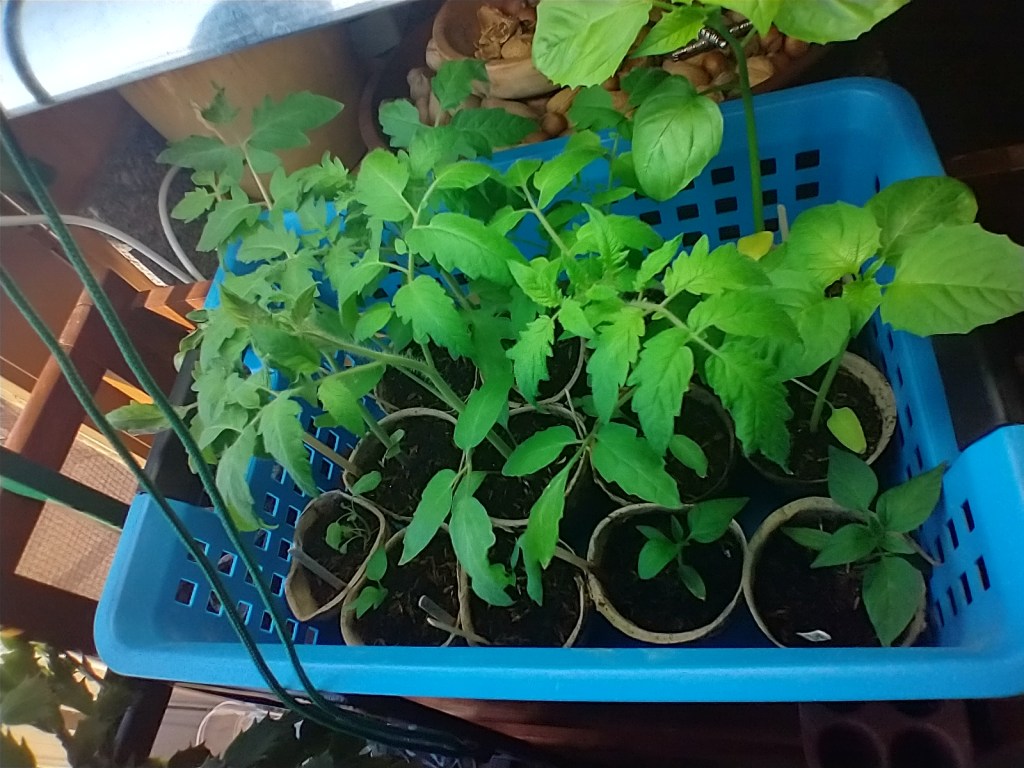
The tomato, tomatillo, and 2 of the varieties of pepper starts are thriving. This week, they will begin daytimes on the back deck sheltered initially, and later full on in the sun to harden off for planting in about a month. Yet again, I seem to have started them a couple of weeks too early.
Today is Easter Sunday and when we have family here, there is usually an Easter Egg hunt for the kids, even for the teens. Last year, daughter created an escape room sort of series of clues to lead the older ones from hidden large egg with the next clue that eventually led them to small baskets of goodies, mostly of the non edible kind. This is always followed by a meal that has traditionally been ham, au gratin potatoes, asparagus, another green for the haters, deviled eggs, rolls, and some sort of dessert. This year it is just the two of us and hubby will get his favorite home cooked Mexican food fiesta instead.
Maybe tomorrow, we will venture to the plant nursery to check out the herb selection, to Tractor Supply to add wild bird feed and suet cakes and if I can find one, a third Bluebird house. My carpentry skills just aren’t up to building my own.
The peas and radishes are beginning to emerge in the garden, the lettuce in the large pot on the back deck is growing, and I await the asparagus that have yet to show in the garden. Last year about this time we added the 4 hives of bees that did not succeed. Two nuks of bees with marked queens are on order for early May and two hives will be started again, hopefully with more success. While I await their arrival, new excluders for the openings will be ordered and sugar syrup will be fed inside the hives this year. I am really raising them as pollinators and not looking for much honey, but some would be a bonus. There is one capped frame of it in the freezer that survived the demise of the last hive. I really don’t know what to do with it, it may go in one of the new hives as starter feed for them.
Spring is officially here, though the chance for a frost lingers until the first week of May.


 Cabin Crafted