Category: farm

  • Bad Chicken Mama

    At lock up time last night, it was pouring rain. The hens had been penned up earlier when I took kitchen scraps over to them, so I left them to their own devices overnight. That was a major error. Though the pen is fenced with an heavy erosion fence cover, a raccoon got in the coop. I didn’t even realize it until just a few minutes ago when I went to check for eggs. as I had seen hens in the yard today and didn’t even dawn on me that they had been penned up last night. Two followed me with the treat pail over to the run, one was in the vegetable garden and joined the other two. Several were frantic under the coop, but I figured they just wanted treats or to be let out as the strong wind today had blown the gate shut, though now that I think about it, I had rolled the rock that holds the gate shut against it when I penned them up late yesterday afternoon. That only accounted for 7 of them. When I opened the coop door, there were feathers everywhere and one dead hen, the victim that I could find. One is missing, probably frightened off into the woods or thickets, but so far she hasn’t returned.

    The Marans that was in the garden went straight into the coop to lay an egg as soon as I did a little clean up. I hope the one that is AWOL reappears or my flock is down to 7. Nine was barely providing enough eggs for daughter’s family and my use.

    They haven’t been providing that many eggs for the number of hens, aging out, I guess. but I had really hoped to get through this laying season before having to replace any.

    I feel bad as it is totally my fault that they weren’t secured in the coop last night. Not wanting to go out in the storm cost me at least one hen and several eggs. It was easy to be complacent as the coop has food and water in it and with the rain, there is a tub of water outside in the run as well. Lesson learned. Regardless how nasty it is outside, the coop needs to be secured at night.

  • Fire

    We live in the zipcode of a tiny Village. On April 1, 1901, almost the entire village was destroyed, leaving only a couple residences, two churches, and a stable. Two stores, a tavern, a hotel, the drug store, and a tannery were among the buildings destroyed.

    “Newport was a thriving community with many businesses. An iron foundry, located on Sinking Creek, made pig iron from ore mined near Newport. A woolen mill in Newport obtained power from a 37-foot diameter overshot water wheel. The mill was later converted into a woodworking plant, then into a blacksmith shop and then into an automobile workshop. There were several mills including the Zell Mill and the Payne Mill. The town had three distilleries, each with a bar room.” Keister, Susie Reed (1969). A History of Newport, Virginia. Virginia Leader

    The village now is a handful of houses, a US Post Office, a small general store with gas pumps, and two churches. There were two professional baseball players and a nationally known songwriter that called Newport home.

    The village is surrounded by National Forest and farmland that is usually a mix of pasture and wood lots. With all of the woods, when we see smoke or a scene like the one we saw last night, we alert.

    This was seen when I went down to make a late evening cup of tea, to the south east of us, just over the hill at the back corner of our farm. Knowing that the neighbor back there has recently cleared areas of woods for more pastures for his cattle, I texted him to see if he was burning piles. Since there is an open burn ban until after 4 pm, he had to wait until then to start the burn. We had a few light hearted text exchanges and he let us know that there were several more big piles, so we will see more nights like this.

    Almost exactly a year ago, our sons helped me pull Autumn Olive bushes in the area where the bee yard was going to be placed and we piled them in the yard away from the house and the woods. That night, the guys tried to have a bonfire that was less than successful as the bushes were green. A second attempt latter in the spring or early summer still didn’t get rid of the pile, but left a ring of trunks and branches that the grass grew through. Today, I piled it all into a teepee type pile and mowed the grass as close to the pile as possible. This afternoon, that pile was burned.

    Continuously dragging in the unburned portions until the pile was reduced to cinders. The cinders were shoveled into the burn barrel and allowed to burn down until dark. It was then thoroughly doused and lidded. On another day, when more time can be spent monitoring it, more small wood will be added to the burn barrel and allow it to burn down to a layer of ash. The barrel isn’t considered open burn. That area is in the upper edge of the hayfield, so it is good that it is now gone and the hay can now grow there and not be a mowing or haying hazard. Once the burn barrel can be moved, it will be placed a bit higher on the property and used to burn pruning from the fruit trees.

  • Signs of Spring

    Though a single Hummingbird is visiting during the day, only the one has been spotted and not frequently enough to try to catch a photo. But other signs abound.

    The apple blossoms against a bright blue sky, as I mowed below them yesterday, the second mowing already this spring, though less of the property is being mowed, with the hope of either more hay mowing or at least a wild meadow. Son 1 suggested last year when he mowed for me that too much was being done on the little riding mower. Without consistent teen helpers around, I agreed and less is being done this year. The section below the garden where the garden used to extend, and between the garden and the orchard where an extended chicken run used to be are very rough and hard on the mowing machine and the mower rider. I have self debated whether it could be smoothed with the tractor blade and reseeded, but somehow the chickens would have to be kept out while the grass grew or the effort would be fruitless. They have denuded two areas where the grass was thin to dustbathe already since being freed back to wander the farm. Trying to keep them penned is an act of frustration as they dig out under the fence and once a hen has succeeded, others follow. The entire run needs to be disassembled, expanded with new fence wire, a chicken wire base that turns inward a foot or so to prevent tunnelling, and a top. It isn’t worth the effort or expense to do that, so they free range and become hawk bait.

    Part of the entourage that run to see what “treat” is in store whenever anyone steps out of the house.

    A very poor photo, zoomed to the extent of my phone and cropped to further enlarge, of two Toms doing their spring dance to entice the 3 hen turkeys nearby. Zoomed as they are about 200 yards away. This dance is a sure sign of spring.

    The first bird nest of the year in a Viola hanging pot, just put up a few days ago. Probably the Wren that builds in one of the pots each year, but I haven’t seen the bird on the rim yet and there are no eggs to identify. In a day or two, there will be eggs and in about 24 days, babies. It is hard on the plants in the baskets, but providing a nesting spot for the little Wrens is more important. Watering those plants has to be done carefully so as not to soak the eggs and nest. The only time I see them is on the planters, as Wrens don’t come to the feeders.

    Today, the swallows were checking out the nesting box that they steal from the bluebirds every year. The bluebirds will get the second one as the swallows won’t occupy two as close together as the two in the garden are set. I still want at least one more house for the garden area. The birds help keep the insect load in the garden reduced.

    The Peony’s are up. Though they are about 15 years old, they only began blooming a couple of years ago. Hopefully, they will bloom this year. It isn’t the best location for them.

    And the lilacs are beginning to bloom.

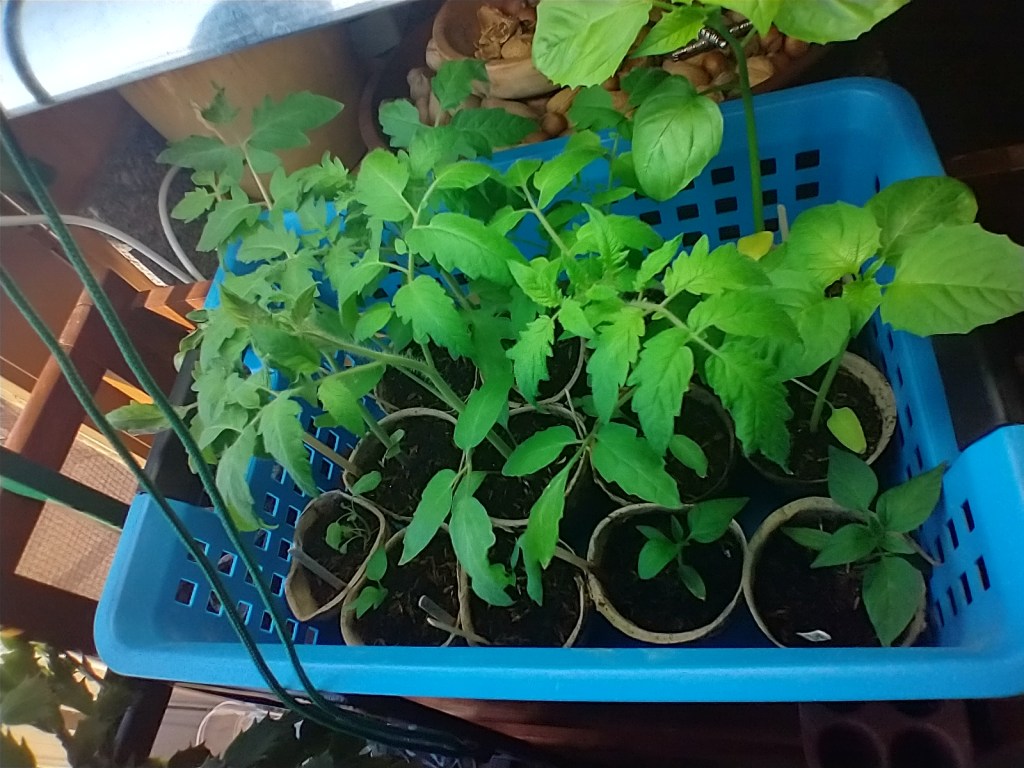
    The tomatoes and tomatillos have been planted deeply in tall single use plastic cups from fast food to allow them to grow more roots up their stems as many nightshades are prone to do, it will make for stronger seedlings when time to plant. At that time, they will still be planted more deeply than they are in the cups. Along with the pepper starts, they are spending their days on the back deck table in deep mesh baskets to protect them somewhat from the breezes, to harden them off and strengthen them for planting out next month.

    Another sign is the proliferation of Carpenter bees. Living in a log home, they are inevitable, drilling into the fascia boards to nest and emerging on every warm day. Though we dislike the damage the woodpeckers do trying to get at the larvae, the bees do not sting and are pollinators like other bees. The fascia boards could be replaced with a material they wouldn’t use, but then the fear is they would attack the logs instead.

    Definite signs that the dark winter has drawn to an end. There will be more chilly days, even a frost or two, but the worst is over. Today it will approach 80f here with clear, blue, sunny skies. There are a few days of cooler, not cold temperatures and some rain in the half week, but the trend is toward more consistent warmer weather.

  • Spring in the mountains

    Spring is always fickle, this entire winter has been though. It was subzero for a week of nights around Christmas with single digit days, and there have been weeks of late spring/early summer temperatures with nights that didn’t drop below 50f. Flowers and fruit trees bloomed early. Fearing our pear trees wouldn’t produce fruit this year because there were blooms before another week of deep freeze temperatures, as it became time for them to bloom, there were more blossoms. Three of the apple trees are blooming heavily, one lightly, one not at all. There will be no plums, it bloomed way too early and all the blossoms froze.

    Seven years ago we awoke to snow. Last night we had our first frost in weeks, but today it will be 60f and by later this week, almost 80f. Friday, though the Hummingbird tracker doesn’t show them here yet, I hung my feeders and yesterday saw our first one of the season feeding on the more popular feeders.

    The hens have dug out under their fence, holes filled, hay layered to fight the mud, but today with the Forsythia nearly leafed out, though there were hardly any blooms, I have again given them free range. They will hopefully hide under the foliage of the shrubs or the cedars for their safety. I hope not to lose anymore, but they can’t stay penned up in a run only slightly larger than their coop.

    Two of the remaining Marans foraging the front yard this morning.

    The yoyo weather seems to have taken a toll on the row of Nandina bushes along the north front porch. Not a single one of them retained any leaves this winter though the one in the protected breezeway nook did. If they don’t grow out new leaves, and that looks doubtful, a decision will have to be made as to how to treat that area. It is not great soil, but the Nandinas had thrived there for about 15 years until this winter. With the chickens scratching up the soil there, growing grass might be a challenge unless I can block them off until it is established. A few large pots with evergreen shrubs scattered along the edge is a possibility or even low growing evergreen juniper planted in the soil.

    The other victim of this winter might be my fig. It produced fruit for the first time last year, but I see no sign of life in the form of new leaf buds.

    This is Penny, she is a jumper, belongs to our neighbor as one of her herd, and she thinks our grass is greener than the fields on which she lives. She visits in the spring time, leaving her calf for a little while to go over the 4 strands of barbed wire to come graze. She is a welcome visitor, it amuses me to find her munching away on the tall grass that will become hay in a few months.

    Her sister was a jumper also and used to visit, sometimes bringing friends.

    The tomato, tomatillo, and 2 of the varieties of pepper starts are thriving. This week, they will begin daytimes on the back deck sheltered initially, and later full on in the sun to harden off for planting in about a month. Yet again, I seem to have started them a couple of weeks too early.

    Today is Easter Sunday and when we have family here, there is usually an Easter Egg hunt for the kids, even for the teens. Last year, daughter created an escape room sort of series of clues to lead the older ones from hidden large egg with the next clue that eventually led them to small baskets of goodies, mostly of the non edible kind. This is always followed by a meal that has traditionally been ham, au gratin potatoes, asparagus, another green for the haters, deviled eggs, rolls, and some sort of dessert. This year it is just the two of us and hubby will get his favorite home cooked Mexican food fiesta instead.

    Maybe tomorrow, we will venture to the plant nursery to check out the herb selection, to Tractor Supply to add wild bird feed and suet cakes and if I can find one, a third Bluebird house. My carpentry skills just aren’t up to building my own.

    The peas and radishes are beginning to emerge in the garden, the lettuce in the large pot on the back deck is growing, and I await the asparagus that have yet to show in the garden. Last year about this time we added the 4 hives of bees that did not succeed. Two nuks of bees with marked queens are on order for early May and two hives will be started again, hopefully with more success. While I await their arrival, new excluders for the openings will be ordered and sugar syrup will be fed inside the hives this year. I am really raising them as pollinators and not looking for much honey, but some would be a bonus. There is one capped frame of it in the freezer that survived the demise of the last hive. I really don’t know what to do with it, it may go in one of the new hives as starter feed for them.

    Spring is officially here, though the chance for a frost lingers until the first week of May.

  • Planning and family time

    Grandson #2 is still with us for another week, so last night, we had our daughter, her partner, and their three “kids,” 11 to 18 over for dinner. Daughter and I have a team routine to make empanadas and tostones together, plus I had assembled a large salad of goodies obtained at the Farmer’s Market yesterday morning. My spring lettuce, radishes, carrots, etc. are still in barely sprouting stage as the garden was a bit late getting started this year. I love cooking with her and love having the extras over to visit and eat.

    While they were here, granddaughter asked me to again do a garden plan for the 6 four foot square raised beds we added to their yard a few years ago. I have been her garden planner since inception. She has been very dedicated to keeping her garden watered and weeded and her Mom enjoys putting up peppers and tomatoes, dilly beans, and any other extras it produces. After they left, I pulled my binder and realized that I failed to keep a copy of last year’s plan, but her Mom texted me a copy this morning along with the wish list of vegetables to grow. Her plan has been drawn out, scanned, and emailed over so their early veggies can get planted out or seeds sown. Later in the spring, we will likely go together to the local nursery to get her tomato and pepper seedlings, and for me to add a few peppers that I only want one of. The plan to fit on the grid leaves out the paths, but she knows that and has learned my shorthand for filling it in.

    I get a kick out of helping the 11 year old to learn to garden. We have been at it now for 4 years.

    She also plays in a under 12 co-ed soccer team, so we spent an hour after our daily walk out in the sun by the field watching her team, coached by her Mom in their first game of the season. It was a little chilly and breezy, but standing by the field, some spindle spinning was accomplished. That is my daughter/team coach under by hand on the left. One of those speck on the field is granddaughter.

    After having lost 4 hens to the Cooper Hawk this early spring, and having at least 1 who has not resumed laying, the egg supply is providing only enough for daughter’s family, us, and a friend getting a dozen every now and then. There were really too many hens in the coop and 9 seems to be plenty as long as eggs are for personal use and not to sell. The hens are approaching 3 years old and a decision will have to be made come late fall whether to replace them with chicks to be laying by spring. If so, how many. If not, the supply will continue to dwindle as they age out.

    We experienced the east end of the storms that raged across the US this past weekend. It rained very heavily on Friday, all day, washing ruts in our very sloped dirt and gravel driveway again. Yesterday the wind kicked up and the gust were strong, reaching up to 60 mph during the late afternoon and overnight. We were fortunate not to have any tornados, hail, or loss of power like thousands in our region. There are some branches down, but as our south neighbor recently cut down the dead Ash trees along our south property line and on his side to install new fencing, I don’t see any trees down.

    The rest of the week is very spring like with many April showers to help the seedling grow. On toward the last frost date (still a month off) but the weather prognosticators thinking April will be warmer than usual, so maybe this spring will be an anomaly and we won’t see another frost.

  • Spring and help continues

    The 16 year old helped bring home 6 more 2 cu ft. bags of raised bed soil. It seems kind of silly on a farm, but my beds are raised for my comfort and I moved all the soil I could into to them a few years ago and some still needed supplementation. He then helped me spread it and dig the rest of the compost pile into the various beds. We are ready for warm weather for outdoor seed starting. In the past couple of days, the rosemary that overwintered indoors was potted out on the back deck, the lettuce seedlings moved to a larger pot, also on the back deck. The tomato and tomatillo seedings were moved from the starter cells to 3 inch coir pots with nice seed starter soil and they seem happy. The peppers are still too small to move into larger pots and are taking their time even growing the first set of secondary leaves.

    Still under lights indoors but thriving.

    No freezing nights are eminent, so they should be okay. If a freeze is predicted, I will cover or move them indoors for the night. There are a lot of rain days in the next 10 day forecast. That should help the herb seed and newly planted garden seeds get a good start. Since peas and radishes are quick germinators, sprouts should be up by this time next week. I am looking forward to the garden, but also a bit wary as I am still having trigger finger issues and some level of shoulder discomfort. due to bursitis in an old injury site, in spite of injections last week.

    In another couple of weeks, the cucumber, squash, and pumpkin seeds will be started in the starter cells. I think I am going to start some sunflower seed in 3″ pots to give them a head start. More will be direct sown when we are past last frost date in May. It is always fun getting started on the garden. By the time the weeds take over in late June it gets frustrating for a while, but then calms back to just harvest and preserving later in the summer. I just need to stay on top of the weeds and get the string trimmer repaired for the paths.

    I’m still rooting for the fruit trees that may have been caught by a long warm spell and then a couple nights of hard freeze. Maybe we will get fruit, maybe not. Time will tell.

  • Let the Season Begin

    With the strong back and strength of a 16 year old assistant in the form of a Grandson, several farm issues have been addressed in the past 5 days. He fortunately is very amenable to and volunteering to help, in the garden or the kitchen. He is being kept busy and well fed.

    On Saturday, we attacked the wire grass that was trying to overtake the spot in the garden where the comfrey grows. The grass was so high, finding the sprouting comfrey was a challenge. We didn’t get it all, but the comfrey has a fighting chance now. When he arrived last week, he and his Dad had purchased a large dog crate to control their two dogs until Son2 left on Wednesday. The dogs left with him, the crate put in their RV that is parked on our farm. The box is going to become a weed barrier above the asparagus bed soon.

    Yesterday, after the three of us went to lunch, a walk, and to the local nursery to get raised bed soil for one of the boxes, we drove down and around the south field to see the new welded wire fence and how much clearing/damage the neighbor did installing his fence. We discovered a very long strand of high tensile fence wire with a long strand of barbed wire dragged into our hayfield but still attached to an uprooted shrub in the thicket on the edge of the field. Fortunately we discovered it before the hay got high and before the hay guy got it tangled in his equipment. Grandson and I spent a couple of hours winding the wire, tying it off with cable ties, cutting it where it was entangled in the uprooted shrub. We then walked the perimeter of the field to make sure there was no more of it out in the grass.

    It is a mystery to me, how farmer’s even work with that stuff. It is difficult to straighten, impossible to bend, and acts like a stiff Slinky toy.

    After we finished there, he helped me move a couple barrows of compost to two beds, and spread the bagged raised bed soil into one.

    That bed needs one more barrow of compost and it will be ready to plant. Today we purchased 4 more bags of raised bed soil and 6 bags of composted cow manure for the long bed.

    This bed received a barrow of compost yesterday and was planted in peas, radishes, carrots, and spinach today. They should have been planted 3 weeks ago, but it is what it is. The long bed had as much Dead Nettle in it as the square bed behind this one.

    This afternoon after planting the bed, the weeding of the long bed was begun and the 4 bags of soil and 4 of the bags of composted cow manure were added to it. I need 5 more bags of soil and the remaining two bags of compost added and it will be ready to plant in early May.

    That bed is where the mint was a few years ago, it has never had enough soil that was good enough to plant, so hopefully today’s efforts and the addition of a few more bags of soil and compost will make it a healthy bed.

    That last little 4 foot bed is being left alone for now as the bees are loving the Dead Nettle growing in it. It will have to be cleared by Mother’s Day to plant peppers and the bed behind it needs a light weeding, but it was covered in old hay over the winter and is in pretty good shape, though it will get fed with the remaining compost. The new pile has been started with the weeds being pulled. The paths will just be mowed or cut with the string trimmer this year. My shoulder just will scream if I try to take on all of that grass and weed pulling.

    It was nice to be out in the 70 degree weather to get the garden underway. The garden plan was revisited as I realized there were seed packets purchased of vegetables not worked into the plan. Hopefully, it will be a successful garden and feed us well this year and into next winter. The garden gets more difficult to deal with each year, but I’m not ready to give up yet.

  • What’s a Chicken keeper to do?

    We got home from an appointment, refill Rx pickup, and walk to find no hens about in the yard. No hens visible in the run, which I have been opening the gate only about 8″ since the Cooper Hawk was in there. The hens can come and go through the crack, but nothing can fly in. Looking in the coop, there were 9 hens fussing about what had happened. The 3 Marans were there, the two Easter eggers and 2 NH reds, but only 2 Buff Orpingtons. The Marans and Buffs are my big girls, very sturdy heavy, but slow hens. That sent me out on a solo search party to determine what had happened, just as it began to rain.

    Near the forsythia where they generally hide, there were two piles of black feathers, but all the Marans were accounted for, and a larger pile of yellow feathers that trailed up across the top of the hill the forsythia grows on and under the farthest bush, the remains of the missing Buff. The damage was consistent with hawk attack and meal, so I have lost another hen. I’m down to 9.

    At this point, I don’t know what to do. I have lost 4 hens this late winter, early spring and it isn’t even hawk chick season yet. Nine hens is enough to provide the eggs for daughter’s family and us, but not if they are getting picked off about one a week or 10 days.

    If I keep them in the covered run, there isn’t enough room for them to do much and they mostly just go back in the coop and one or more of them eat eggs. If I let them free range, my preference, the current loss rate is too high. I haven’t had this kind of loss since the neighbor’s dog, many years ago, used to come down and catch and kill them, even running up and down the run to get one to fly out, but he got rid of that dog. Penning them in electric mesh fence makes them easier targets. Buying more fencing and creating a larger run would give them more space and fresh grass until they scratched it all up, but how would it be covered to keep the hawk from swooping in and cornering one against the fence. For now they are locked up again and will be for a day or two. I guess it was a mistake removing the two young roosters that would at least alert the hens to danger, but I have not been a fan of roosters due to the mating damage and their all day long crowing.

    Eight or 9 hens are about the right number for the coop we own, but I don’t want to lose anymore to the hawk. It can feed on rabbits, squirrels, field mice, voles, and groundhogs, it doesn’t need my hens.

    We live amidst hayfields with the occasional tree in a rock pile for the hawk to sit in and spy on potential prey. There isn’t a lot of cover near the coop, the fruit trees are too open, there is a cedar cluster they sometimes hide in, but the hiding place of choice is the forsythia bushes and they aren’t leafed out yet. I will fret on it for a while, trying to prize out a solution, but will probably end up letting them free range again and hope the hawk can’t get anymore.

  • Let the Season Begin

    Today is chilly and rainy, the beginning of a cold front that will bring snow to some extent on Sunday and Monday, but it is 8 weeks to our last average frost date, the time to start slow seeds.

    Yesterday, the Aerogarden was dismantled, scrubbed, the parts that could go in the dishwasher for more thorough scrubbing done, then left to dry overnight. This morning, it was set up, filled with water and fed, and two each of 3 peppers started in it under it’s lights. Two Jalapenos, two seranos, and two Chocolate Sweet peppers. Once pepper starts are available at the nursery, a ghost and a cayenne will be added.

    The self watering seed starter was begun with fresh seed starter mix that is organic and has no peat in it. In my environmental awareness move, peat is eliminated as it is not a quickly renewable resource. The seed starter, placed under the grow light has 2 tomatillos, 4 Amish paste tomatoes, 2 slicers that carry the black gene so produce a darker, purplish/brownish medium size tomato, and 2 common sage plants. The pots with basils, thyme, dill, and lettuces are thriving on a shelf in the south facing fully windowed doors. Hopefully, the parsley in the half barrel in the back will come back up this spring and the rosemary overwintered indoors nicely. There is a lot of oregano in the bed with the fig that will hopefully continue to produce after the snow melts off next week.

    In reviewing the seed supply, I remembered two vegetable seed packets purchased earlier that were not accounted for in the garden plan, so that will have to be revisited before digging in the garden can commence. It is almost time to plant spinach, carrots, and peas.

    Fortunately, the apple, pear, and peach trees did not bloom before this freeze. Maybe a week of cold will delay their blooming long enough that fruit is still possible.

    There is a supply of starter pots that can be filled with seed starter mix in a few more weeks to start the squash and cucumbers in, but they only need about 4 weeks head start. The plastic webbed baskets will be washed out once there are seedlings that need to be hardened off. Some produce I have grown in the past in limited, mostly unsuccessful attempts will not be grown as those products are readily available from local farmers at their farms or the farmer’s market.

    As the weather is behaving like winter, it is nice to be planning the summer garden. In late April or early May, two new hives of bees will be introduced, hopefully with greater success than last year. Plans being made, plans begun, hoping for a successful season with vegetables, fruits, eggs, and bees for eventual honey. A busy season ahead, I hope I can stay on top of it.

    As the grass is beginning to green up and grow with a vengeance, the riding mower was taken back to the shop to figure out why the blades won’t engage and throw the belt every time it is disengaged when it did work. Less area will be mowed this year and more left for the hay guys.

  • Another one down

    Monday, the hens all seemed to disappear. The day was warm and usually they are hanging out in front of the house or in the back garden, but not one to be seen. Upon investigation, I found this.

    A lovely but lethal Cooper’s Hawk in the run with a dead Buff Orpington hen that was at least twice as large as the hawk. The hawk had managed to get in through the partially opened gate as the run is covered. It must have followed the hen in as it was chasing it. Once in and fed, it couldn’t figure out how to get out. It has been there a while as the hen was already cold. There was no way I was going in the low netted run to try to chase it out and my efforts to frighten it out by moving around the outside of the run to force it back near the gate were agitating it to try to fly up and into the fence repeatedly. Once it found it’s way out, it flew only a couple of feet and sat on the grass. When I approached from behind, it flew a few more feet to the top of the wood pile and sat until with me arms waving and shouting, it flew across the yard to a huge maple tree and sat to recover. Five of the remaining hens were in the coop very afraid, the other five remaining hens were no where to be found. I searched all of their usual hiding places and thickets, but could not find any of them.

    The hen that lost the battle was removed from the run for disposal and the wait began to see if the others would return. It was raining hard by late afternoon and still no hens. By dusk, the missing 5 reappeared and were lured into the enclosed run and locked in with the 5 that had been hiding out in the coop.

    Yesterday they remained in their run with the gate closed, and unless I took scratch or scraps out to them, wouldn’t even leave the coop. I don’t like keeping them confined in the small enclosed run because when they are penned up, one becomes an egg eater. That behavior doesn’t seem to happen when they can free range. This poses the dilemma of risking more egg loss by egg eating or egg loss by losing hens to the hawk.

    I always thought it was the Red tailed hawks that were getting my hens, 3 this winter, but research indicated that they rarely attack poultry, but the smaller Cooper seems to have a propensity to catch and kill a chicken. My flock is down to 10.