Category: farm

  • Let the Season Begin

    With the strong back and strength of a 16 year old assistant in the form of a Grandson, several farm issues have been addressed in the past 5 days. He fortunately is very amenable to and volunteering to help, in the garden or the kitchen. He is being kept busy and well fed.

    On Saturday, we attacked the wire grass that was trying to overtake the spot in the garden where the comfrey grows. The grass was so high, finding the sprouting comfrey was a challenge. We didn’t get it all, but the comfrey has a fighting chance now. When he arrived last week, he and his Dad had purchased a large dog crate to control their two dogs until Son2 left on Wednesday. The dogs left with him, the crate put in their RV that is parked on our farm. The box is going to become a weed barrier above the asparagus bed soon.

    Yesterday, after the three of us went to lunch, a walk, and to the local nursery to get raised bed soil for one of the boxes, we drove down and around the south field to see the new welded wire fence and how much clearing/damage the neighbor did installing his fence. We discovered a very long strand of high tensile fence wire with a long strand of barbed wire dragged into our hayfield but still attached to an uprooted shrub in the thicket on the edge of the field. Fortunately we discovered it before the hay got high and before the hay guy got it tangled in his equipment. Grandson and I spent a couple of hours winding the wire, tying it off with cable ties, cutting it where it was entangled in the uprooted shrub. We then walked the perimeter of the field to make sure there was no more of it out in the grass.

    It is a mystery to me, how farmer’s even work with that stuff. It is difficult to straighten, impossible to bend, and acts like a stiff Slinky toy.

    After we finished there, he helped me move a couple barrows of compost to two beds, and spread the bagged raised bed soil into one.

    That bed needs one more barrow of compost and it will be ready to plant. Today we purchased 4 more bags of raised bed soil and 6 bags of composted cow manure for the long bed.

    This bed received a barrow of compost yesterday and was planted in peas, radishes, carrots, and spinach today. They should have been planted 3 weeks ago, but it is what it is. The long bed had as much Dead Nettle in it as the square bed behind this one.

    This afternoon after planting the bed, the weeding of the long bed was begun and the 4 bags of soil and 4 of the bags of composted cow manure were added to it. I need 5 more bags of soil and the remaining two bags of compost added and it will be ready to plant in early May.

    That bed is where the mint was a few years ago, it has never had enough soil that was good enough to plant, so hopefully today’s efforts and the addition of a few more bags of soil and compost will make it a healthy bed.

    That last little 4 foot bed is being left alone for now as the bees are loving the Dead Nettle growing in it. It will have to be cleared by Mother’s Day to plant peppers and the bed behind it needs a light weeding, but it was covered in old hay over the winter and is in pretty good shape, though it will get fed with the remaining compost. The new pile has been started with the weeds being pulled. The paths will just be mowed or cut with the string trimmer this year. My shoulder just will scream if I try to take on all of that grass and weed pulling.

    It was nice to be out in the 70 degree weather to get the garden underway. The garden plan was revisited as I realized there were seed packets purchased of vegetables not worked into the plan. Hopefully, it will be a successful garden and feed us well this year and into next winter. The garden gets more difficult to deal with each year, but I’m not ready to give up yet.

  • What’s a Chicken keeper to do?

    We got home from an appointment, refill Rx pickup, and walk to find no hens about in the yard. No hens visible in the run, which I have been opening the gate only about 8″ since the Cooper Hawk was in there. The hens can come and go through the crack, but nothing can fly in. Looking in the coop, there were 9 hens fussing about what had happened. The 3 Marans were there, the two Easter eggers and 2 NH reds, but only 2 Buff Orpingtons. The Marans and Buffs are my big girls, very sturdy heavy, but slow hens. That sent me out on a solo search party to determine what had happened, just as it began to rain.

    Near the forsythia where they generally hide, there were two piles of black feathers, but all the Marans were accounted for, and a larger pile of yellow feathers that trailed up across the top of the hill the forsythia grows on and under the farthest bush, the remains of the missing Buff. The damage was consistent with hawk attack and meal, so I have lost another hen. I’m down to 9.

    At this point, I don’t know what to do. I have lost 4 hens this late winter, early spring and it isn’t even hawk chick season yet. Nine hens is enough to provide the eggs for daughter’s family and us, but not if they are getting picked off about one a week or 10 days.

    If I keep them in the covered run, there isn’t enough room for them to do much and they mostly just go back in the coop and one or more of them eat eggs. If I let them free range, my preference, the current loss rate is too high. I haven’t had this kind of loss since the neighbor’s dog, many years ago, used to come down and catch and kill them, even running up and down the run to get one to fly out, but he got rid of that dog. Penning them in electric mesh fence makes them easier targets. Buying more fencing and creating a larger run would give them more space and fresh grass until they scratched it all up, but how would it be covered to keep the hawk from swooping in and cornering one against the fence. For now they are locked up again and will be for a day or two. I guess it was a mistake removing the two young roosters that would at least alert the hens to danger, but I have not been a fan of roosters due to the mating damage and their all day long crowing.

    Eight or 9 hens are about the right number for the coop we own, but I don’t want to lose anymore to the hawk. It can feed on rabbits, squirrels, field mice, voles, and groundhogs, it doesn’t need my hens.

    We live amidst hayfields with the occasional tree in a rock pile for the hawk to sit in and spy on potential prey. There isn’t a lot of cover near the coop, the fruit trees are too open, there is a cedar cluster they sometimes hide in, but the hiding place of choice is the forsythia bushes and they aren’t leafed out yet. I will fret on it for a while, trying to prize out a solution, but will probably end up letting them free range again and hope the hawk can’t get anymore.

  • Let the Season Begin

    Today is chilly and rainy, the beginning of a cold front that will bring snow to some extent on Sunday and Monday, but it is 8 weeks to our last average frost date, the time to start slow seeds.

    Yesterday, the Aerogarden was dismantled, scrubbed, the parts that could go in the dishwasher for more thorough scrubbing done, then left to dry overnight. This morning, it was set up, filled with water and fed, and two each of 3 peppers started in it under it’s lights. Two Jalapenos, two seranos, and two Chocolate Sweet peppers. Once pepper starts are available at the nursery, a ghost and a cayenne will be added.

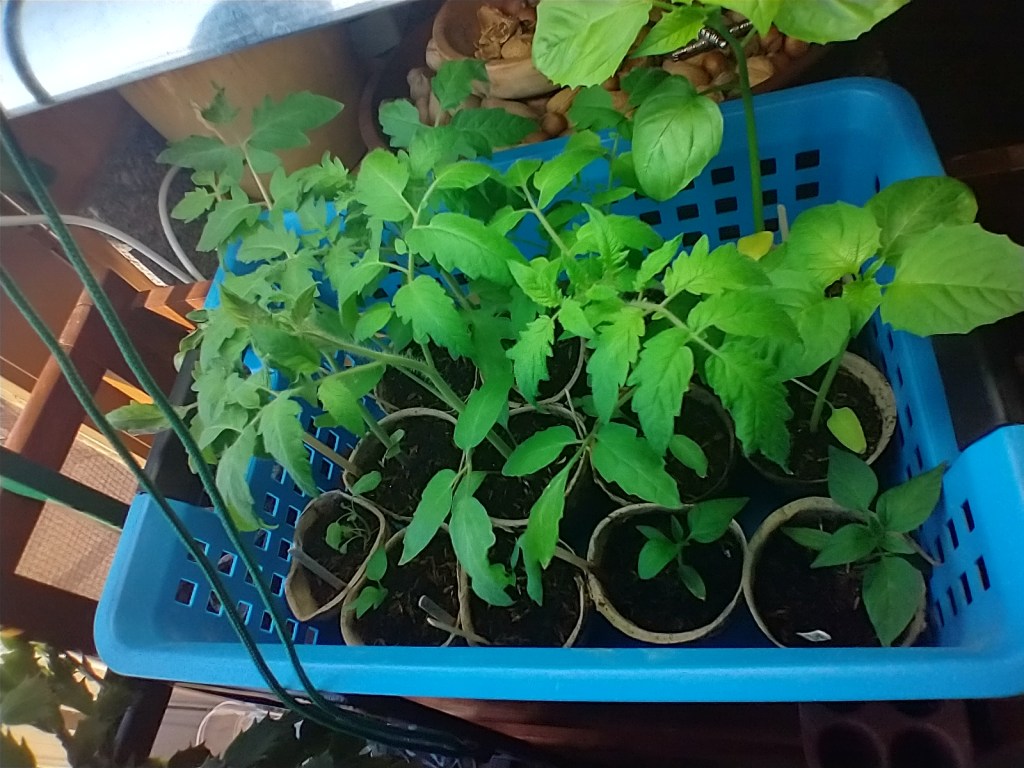
    The self watering seed starter was begun with fresh seed starter mix that is organic and has no peat in it. In my environmental awareness move, peat is eliminated as it is not a quickly renewable resource. The seed starter, placed under the grow light has 2 tomatillos, 4 Amish paste tomatoes, 2 slicers that carry the black gene so produce a darker, purplish/brownish medium size tomato, and 2 common sage plants. The pots with basils, thyme, dill, and lettuces are thriving on a shelf in the south facing fully windowed doors. Hopefully, the parsley in the half barrel in the back will come back up this spring and the rosemary overwintered indoors nicely. There is a lot of oregano in the bed with the fig that will hopefully continue to produce after the snow melts off next week.

    In reviewing the seed supply, I remembered two vegetable seed packets purchased earlier that were not accounted for in the garden plan, so that will have to be revisited before digging in the garden can commence. It is almost time to plant spinach, carrots, and peas.

    Fortunately, the apple, pear, and peach trees did not bloom before this freeze. Maybe a week of cold will delay their blooming long enough that fruit is still possible.

    There is a supply of starter pots that can be filled with seed starter mix in a few more weeks to start the squash and cucumbers in, but they only need about 4 weeks head start. The plastic webbed baskets will be washed out once there are seedlings that need to be hardened off. Some produce I have grown in the past in limited, mostly unsuccessful attempts will not be grown as those products are readily available from local farmers at their farms or the farmer’s market.

    As the weather is behaving like winter, it is nice to be planning the summer garden. In late April or early May, two new hives of bees will be introduced, hopefully with greater success than last year. Plans being made, plans begun, hoping for a successful season with vegetables, fruits, eggs, and bees for eventual honey. A busy season ahead, I hope I can stay on top of it.

    As the grass is beginning to green up and grow with a vengeance, the riding mower was taken back to the shop to figure out why the blades won’t engage and throw the belt every time it is disengaged when it did work. Less area will be mowed this year and more left for the hay guys.

  • Another one down

    Monday, the hens all seemed to disappear. The day was warm and usually they are hanging out in front of the house or in the back garden, but not one to be seen. Upon investigation, I found this.

    A lovely but lethal Cooper’s Hawk in the run with a dead Buff Orpington hen that was at least twice as large as the hawk. The hawk had managed to get in through the partially opened gate as the run is covered. It must have followed the hen in as it was chasing it. Once in and fed, it couldn’t figure out how to get out. It has been there a while as the hen was already cold. There was no way I was going in the low netted run to try to chase it out and my efforts to frighten it out by moving around the outside of the run to force it back near the gate were agitating it to try to fly up and into the fence repeatedly. Once it found it’s way out, it flew only a couple of feet and sat on the grass. When I approached from behind, it flew a few more feet to the top of the wood pile and sat until with me arms waving and shouting, it flew across the yard to a huge maple tree and sat to recover. Five of the remaining hens were in the coop very afraid, the other five remaining hens were no where to be found. I searched all of their usual hiding places and thickets, but could not find any of them.

    The hen that lost the battle was removed from the run for disposal and the wait began to see if the others would return. It was raining hard by late afternoon and still no hens. By dusk, the missing 5 reappeared and were lured into the enclosed run and locked in with the 5 that had been hiding out in the coop.

    Yesterday they remained in their run with the gate closed, and unless I took scratch or scraps out to them, wouldn’t even leave the coop. I don’t like keeping them confined in the small enclosed run because when they are penned up, one becomes an egg eater. That behavior doesn’t seem to happen when they can free range. This poses the dilemma of risking more egg loss by egg eating or egg loss by losing hens to the hawk.

    I always thought it was the Red tailed hawks that were getting my hens, 3 this winter, but research indicated that they rarely attack poultry, but the smaller Cooper seems to have a propensity to catch and kill a chicken. My flock is down to 10.

  • Spring? or …

    On our walks, the daffodils, crocus, pussy willow, and a low purple daisy like flower I can’t ID are blooming. The forsythia, even in our hollow is beginning to bloom and yesterday, the white blooms of our plum began opening. This is good for the early bees, though I have no active hives at the moment, but it will be terrible for fruit production if we have a freeze which is inevitable this early in the season.

    The longer days are upping the egg supply. At least 9 of the 11 hens are laying as I got 7 on Saturday and 9 yesterday. There will be fewer today and tomorrow, but last week there were more than 3.5 dozen which delights daughter and a friend who benefit from overabundance. Three or four hens would likely produce way more eggs than I would use in a week, but there is safety in numbers and as long as there are folks that want the extra, I will keep the larger flock.

    And the variety of color is a treat in a bowl or basket on the counter top.

    The coop needs exterior maintenance come consistent warmer, drier weather. The hens have pecked a small hole in the siding that is not large enough for most predators, but large enough for a snake or mouse. It needs to be filled with wood putty or a framing strip nailed over it. The exterior needs to be stained again, a job I abhor as it requires a lot of over my head reaching which my shoulders object to strongly. Maybe a sprayer would solve that problem or a long handled roller instead of trying to brush it on like I did summer before last.

    The spinning challenge for February was to “Dare” yourself to a challenge of your choice. Some chose to try to spin a different weight or style of yarn than they usually do, some to just commit to a daily amount of time if they had not been spinning as much. I want to knit a real Shetland Hap, the traditional shawl of the Shetland Islands, usually square with a simple center and a lace edge. But I also want to spindle spin all of the Shetland wool necessary for it. My challenge was to spin enough yarn for the center square. About 10 days into the challenge, I changed the pattern which made deciding how much yarn was needed a difficult calculation. The original pattern had a solid color center square and concentric bands of lace of different colors around it. The new pattern is a solid color, but knit from the center out with eyelet lace bands that then create the concentric bands for the outer bands. My math skills were never great and disuse of more than basic calculations make it even more difficult to figure it out. I ended up spinning about 43% of the yarn needed for the entire shawl, and since I am not knitting it in a single natural color, using two other naturals for the outer bands, concluded that my goal was met. I succeeded in spinning and plying 409.5 yards of fine Shetland for the month. I had purchased 200 grams of the Moorit color for the shawl and used just about 100 grams to spin the skein.

    Last night, I began the knitting, which wasn’t part of my challenge and will continue to spin more of the Shetland Moorit, White, and dark Brown. At this point, I am unsure how many bands will be the other colors, and if the Moorit is enough to do all but the Birch Lace outer most band, it may be done in the dark brown and the white saved for another day and another project.

    Since ending the cottage business, any spinning being done is being done with a specific project in mind for me, for the household, or as a gift for a family member or friend. And with that in mind, only spindles are being used for spinning. With 6 Turkish spindles in 3 sizes, there is always one available and they are so portable with a few grams of wool roving or combed top to carry in my bag in a small tin or zip case to have when there is time away from home to spin or to pull out when sitting in my chair at home.

    Life goes on one day at a time, seasons change, though this year not in a normal average pattern. Perhaps hoarding some of last year’s apple sauce, apple pear sauce, peach Sriracha sauce, and pear marmalade might be in order. There may be no fruit this year except figs and grapes (I hope).

  • Just In Time

    This is a part of Virginia that gets at least a couple of several inch snows each winter, once in a while, a foot or foot and a half that prevents us from leaving for a few days as the State 700 roads are the last to be cleared, plus we live downhill about 2/10 of a mile on a dirt and gravel driveway. This winter has been an anomaly. There have been flurries and barely dusting bare surfaces, an inch or two that lasted a mere 6 hours before there wasn’t a trace left. If all the rain we have gotten since September was snow, we would never get out. Each time the forecast says snow possible, weather patterns shift just enough for it to be wintery mix or rain. There is another weather event predicted that could/might unload 2 up to 4 inches late Sunday, but chances are it will just be another cold rain.

    As I was walking back from releasing the hens into the yard, you can see a few inches of Daylily leaves emerging and the daffodils in the back garden have buds. The snow won’t bother the daffodils, the Daylilies won’t be too happy, but will be okay. The Snowdrops on one of our walks are blooming. They will be fine, they often bloom in the snow when it happens.

    In the fall, during hubby’s early months dealing with the health issues, an online friend offered to proxy shop for a spindle for me from the craftsman who makes the best Turkish style spindles available, Ed Jenkins, Jenkins Yarn Tools. They are in Oregon and only do events within a couple hours from home. Linda bought me a lovely Crabapple Finch, a smaller size that I love and wrapped it in some gorgeous black Merino/Alpaca/Silk blend roving, a very generous amount. About a month or so later, she was going to attend another event where Ed and Wanda were set up and offered again, this time getting me a Lilac Finch, and packed it in the same blend in a camel brown color. Those fibers were spun on the spindles they came with and a shawl/scarf was started for me. Last night, I cast off “Linda’s Hug,” soaked it, blocked it, and because it is so delicate, the yarn spun to 20 wraps per inch or lace weight yarn, it dried over night.

    The two yarns were used together and in spite of the light weight (50.94 g or 1.8 ounces) of the shawl, it is very warm with the Alpaca and Silk, just in time for a possible winter blast.

    I am ever grateful to the friends I have met through my Jenkins group and also my two local friends who I taught to spindle spin and hooked on the Jenkins spindles. They have been very generous in their time and support first through the Covid lockdowns and then through the early days of hubby’s issues. Each time I wear this shawl, I am reminded of love and concern.

  • Spoiled Pups

    For several years, I have subscribed to a blog, The Kitchen’s Garden written by a New Zealander living on a farm in the midwest. She is definitely a soulmate in philosophy, avoiding waste, reusing, recycling, growing organically, re-establishing trees and converting fields to organic practice growing. Though her farm has many more and varied animals than ours, she does raise chickens and has two older dogs.

    For a while, I have been bothered by both the cost and quality of commercial dog food, but had not taken the time to research a homemade healthier alternative. I have often made feed for the hens in lieu of the commercial layer pellets, though a good organic layer pellet and a multi grain scratch are usually less expensive than making it as the grains that are needed to get organic come from the local natural foods store. Recently, Cecilia posted her recipe for homemade dog food and the quantity she feeds her dogs. I purchased the ingredients that I didn’t have on hand and compared the cost to the commercial feed and it is about $1+/day cheaper to make it. Everything in the mix is human grade food, the “stew” though unsalted could easily be eaten by us. The mix contains meat, whole grain, pulses, fruit or sweet potatoes, pumpkin, vegetables. For her recipe, you can go to her blog. The recipe makes enough to feed both of our dogs for 6 or 7 days, 2 meals per day.

    The first time I made it in a large pot and had some scorching at the bottom of the pot. Today, the rice, lentils, oats, sweet potato, and pumpkin with the water were cooked first in the Instant Pot, the meat in the large pot on the stove, and then mixed together with the frozen peas and carrots before ladling it into reusable containers and wide mouth pint jars, some to freeze, some to go into the refrigerator for the next couple of days meals.

    This was prepared this morning before hubby got up.

    The dogs love it. It is healthier, less expensive, and hopefully both pups will shed a few pounds on it. A side benefit is that Shadow, the German Shepherd who seems to be constantly on some med or another will take the pills in the food without having to resort to trickery and it should help reduce the UTI’s that she experiences.

    As the meat can be of various sources and since there are too many frozen chickens in the basement freezer, a couple of them may be the protein source for a few batches before the next round are replaced with younger birds and more tough old hens added to the supply.

  • A Warm Winter?

    During Christmas week, we had a -9 f (-23 c) night and many, many nights in the teens and twenties with daytime temperatures in the upper 30’s and low 40’s since then. Many, many days with light sleet and snow flurries, but until last night, no accumulated snow. The local weather prognosticators say it has been a warm winter.

    This morning, we awoke to our first measurable snow. Not a lot, maybe two inches with it hanging heavy in the evergreens.

    And frozen fog.

    It was pretty while it lasted. Never covering the driveway or the roads. By the time we headed out to town for supplies and our walk, it was already melting and the grass beginning to show through. By the time we returned, about 6 hours after the above photos, this was the scene.

    The past two day’s walks have been quite chilly, glad to have a down coat, warm hat, and the heated ski gloves that hubby got me for Christmas. Whenever it gets cold, my right hand gets frigid. The circulation has never been good since I broke that wrist in my early 50’s and even worse after having a trapeziectomy on the same wrist due to arthritis in my mid 60’s. The heated gloves help. Tonight it going to get frigid and not even reach freezing for the high tomorrow.

    Once home, a thick layer of hay was put down in the muddy chicken pen and they were let out to scratch through it. They won’t leave the coop if there is snow on the ground. With the days beginning to lengthen and molt finally over, egg production is picking up a little. For a while there were none, then one or two every couple days, now 3 or 4 most days and with different colors and sizes, I can tell more are joining in each day.

    The Groundhog saw his shadow in Punxsutawney, he wouldn’t have seen it here, but regardless, there will be 6 more weeks of winter, at least according to the calendar.

  • False Spring

    After typical winter for weeks with cold, damp, gray days and lots of wind, today is glorious. It is 50f (10c), clear, sunny, and calm. A couple of springs ago, a new metal raised bed was added to the garden with the idea of restarting the asparagus bed in a controlled area. Nothing came up from the crowns that were planted there and the bed was not in a good location. I moved it out of the way last year, moving the soil with it and put the third planting of beans in it that the bean beetles destroyed before they could produce. Where I moved it was also not a good location because it was hard up against the fence, an area with every noxious weed under the fence, and in a position that prevented getting the wheelbarrow to the compost pile. Last fall, Son 1 turned the compost pile for me and as I had moved a non productive bed box over my blueberries and heavily mulched them, he moved my raspberry and blackberry half barrels to where the old bed had been and it created the perfect spot for the raised bed.

    Today because it was too nice to stay indoors, I moved the metal box frame to it’s new and permanent location and since I wanted it full, not just a couple inches of soil, it became a Hugelkultur bed. The sunflower stalks and corn stalks from last year’s garden were cut and layered in the bottom on a cardboard base and a layer of wood chips fouled with chicken manure shoveled on top.

    On top of that, a layer of straw:

    On top of the straw was a wheelbarrow full of the compost from the turned pile.

    Then the soil that had been in the box was weeded and shoveled into the barrow and added on top and top dressed with another layer of compost to fill the box nicely and have it ready for early peas in another month or so.

    While out there, the bed that had the flying greenhouse in it was weeded, hoping that with this week’s potential snow that it will stay clear, and another 4 X 8 bed that had a layer of old chicken bedding piled in it was turned to help it break down. Finally, the compost pile was shoveled back into a pile, trying to turn it a bit more to add to the bed nearest it when the weather warms a bit and the kitchen scrap pile beside it was fenced off with temporary fencing and top and an opening from the chicken run created to allow them to eat the weeds and kitchen scraps and make more compost in that location.

    It didn’t take the hens long to discover the new territory.

    As I was coming back in the house, I saw a text from a west coast friend, asking if we could chat as there is no Zoom session today and ended up with a delightful half hour or so on the phone, sitting in the warm sun on the front porch and sharing stories. Such a delightful way to end an afternoon outdoors.

    Tomorrow the weather takes a turn back to cooler and rainy with wintery mix, possibly snow mid week. We will see, there hasn’t been any so far this winter.

  • Failure

    The local bee group is offering pollen cakes for sale this weekend. Before I made the effort to get there and possibly have a chance to get one or two, I decided to check on my last remaining hive. I hadn’t checked since before the Christmas week Arctic freeze, actually, when I installed the sugar board to feed them. It wasn’t very strong then, but I hoped that with 10 pounds of food, they would struggle through the winter and hopefully survive to thrive this spring. At first I just listened to try to detect a hum, no sound. I popped the outer lid and peeked under the inner lid to see if I saw or heard any activity or if they had eaten any of the sugar. No activity and no sound. Fearing the worst, I removed the sugar board and the bottom cover and only saw dead bees. So, my first year of bee keeping was a total failure.

    That hive will be dismantled and the frames put in the freezer for a few days then sealed in black plastic contractor bags. One or two nuks of bees will be ordered from one of the local beekeepers and I will try again this spring with only one or two hives, much more knowledge, and in medium boxes that I can handle. That is going to leave 8 deep boxes some with new frames, some built out frames that Son 2 purchased that he can take for his use, or sell as he wishes. I will keep the medium boxes and frames to try to get a couple of hives thriving.

    At least the two bears we saw on the farm this summer left them alone, so I guess our 12V charger is doing it’s job.