Category: farm

  • Mid Summer Heat and Weeds

    This time of summer always makes me feel the garden is all weeds and finding the vegetables impossible. And I get frustrated with the whole vegetable garden idea, especially since we have such a stellar Farmer’s Market twice a week.

    This past week, the hay team finally got the hay down and baled. A few scattered thunderstorms have the underlying grass greening up again and there are two small bales set aside for my use in the chicken run and garden.

    There was still part of a large bale from two years ago that I couldn’t handle alone. Last time the local 16 year old grandson was here to mow, he helped me relocate what was left of it into the garden. This afternoon, after having spent a couple of hours over the past few days weeding what I could, the gas mower was pushed over and the wider paths were mowed, another couple of hours of weeding and a lot of wrestling, managed to stand the bale on end so it could be unwrapped and thick layers of the old, spoiled hay were applied over the mowed area and an idle bed. There is a small core about 14″ in diameter left and a little more path area that needs to be mulched with it, but the heat, sweat, and prickly skin ended the project for the day.

    The beans are nearly done, cucumbers are beginning to come in enough to ferment a couple jars of sour pickles, pumpkin vines escaping the huge bed they are in, the tomatoes too close together are a tangle of branches and vines with fruit, but probably not as much as I would have gotten if they had been properly spaced and staked. The zucchini are producing baseball bat sized squash overnight, though it was supposed to be a compact small garden variety that produced smaller squash. Tomatillos are showing lots of blossoms and fruit, and some peppers are developing, though those plants will wait for it to cool off some to really shoot up and produce. Each trip out to the garden results in more notes for next year. I should remember from year to year, but still make the same errors. There is really more garden than I am comfortable with at this stage of life. Perhaps one of the beds will become the thornless blackberries and raspberries heavily mulched and get them out of the plastic half barrels. They would produce more fruit if they had more room. The asparagus when they aren’t 6 foot high ferns are going to be boxed to make weeding around them easier.

    I would love to have taller raised beds with thick wood chip paths, but that will never be.

    My photo memories show a lot of produce had already been canned by this time of the summer. This garden seems to be slower to provide.

  • Trouble In The Nursery

    After Mama Hen initially took to the chicks we bought her to round out her family, she decided the two little Midnight Marans were hers, but the Americaunas and Easter Eggers were not. For a couple of nights after the divider netting was installed, I could get them back under her, but after a couple of days, it was obvious she wanted no part of them and didn’t want them near “her” chicks. The 4 light colored chicks managed somehow to get on the other side of the net from her and the other hens were okay with that, but not motherly to them either. The divider net was pulled down so they had the run of the coop and for two nights, Mama Hen put her 4 in a nesting box with her and the other 4 huddled together in an adjacent nesting box. Fortunately, I guess, it has been very hot and they have done okay.

    Today, she urged her 4 little dark chicks out of the coup into the run and ultimately farther away from the coop over toward the relative shelter of the grape arbor and wood pile.


    She does her best to keep herself between the chicks and me, but I did catch this photo. I tried putting one of the Americana’s that is more darkly marked down near them and she ran her off and tried to peck her. And one of the very light Easter Eggers must have followed her out of the coop or fallen out of the coop and was hiding in the Comfrey plant nearby, loudly protesting.

    It looks like she will raise 4 and I will raise 4. The light colored ones are now safely in a large dog crate with wood chips, food and water in the garage.

    Next week the temperature is supposed to drop back to something more comfortable for humans and I may have to add one of the heat tables in there with them for a week or so. The 6 we bought seem to be of different ages. The Americana’s look like they may be a week older than the Easter Eggers and Midnight Marans, and they are almost a week older than the two she managed to hatch. The Americana’s are almost feathered out and have long feathered wings. When the Easter Eggers are about 6 weeks old, I will try to reintroduce these to the coop or put the dog crate out in the run or yard so the hens can readapt to them.

    Three of the chicks we purchased are going to the friend that gave me the eggs when they are old enough. And with any luck, the remaining 5 will add to our flock to be egg producers late fall or next spring.

  • Midwifery and Adoption on the Farm

    As previously mentioned, almost half of my flock of hens were killed off by predators this winter and early spring. A Coopers Hawk got a couple, a raccoon another couple and one just disappeared, all I could find was a pile of feathers. Then one of the Easter Eggers quit laying at molt last fall and never started back up over the winter or this spring. I didn’t know which one of the two, until about 26 days ago when one of them decided she was broody and there is no rooster here. Usually when they get broody, they are put in time out for several days with no nesting box and it breaks the brood. Since the flock was light, I asked a friend with a rooster if I could buy a dozen possibly fertile eggs from her. She offered them for free and they were tucked under Mama 24 days ago. On day 21, one cute little almost black chick emerged, then another dark, but gray one overnight. One other tried to hatch but died in the process and she still sat. It appeared today on day 24 that was all we were going to get.

    On our way home from an appointment in the city, we stopped at Rural King and purchased 6 nearly week old chicks to give to her in place of the eggs that obviously weren’t going to hatch. Two Midnight Marans, two Americanas, and two Easter Eggers and of course, I failed to take a picture of them.

    After preparing and eating dinner, while the hay team worked at teddering the hay that was finally mowed today, the coop was cleaned and a “nursery” built at the door end to allow Mama to get them old enough to go up and down the ramp into the coop that is a couple feet off the ground and then the fun began, trying to round them up and get them into the nursery with water and chick starter/grower and isolated from the other 6 hens and their laying feed. They have a space two nesting boxes deep and the width of the coop with one of the two perch bars exposed. That leaves 4 nesting boxes and the rest of the two perches for the 6 hens at night.

    Once I thought I had all the chicks moved, I shifted a very agitated Mama, who willingly adopted the 6 new babies to add to the two she hatched and one was missing. As you can see, I can not get in the end of the coop where they had been and was trying to find the missing chick through the egg door which further agitated Mama Hen as it opens all 6 nest boxes at once. The very quiet Easter Egger was finally located and moved in with her siblings and adoptive Mom. I left them to calm down, release the hens who had been penned up while the mowers were here.

    Here is Mama Hen with two of her adoptees, a Midnight Marans on the left and an Americana on the right. One of the little barn yard mutts that she hatched in the middle. The rest are hiding under her, wondering what on earth happened this evening.

    Now off to shower off the chicken coop cleaning dust and doctor the scratches from trying to move the hen and from the edges of the plastic chicken wire I was using to separate them off. Nothing like a little excitement on a sticky, hot evening.

  • The Garden begins to provide

    This week, the garlic was pulled and is curing in the garage. The late potatoes were planted where the corn failed and the pumpkins in the middle of that bed are growing well. The first zucchini were harvested, it is a compact variety and the squash are about 8″ long and an inch in diameter, so not likely to overwhelm. The green beans are flowering and some small beans are developing.

    This afternoon when I went to harvest peas for dinner, I realized that the vines were drying, so I began pulling them and harvesting the peas. After dinner, the rest were pulled. A couple hours of shelling peas, blanching, and freezing and there are about 8 or 9 cups in the freezer, added to about 5 cups of sugar snap peas, and a quart of carrot chunks.

    The first basket full.

    Headed to the freezer.

    Yesterday at the Farmer’s Market, a few quarts of peaches were purchased as we did not get any from our trees this year, and a batch of a favored Peach Sriracha sauce was made and canned for the shelves.

    We have a broody hen, she has been sitting the daily eggs for a couple of days. One of my friends has a rooster and gave me a dozen of her fertile extra eggs which will be tucked under her to see if she will raise some barnyard mutts to add to or replace my older gals, and maybe provide a rooster to help protect them.

    As successes and failures occur in the garden, and as I age and wish for easier gardening, notes are being made on the plan to remind me for next year. I will plant only sugar snap peas and will make sure to trellis them. The variety of shelling peas planted this year is advertised as free standing, but they were a tangle of 5-6 foot long vines, only harvestable by pulling the lot. It did make for a huge compost pile between the pea vines and the weeds that were hidden within the mess and between the bed and the comfrey. Next time I have a strong helper here, the pile needs to be turned. Last year the tomatillos and cucumbers were a mess, so this year the tomatillos are caged like tomatoes and the cucumbers have a trellis. I followed the Square Foot gardening plan which says a tomato plant only needs 1 square foot. I put 3 in a 4 foot row and 6 in a 4 X 4 square and they are too close together. Son 1 made an A frame trellis for his tomatoes a couple of years ago and I think that would help with spacing and harvesting later.

    I now have a 4 x 4 foot bed and a 4 X 8 foot bed idle. In mid July or the first of August, a winter’s worth of carrots, spinach, and chard will be planted there. I am going to figure out how to make cold frames or a mini greenhouse to cover the greens and the carrots will have a thick layer of straw layered over them when freeze threatens.

    The apple and Asian pear trees are heavy with fruit. The deer are beginning to come and nibble at the lower branch fruit, but there will be plenty too high for them to reach for us.

    This year, I pruned all of the lower branches from the grape vine so the vines are about 4 feet off the ground and they are heavy with fruit. I need to shield the grapes from the deer and then decide how the grapes will be used.

    It was difficult to get motivated on the garden this year, but it is nice now that food is coming from it. The last of the spring carrots and the second planting for radishes were harvested earlier this week.

    It will be nice if we get some potatoes and pumpkins to store, and carrots that can be pulled as needed this winter. Adding green beans to the freezer as they mature, and having greens in a cold frame or green house to have fresh will make it worth while. I’m still fighting a battle with the Creeping Charlie and to some extent the Smartweed, but less than a month ago.

    The riding mower was finally repaired and yesterday afternoon, the remaining grass was mowed. This week is true summer, with temperatures in the mid to upper 80’s and rain predicted only as scattered thunder storms. Maybe our hay will finally be able to be mowed and baled.

    Two days ago, I went to my friend’s house and helped them extract honey. That was a new experience and came home with a couple of quarts of very dark delicious honey.

  • Summer

    After a very cool, wet June, we have had two hot sticky days with no rain. More rain and cooler days ahead, but it has allowed walks without umbrellas or raincoats and being able to inspect my hives for the first time since I installed them. This is a very different experience than last year. The two medium boxes for brood on each hive are bursting with honey, eggs, and brood. So many bees. I added a queen excluder to each hive and a honey super on each in hopes of some fall honey. The sourwood is just beginning to bloom so they will be busy, the fields are full of daisies and since we haven’t had a mower in over two weeks, the lawn is full of white and red clover.

    The shelf unit I put on the front porch with houseplants has a Wren nest tucked between pots. I think is was a practice nest as it hasn’t been occupied. I will leave it for a few more days before I remove it.

    Walks have had some wildlife to see, yesterday a box turtle who didn’t seem to like the attention it was getting and today a caterpillar that has been parasitized with several eggs on it’s back.

    The garlic pulled was brought in to the garage and hung in bundles to cure for storage. The garage smells very garlicy now and will until the leaves dry and the skins dry.

    Since we live in a log home, we have had annual problems with Carpenter Bees. They drill holes in the facia boards and lay their eggs. That is less of a problem than once they hatch, the woodpeckers peck at the wood to get the larvae. This year the woodpeckers have been relentless, so we purchased 4 owls with a bell and mylar strip and hung them in strategic places hoping that they will discourage any more early morning pecking and stop the damage they are doing.

    The month is fading away, July and August bring harvest and processing, a busy time.

  • SeeSaw days

    Typical spring here, hot and humid one day and chilly and gray the next, but the garden grows. Except for the corn. Out of 4 rows in a 12 X 4 foot bed, only two seeds sent up blades. We were due for thunderstorms a couple of days ago, so the bed was reseeded. This may be the last time I try corn. Year before last, there was nothing, last year some came up, but the harvest was pretty paltry for the space it consumed. The only year that corn has ever been “successful” though marginally was the year of the popcorn.

    The seed starts for squash, tomatillos, pumpkins, tomatoes, and peppers were all successful and are doing well planted in the beds. The cucumbers failed on first start, but there are several strong seedlings putting out secondary leaves that are currently being hardened off and soon they will be planted in the last bed.

    The motivation for the garden has been hard to come by this year, and since I am currently unable to be out in the sun due to a chemo cream use on my face, I have to heavily cover with mineral sunscreen, wear a huge hat and limit my exposure. Sunburns as a kid camping with family, as a young adult working as a lifeguard, have come back to haunt me. Usually, anything found by the dermatologist is zapped with liquid nitrogen, but this time is wasn’t in a place they want to spray. At any rate, early or late, very protected sessions are being done. As an adult, I wear long sleeves nearly year round and always wear a hat with a brim when we are out walking. Sun damage from years ago revisits as we age.

    Peas are heavy with blooms and though they are supposed to be a free standing variety, they have toppled all over each other. Soon, peas will be harvested. One of the varieties of spinach is bolting as is the lettuce. The beans are up. The tomatoes, peppers, basil, squash, and tomatillos have been mulched with clean straw, thanks to a friend that was able to get me a couple of bales yesterday. Part of a bale was used to clean the hens coop, a few flakes as mulch and the rest set back in the dry garage for further coop cleaning and garden mulching.

    Now if I can just get the paths under control, figure out how to kill off the smartweed and creeping charlie, I will be happy. As it is upper 70’s today and tomorrow with bright sun, the paths were all sprayed with white vinegar and dish soap. If that shows any level of success, it will be repeated until I win, vinegar is cheap and safe. A truck load of wood chips would be great to have, to put about 4 inches between all the beds. The other frustrating area is the tall grass that grows up the welded wire fence. The line trimmer can’t get under the fence and if it hits the wire, it breaks off the trimming line. I don’t want to use chemicals like Liquid Fence, nor do I want to take down the fence and reset it an inch or two off the ground so I can weed under it. I envy neat gardens with no weeds, no grass in-between beds, no fence needed to thwart the deer, groundhogs (saw one today in the yard), and free ranging chickens. Perhaps the electric mesh type moveable fencing that can be moved away, allow mowing, then re-set would do the trick. I already have the 6V charger. Maybe if the vinegar trick works and I can get woodchips, cardboard can be slipped under the fence wire, heavily mulched on both sides out maybe far enough to keep an edge would work.

    The bees are again protected from the resident bear. A new battery for the 12V charger was ordered and installed. Tested on the deck, it showed a strong charge, so it was taken back to the bee yard, rehung, and attached to the electric fence wire. When it was turned on, it showed only marginal charge on the fence. Because it was a new solar charged battery, it was left alone to charge for a couple days and still only marginal. This morning, the piece of line that connects the wire to the charger was replaced and the fence is again hot. Hopefully, 12 V will deter the furry beasts.

  • Be Local

    There are variations of bumper stickers around to remind us to keep our money close to home, to support local businesses, local farmers, local crafters. I particularly endorse this mindset. When we eat out, we try to go to the local restaurants, yes, they do have to purchase some goods trucked from many miles away, but many also support the local farmers and purchase their goods when available. We do a weekly trip to the local Farmers’ Market, where they can sell nothing grown more than 50 miles from it, so all meats, eggs, vegetables, and fruits are grown locally. The meat vendors prescribe to the practice of pasture raising their animals and do not use feedlots to “fatten” them up before processing. The produce vendors practice organic methods of growing, even if they don’t all go through the expensive and arduous process of becoming certified. Many of them do use big hoop houses to extend the seasons, so often, greens, radishes, and pea shoots are available long before and after my gardens can provide.

    Every couple of years, I reread, Barbara Kingsolver’s book, Animal, Vegetable, Miracle, of her family’s one year adventure to only eat what they could grow or purchase from local farmers. It helps me to renew my resolve to try to keep it local. We aren’t as dedicated as they were, continuing to purchase fresh fruit and frozen berries out of season that has been hauled from Mexico or California during the off seasons. But we do have an orchard with 4 different fruit trees and 3 different berries to enjoy in season as well as Wine berries and wild blackberries growing around the hayfields of the farm that can also be picked when the hay is mowed and you can get to them. This year, it was harder to get going on the garden for some reason, though it is now all planted. I am currently rereading her book to jump start my motivation to stay on it. The loss of nearly half my hens in the past few months was difficult, but the remaining 7 are providing enough eggs for daughter’s family and our use.

    As I go to deal with the hens in the morning, I walk along the north edge of the vegetable garden and note the first asparagus tips emerge, then the daily or near daily venture in to cut the ones that are 6 to 8″ tall. This allows me to walk past the garlic and see it’s progress, and up past the peas, spinach, carrots, and radishes. The other side of the asparagus bed are the beans. This morning, a large handful of asparagus was cut and the garlic had scapes, so they were snapped off to bring in as well. This sent me back out with scissors to cut the large spinach leaves with the idea that sauteed garlic scapes and spinach would be a delightful addition to dinner. I will also enjoy some of the asparagus (not hubby’s favorite). With an egg for my protein, that will be a wonderful dinner if a healthy starch is added in the form of brown rice, sweet potato, slice of local whole grain sourdough bread, or even a baked or roasted white potato. He will get some meat with his. It doesn’t get any fresher or more local than this.

    The asparagus will soon come to an end so they can grow the tall ferny tops to provide the crowns with the necessary food to provide us with stalks next spring. When the weather gets consistently warmer, the spinach will bolt and it too will end until a fall planting can be made. The second crop of radishes is up, the peas are flowering, the beans are sprouting, and all of the starts planted out a few days ago are thriving. It took some self motivation to get going this year, but the garden is providing and will continue on for the next few months. The Farmers’ Market will still be visited for vegetables I don’t grow, meats for hubby and visitors, and an occasional loaf of sourdough bread or chunk of local cheese. We strive to be local, and are thankful for the garden, orchard, and local Farmers’ Market that is the best one I have ever visited.

  • Let’s Try Again

    The farm’s (my) bee experiment last year was a total failure. Early this spring, two nuks were ordered from a local beekeeper, member of the same organization I joined for help. Son 2 who started this adventure on our farm, picked up all of the deep boxes and frames to expand his hives where he lives. Because of my age, strength, and a recently ruptured bicep, I decided to work only with medium boxes and frames. This morning, I received a text saying my bees were ready to pick up and could I come today. That wasn’t a problem, the graduation ceremony at the University was very early today, so traffic was not as bad as the last few days.

    We picked them up, put them in the cool garage, and went to take our walk. Once home, equipment was gathered, the boxes set up on the stands with the bottoms in place. The new spacers and entrance reducers were installed, the extra frames that would be needed to fill in the five from the nuk were put in place and finally, donned the very hot bee jacket with veil and gloves. The nuk boxes were opened and bees transferred to their new homes. The nuks were much better than the ones we started with last year, lots of bees, lots of capped brood, and two good frames of stores.

    They will be left to settle in for a couple of weeks, then I will examine them and make sure that all is well. The locust and basswood trees are in full bloom right now, so nectar flow should be good and hopefully, there will be greater success this year.

    Again, I will try to be a beekeeper.

  • It looks like spring is really here

    Finally, it appears that we experienced the last possible frost a few days ago, and it didn’t frost, at least not in our hollow. With the past few warm days and a forecast for many more with intermittent showers, a full on garden event happened in the past couple of days. Grass, Creeping Charlie, and Smartweed pulled from around the edges of the beds and from where it was intermixing with the Comfrey. Soon the Comfrey will get large enough to shade out most of the weeds where it grows, except for the Bermuda grass. Whoever introduced that invasive plant should be exiled to a life of pulling it from garden beds forever. And Creeping Charlie too.

    The peppers and tomato starts were planted in a bed yesterday, flower seed sown in areas that can be blocked off from the chickens scratching, and half of the bean bed seeded. The other half will be planted in a couple of weeks so there is a longer season of harvest. Last year, a late summer planting was tried and the bean beetles decimated them in short order before any beans could be harvested. The blueberry bed was weeded, the old, dead, canes on the raspberries and blackberries pruned off.

    And for our daily pleasure, my favorite breakfast spot, the back deck was set up with new blooms and the umbrella. It is now warm enough most mornings to enjoy my coffee and some spindle spinning time in the early sun, and with the umbrella up, dinner on the deck. I will definitely keep an eye on the underside of the deck for a returning wasp/hornet nest. We don’t want a repeat of last summer when both of us were stung multiple times for pulling a chair out to sit and eat dinner there.

    The flowers in the pots and in the near gardens will attract the hummingbirds, bees, and butterflies to the back to enjoy while sitting out there. The intermittent rains expected over the next few days will help the seed germinate and the plant starts settle in.

    After dinner last night, pumpkins, squash, and cucumber seeds were started in plantable pots to give them a head start. They will move in and out with the tomatillos until they are ready to put in the ground in a few weeks.

    The line trimmer still needs to be worked on so edging around the fence of the gardens can be done. And the north side of the house needs attention. After years of growing Nandina in Virginia Beach and later here, all but one of them seemed to have taken a death blow this winter. It doesn’t help that the chickens prefer that area to dust bathe and have exposed shallow roots. New soil is going to have to be applied, new foundation shrubs planted, and some sort of barrier to prevent the hens from scratching there. The front porch needs a scrubbing and hosing off and soon the house plants moved out for a summer vacation there.

    The little Wren in the front hanging pot is sitting 5 eggs. She is very skittish though and flies off every time the front door is opened. In the past, most of the Wrens that have nested there have been very tolerant of someone sitting on the porch or coming and going out the front. In a couple of weeks there should be babies. The swallow family set up housekeeping in one of the garden nesting boxes and have a babies in there. A peek at them yesterday show they are feathering out and will soon be fledging. The newer bird house at the other end of the garden didn’t attract the bluebirds as I had hoped and it sits empty this spring.

    Spring is a favorite time. The emergence of leaves, new blooms, temperatures mild enough to enjoy working outdoors and for daily walks for our health and fitness. Too soon it will get too warm to want to be out except in early morning or at dust and the weeds will win the garden war for a while. Hopefully, before then, there will be peas and beans to enjoy, peppers and tomatoes to harvest and can, and the line trimmer functioning so the paths in the garden can be kept under control.

  • The Hermit

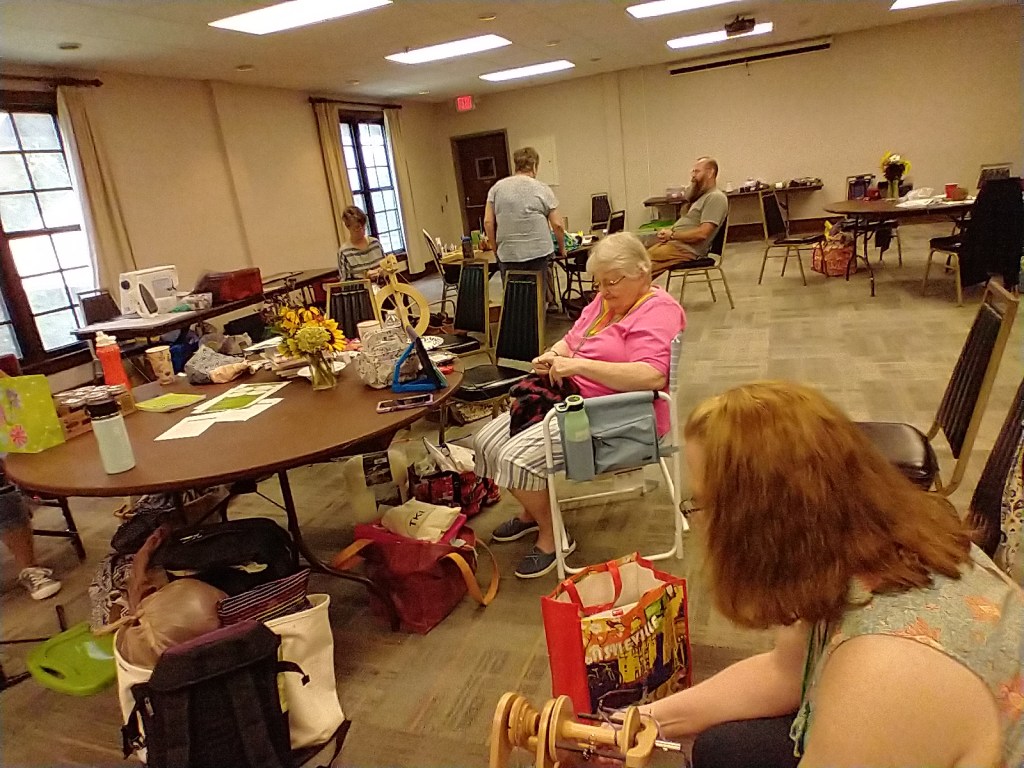
    As an introvert, quiet appeals to me. Sitting silently in the mornings before the activity of the day is a good way to reset before the chaos and noise of the daily events begin. My hubby and children, I think, fear that if I am ever alone in life that I will become that hermit. As a result, they encourage me to participate in activities with folks that share my crafts. It is easy with the two ladies that live in the same village and we try to get together at one of our homes each week. Those sessions are relatively quiet, chatting, quietly spinning or knitting, but each of us comfortable enough with silence to not feel the need to fill it with talk.

    Noisy environments have always been uncomfortable to me and now that I wear two hearing aids, even more so. Maybe it was more comfortable not being able to hear it as well, though most conversation was missed. This is where forcing myself to become part of the event is more of a challenge. I will commit to attending the larger spinning weekly group, stating to hubby that I am going, then finding any excuse to not attend, though I made it today and there were only a few of us present. There are a couple of retreats that occur each year, and at one, I know most of the participants and feel more comfortable attending. The other, I have backed away from as many of the folks I knew for various reasons are no longer there. It is difficult for me to try to fit in then even though we are all doing the same sorts of fiber crafts.

    Son1 and daughter, helped me get set up to Zoom with an online group of crafts folk, but I find that type of interaction very stressful and our internet is not the best, so keeping a picture and sound varies, making it more stressful. I am thankful that by the time Covid sent the world in that direction that I was already retired.

    The hermit tendencies are ideal for garden work. Outdoors with only the sun, wind, and bird sounds as company. Sometimes, help would be nice, but given enough time, it gets done. It is almost time to put the tomatoes and peppers out instead of moving them out and back in the house daily. And the beans can be planted. That may happen today. Yesterday after spinning with the small group in town, the beds that had previously been prepared or planted were given a light scuffle with the hoe. The first radish and a handful of asparagus brought in.

    For those who read the previous post, the missing Marans never returned, so the raccoon episode resulted in the loss of two hens, one killed and one missing, probably caught by another predator while out hiding. That leaves a small flock of 7. Day before yesterday, they were too traumatized to lay, but yesterday provided 6. We may be okay with just the remaining flock, but there are no extras to share with friends anymore.

    The nice weather, though very windy this week has allowed a profusion of Iris blooms. My bouquet from the Farmer’s Market last week was looking sad, so the remaining blooms from it were added to a bouquet of Iris from the beds around the house. They are a favorite spring flower with their sunny colors and repeat blooms.

    So the hermit of the mountain lives on, not writing as much as some years, wondering if the garden will overwhelm this year with trying to keep it thriving, and with preserving it’s bounty for the cold months that follow. She will get out again with friends to spin, even attending an annual social/potluck on the porch of one of the members of the spinning group. As I age, the hermit tendencies grow and it requires more effort to be social, but I am working at it.

    Sometime this month, the new bees will arrive and again, an effort to keep a couple of hives alive for the year. The son that initiated this project is having better luck.