The school year is winding down here and so, the class groups at the museum are coming to an end. Today, we had about 40 second graders visit us. Not as many rotations, fewer volunteers, but the kiddos did very well.
It is a bit more challenge with the younger students as they haven’t had the history in their Social Studies classes in any depth, their attention span is much shorter than the middle school aged students, so my presentation takes a much simplified form.
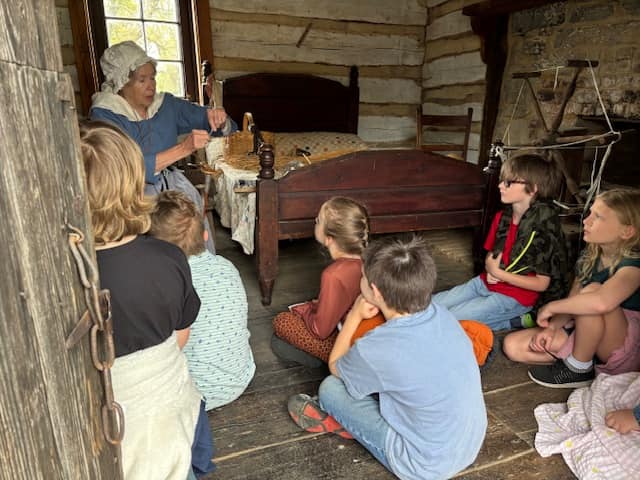
I start with asking them, “How many outfits do you think you own?” Answered by 10 to 1,000,000. “Where do you get your clothes?” Answered by Walmart, Target, Amazon, etc. From there, I try to get them to imagine having only 1 or 2 outfits, having to make them, including making the cloth they are made from, and wearing that same outfit until they outgrew it and handed it down to a younger sibling. They have a hard time with that idea or having only a handed down outfit themselves. How no handmade cloth was wasted, that worn garments were taken apart and the cloth reused for bags or quilts.
Trying to get them to imagine living in a 10′ x 10′ log home with parents and several siblings with no kitchen and no bathroom is also difficult for them to comprehend.
There are some good questions, some wrinkled noses over how few baths they could take and how that process works. How they had to help shear sheep, skirt and wash fleece, help card the wool, then help spin it on spindles. I have a handful of small spindles I have made for them to try and for them to see how difficult the process is initially, as I have been spinning on a spindle the entire time I have been talking to them.
There are lots of flax, hemp, and wool samples to pass around. Some woven pieces, box loom tapes, and lucet cords to see what even as kids that young would have helped make.
It is fun to have the various ages and drawing from my teaching skills with them.


 Cabin Crafted