Tag: bees

  • SeeSaw days

    Typical spring here, hot and humid one day and chilly and gray the next, but the garden grows. Except for the corn. Out of 4 rows in a 12 X 4 foot bed, only two seeds sent up blades. We were due for thunderstorms a couple of days ago, so the bed was reseeded. This may be the last time I try corn. Year before last, there was nothing, last year some came up, but the harvest was pretty paltry for the space it consumed. The only year that corn has ever been “successful” though marginally was the year of the popcorn.

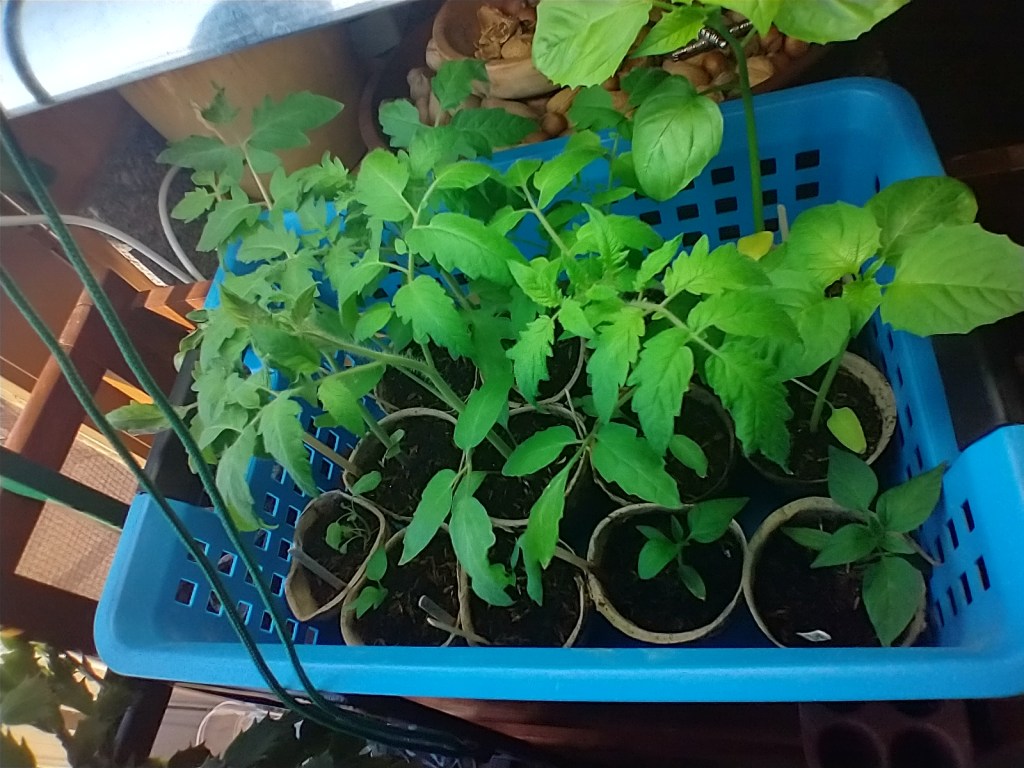
    The seed starts for squash, tomatillos, pumpkins, tomatoes, and peppers were all successful and are doing well planted in the beds. The cucumbers failed on first start, but there are several strong seedlings putting out secondary leaves that are currently being hardened off and soon they will be planted in the last bed.

    The motivation for the garden has been hard to come by this year, and since I am currently unable to be out in the sun due to a chemo cream use on my face, I have to heavily cover with mineral sunscreen, wear a huge hat and limit my exposure. Sunburns as a kid camping with family, as a young adult working as a lifeguard, have come back to haunt me. Usually, anything found by the dermatologist is zapped with liquid nitrogen, but this time is wasn’t in a place they want to spray. At any rate, early or late, very protected sessions are being done. As an adult, I wear long sleeves nearly year round and always wear a hat with a brim when we are out walking. Sun damage from years ago revisits as we age.

    Peas are heavy with blooms and though they are supposed to be a free standing variety, they have toppled all over each other. Soon, peas will be harvested. One of the varieties of spinach is bolting as is the lettuce. The beans are up. The tomatoes, peppers, basil, squash, and tomatillos have been mulched with clean straw, thanks to a friend that was able to get me a couple of bales yesterday. Part of a bale was used to clean the hens coop, a few flakes as mulch and the rest set back in the dry garage for further coop cleaning and garden mulching.

    Now if I can just get the paths under control, figure out how to kill off the smartweed and creeping charlie, I will be happy. As it is upper 70’s today and tomorrow with bright sun, the paths were all sprayed with white vinegar and dish soap. If that shows any level of success, it will be repeated until I win, vinegar is cheap and safe. A truck load of wood chips would be great to have, to put about 4 inches between all the beds. The other frustrating area is the tall grass that grows up the welded wire fence. The line trimmer can’t get under the fence and if it hits the wire, it breaks off the trimming line. I don’t want to use chemicals like Liquid Fence, nor do I want to take down the fence and reset it an inch or two off the ground so I can weed under it. I envy neat gardens with no weeds, no grass in-between beds, no fence needed to thwart the deer, groundhogs (saw one today in the yard), and free ranging chickens. Perhaps the electric mesh type moveable fencing that can be moved away, allow mowing, then re-set would do the trick. I already have the 6V charger. Maybe if the vinegar trick works and I can get woodchips, cardboard can be slipped under the fence wire, heavily mulched on both sides out maybe far enough to keep an edge would work.

    The bees are again protected from the resident bear. A new battery for the 12V charger was ordered and installed. Tested on the deck, it showed a strong charge, so it was taken back to the bee yard, rehung, and attached to the electric fence wire. When it was turned on, it showed only marginal charge on the fence. Because it was a new solar charged battery, it was left alone to charge for a couple days and still only marginal. This morning, the piece of line that connects the wire to the charger was replaced and the fence is again hot. Hopefully, 12 V will deter the furry beasts.

  • Spring in the mountains

    Spring is always fickle, this entire winter has been though. It was subzero for a week of nights around Christmas with single digit days, and there have been weeks of late spring/early summer temperatures with nights that didn’t drop below 50f. Flowers and fruit trees bloomed early. Fearing our pear trees wouldn’t produce fruit this year because there were blooms before another week of deep freeze temperatures, as it became time for them to bloom, there were more blossoms. Three of the apple trees are blooming heavily, one lightly, one not at all. There will be no plums, it bloomed way too early and all the blossoms froze.

    Seven years ago we awoke to snow. Last night we had our first frost in weeks, but today it will be 60f and by later this week, almost 80f. Friday, though the Hummingbird tracker doesn’t show them here yet, I hung my feeders and yesterday saw our first one of the season feeding on the more popular feeders.

    The hens have dug out under their fence, holes filled, hay layered to fight the mud, but today with the Forsythia nearly leafed out, though there were hardly any blooms, I have again given them free range. They will hopefully hide under the foliage of the shrubs or the cedars for their safety. I hope not to lose anymore, but they can’t stay penned up in a run only slightly larger than their coop.

    Two of the remaining Marans foraging the front yard this morning.

    The yoyo weather seems to have taken a toll on the row of Nandina bushes along the north front porch. Not a single one of them retained any leaves this winter though the one in the protected breezeway nook did. If they don’t grow out new leaves, and that looks doubtful, a decision will have to be made as to how to treat that area. It is not great soil, but the Nandinas had thrived there for about 15 years until this winter. With the chickens scratching up the soil there, growing grass might be a challenge unless I can block them off until it is established. A few large pots with evergreen shrubs scattered along the edge is a possibility or even low growing evergreen juniper planted in the soil.

    The other victim of this winter might be my fig. It produced fruit for the first time last year, but I see no sign of life in the form of new leaf buds.

    This is Penny, she is a jumper, belongs to our neighbor as one of her herd, and she thinks our grass is greener than the fields on which she lives. She visits in the spring time, leaving her calf for a little while to go over the 4 strands of barbed wire to come graze. She is a welcome visitor, it amuses me to find her munching away on the tall grass that will become hay in a few months.

    Her sister was a jumper also and used to visit, sometimes bringing friends.

    The tomato, tomatillo, and 2 of the varieties of pepper starts are thriving. This week, they will begin daytimes on the back deck sheltered initially, and later full on in the sun to harden off for planting in about a month. Yet again, I seem to have started them a couple of weeks too early.

    Today is Easter Sunday and when we have family here, there is usually an Easter Egg hunt for the kids, even for the teens. Last year, daughter created an escape room sort of series of clues to lead the older ones from hidden large egg with the next clue that eventually led them to small baskets of goodies, mostly of the non edible kind. This is always followed by a meal that has traditionally been ham, au gratin potatoes, asparagus, another green for the haters, deviled eggs, rolls, and some sort of dessert. This year it is just the two of us and hubby will get his favorite home cooked Mexican food fiesta instead.

    Maybe tomorrow, we will venture to the plant nursery to check out the herb selection, to Tractor Supply to add wild bird feed and suet cakes and if I can find one, a third Bluebird house. My carpentry skills just aren’t up to building my own.

    The peas and radishes are beginning to emerge in the garden, the lettuce in the large pot on the back deck is growing, and I await the asparagus that have yet to show in the garden. Last year about this time we added the 4 hives of bees that did not succeed. Two nuks of bees with marked queens are on order for early May and two hives will be started again, hopefully with more success. While I await their arrival, new excluders for the openings will be ordered and sugar syrup will be fed inside the hives this year. I am really raising them as pollinators and not looking for much honey, but some would be a bonus. There is one capped frame of it in the freezer that survived the demise of the last hive. I really don’t know what to do with it, it may go in one of the new hives as starter feed for them.

    Spring is officially here, though the chance for a frost lingers until the first week of May.

  • Let the Season Begin

    With the strong back and strength of a 16 year old assistant in the form of a Grandson, several farm issues have been addressed in the past 5 days. He fortunately is very amenable to and volunteering to help, in the garden or the kitchen. He is being kept busy and well fed.

    On Saturday, we attacked the wire grass that was trying to overtake the spot in the garden where the comfrey grows. The grass was so high, finding the sprouting comfrey was a challenge. We didn’t get it all, but the comfrey has a fighting chance now. When he arrived last week, he and his Dad had purchased a large dog crate to control their two dogs until Son2 left on Wednesday. The dogs left with him, the crate put in their RV that is parked on our farm. The box is going to become a weed barrier above the asparagus bed soon.

    Yesterday, after the three of us went to lunch, a walk, and to the local nursery to get raised bed soil for one of the boxes, we drove down and around the south field to see the new welded wire fence and how much clearing/damage the neighbor did installing his fence. We discovered a very long strand of high tensile fence wire with a long strand of barbed wire dragged into our hayfield but still attached to an uprooted shrub in the thicket on the edge of the field. Fortunately we discovered it before the hay got high and before the hay guy got it tangled in his equipment. Grandson and I spent a couple of hours winding the wire, tying it off with cable ties, cutting it where it was entangled in the uprooted shrub. We then walked the perimeter of the field to make sure there was no more of it out in the grass.

    It is a mystery to me, how farmer’s even work with that stuff. It is difficult to straighten, impossible to bend, and acts like a stiff Slinky toy.

    After we finished there, he helped me move a couple barrows of compost to two beds, and spread the bagged raised bed soil into one.

    That bed needs one more barrow of compost and it will be ready to plant. Today we purchased 4 more bags of raised bed soil and 6 bags of composted cow manure for the long bed.

    This bed received a barrow of compost yesterday and was planted in peas, radishes, carrots, and spinach today. They should have been planted 3 weeks ago, but it is what it is. The long bed had as much Dead Nettle in it as the square bed behind this one.

    This afternoon after planting the bed, the weeding of the long bed was begun and the 4 bags of soil and 4 of the bags of composted cow manure were added to it. I need 5 more bags of soil and the remaining two bags of compost added and it will be ready to plant in early May.

    That bed is where the mint was a few years ago, it has never had enough soil that was good enough to plant, so hopefully today’s efforts and the addition of a few more bags of soil and compost will make it a healthy bed.

    That last little 4 foot bed is being left alone for now as the bees are loving the Dead Nettle growing in it. It will have to be cleared by Mother’s Day to plant peppers and the bed behind it needs a light weeding, but it was covered in old hay over the winter and is in pretty good shape, though it will get fed with the remaining compost. The new pile has been started with the weeds being pulled. The paths will just be mowed or cut with the string trimmer this year. My shoulder just will scream if I try to take on all of that grass and weed pulling.

    It was nice to be out in the 70 degree weather to get the garden underway. The garden plan was revisited as I realized there were seed packets purchased of vegetables not worked into the plan. Hopefully, it will be a successful garden and feed us well this year and into next winter. The garden gets more difficult to deal with each year, but I’m not ready to give up yet.

  • Let the Season Begin

    Today is chilly and rainy, the beginning of a cold front that will bring snow to some extent on Sunday and Monday, but it is 8 weeks to our last average frost date, the time to start slow seeds.

    Yesterday, the Aerogarden was dismantled, scrubbed, the parts that could go in the dishwasher for more thorough scrubbing done, then left to dry overnight. This morning, it was set up, filled with water and fed, and two each of 3 peppers started in it under it’s lights. Two Jalapenos, two seranos, and two Chocolate Sweet peppers. Once pepper starts are available at the nursery, a ghost and a cayenne will be added.

    The self watering seed starter was begun with fresh seed starter mix that is organic and has no peat in it. In my environmental awareness move, peat is eliminated as it is not a quickly renewable resource. The seed starter, placed under the grow light has 2 tomatillos, 4 Amish paste tomatoes, 2 slicers that carry the black gene so produce a darker, purplish/brownish medium size tomato, and 2 common sage plants. The pots with basils, thyme, dill, and lettuces are thriving on a shelf in the south facing fully windowed doors. Hopefully, the parsley in the half barrel in the back will come back up this spring and the rosemary overwintered indoors nicely. There is a lot of oregano in the bed with the fig that will hopefully continue to produce after the snow melts off next week.

    In reviewing the seed supply, I remembered two vegetable seed packets purchased earlier that were not accounted for in the garden plan, so that will have to be revisited before digging in the garden can commence. It is almost time to plant spinach, carrots, and peas.

    Fortunately, the apple, pear, and peach trees did not bloom before this freeze. Maybe a week of cold will delay their blooming long enough that fruit is still possible.

    There is a supply of starter pots that can be filled with seed starter mix in a few more weeks to start the squash and cucumbers in, but they only need about 4 weeks head start. The plastic webbed baskets will be washed out once there are seedlings that need to be hardened off. Some produce I have grown in the past in limited, mostly unsuccessful attempts will not be grown as those products are readily available from local farmers at their farms or the farmer’s market.

    As the weather is behaving like winter, it is nice to be planning the summer garden. In late April or early May, two new hives of bees will be introduced, hopefully with greater success than last year. Plans being made, plans begun, hoping for a successful season with vegetables, fruits, eggs, and bees for eventual honey. A busy season ahead, I hope I can stay on top of it.

    As the grass is beginning to green up and grow with a vengeance, the riding mower was taken back to the shop to figure out why the blades won’t engage and throw the belt every time it is disengaged when it did work. Less area will be mowed this year and more left for the hay guys.

  • Tick Season and preparing for new garden

    It is only May 1 and already many ticks have made their way into the house on our bodies or on the pups. Three bites already on me. It is going to be a bad year for them I fear.

    There is a mowed path to the bees that will stay mowed as the adjacent hay grows, but sometimes you have to walk through the branches of a cedar tree to brush off any hitchhikers and in spite of pants tucked into socks into boots, the bee jacket, veil, and gloves, they are still finding their way in. I dislike chemical sprays even around my pants legs, much less on upper body, especially since most are from going to the bee yard. I’ve had folks suggest wrapping a dog tick collar around my lower pants legs, but that doesn’t stop them from the cedar branches above the lower legs.

    They are disgusting, creepy crawlies, disease carriers. We need Guineas, but doubt they would stick around and they are so noisy, but definitely tick gobblers. This will be a difficult year to wild berry pick because of them.

    This week, the last of the tomatoes frozen toward the end of the season last year were finally processed into pasta sauce. That puts 11 pints of pasta sauce on the shelf to start this year. Three from last year, 8 new ones, plus 3 in the freezer, 3 pints of canned tomato puree added this spring. There is still a supply of assorted tomatillo sauces/salsas/jams, and a bag remaining in the freezer, so they won’t go in this year’s garden. There are 8 peppers ready to plant in two weeks, plus another variety started from seed that will be a bit later. One of the Farmer’s Market vendors had several varieties of tomato starts so one each of two varieties were added to my purchase to give me 8 tomato plants, 2 more than originally planned. The huckleberries didn’t come up in the starter flat which gives me some space to accommodate the extras. The corn patch will be half sweet corn and half Bloody Butcher so seed can’t be saved, but extra seed of the dent corn was purchased to use next year. The plan this year has two varieties of beans and two varieties of peas, so again, seed can’t be saved. Already, a plan for next year is in the works to grow only single varieties of heritage vegetables and save seed for future planting. This will be somewhat limiting, but our primary hot pepper use is Jalapenos, primary tomato use is sauces, sweet corn is such a short season, the Bloody Butcher will provide corn meal and roasting ears. Though we enjoy bush beans, young Pinto’s can be eaten green and if enough are planted, dried for winter chili and goulash. With peas, we enjoy both sugar snaps and shelling peas, but if only shelling peas are grown like year’s past, seed can be saved. It will be an interesting experiment to see if the lack of variety bothers us or if the variety will just come from Farmer’s Market purchases. Seminole pumpkins are great for stuffing or pies and will be the third part of the Three Sister’s garden. Spinach will be planted, but I have never tried to save seed from spinach or lettuce. Cucumbers of course will be in the garden to eat fresh and to make pickles. Garlic was not planted for this year, but will be added back in for the fall garden to overwinter and provide bulbs next summer.

    Here’s hoping for a great garden season and more putting by for the off seasons. I need to start gathering jars for processing vegetables and later for when honey gathering commences, probably not until next year though.

  • A Bee-utiful day

    The weather is glorious and we took a walk, followed by a visit with my local bee keeping friend and her husband as they did their post winter box inspections. That was delightful and a bit overwhelming as we asked questions and got answers, they offered other information, showed us around. I am glad we live where we do as their property doesn’t have a flat spot on it that they haven’t created themselves. To the point that many areas are being made into gardens so it doesn’t have to be mowed. They also don’t have a lot of open space for sunshine and they are only a few miles from us, less as the crow flies. One of my issues was how quickly the bees are emptying the feeders, and they suggested switching to quart jars instead of pints.

    Once home, new batches of syrup were started and the son that got us going and is the official owner of our hives called for an update and he answered more questions. I hope my feeble brain can hold all this information. As we were talking, he walked back to check on his two hives and his feeders were empty too, so I passed on the suggestion of quarts.

    Because we haven’t had rain in a few days, the hoses were moved around and the back garden was watered. And the little garden built last year over the septic clean out received a bird bath half filled with rocks so the bees can find water and not drown. To keep the chickens out of that bed as seedlings of flowers are beginning to germinate there, a section of old fencing was cut as a cover with a hole in the middle to allow the birdbath base to fit through.

    After dinner, it was still bright sunny and hot, but the bee garb was donned, the quart jars of syrup loaded into a large bucket and the bees were fed. They were pretty agitated that the empty feeders were removed, but calmed back down when the larger feeders of syrup were placed in the hive openings.

    The very novice bee lady.

    What couldn’t be captured with gloves through the veil net was a picture of the cloud of bees circling the hives and me. This turned into a bee filled day and is quite an adventure. I had read that the hives could/should be different colors or decorated, so some of the remaining boxes are going to get painted and decorated before they are installed on the existing boxes. I need to get some acrylic paints and get creative.

  • Bee Help

    Part of the excitement of this new project is the help that is offered by near and far friends. Friends I have met through this blog and friends that I have met through other friends. The local one, recently introduced to me by a spinner friend, with her husband has 14 hives and she was excited to see our set up. She came over yesterday and made a few suggestions. One was to lower the bottom strand of the electric fence as it was high enough for skunks to go under it without touching it. She said a skunk would scratch at the front of the hive at night, causing bees to come out to examine why and get picked off as they left the hive.

    Last night after dinner, bee jacket and veil put donned, fence equipment box hauled down to the enclosure and the electric fence reworked with strands 6″ off the ground, 14″ off the ground, 30″ and about 42″. This should discourage most of our local predators. There are now 4 strands instead of 3, lower and closer together. If I can figure out how to use the volt meter, I will test it’s strength.

    When the enclosure was reached, all 4 feeders were empty and the hives were very active. After fencing was finished, syrup was made and the feeders filled. The activity at the hives was encouraging and many of the bees were out foraging. Soon it will be warm enough and they will be settled in enough that the feeders can be removed.

    She also suggested placing a brick or rock on top of each hive. That didn’t get done today but will tomorrow.

    The distant friend from the blog has offered many suggestions on predator deterrent and winter feeding, providing a website link and all that has helped and will help as I move forward with this project.

    I did learn that that the bee suit is very hot when the outdoor temperature is above 70f. I can just image what it will be like come August. But the bees are very docile. I have filled their feeders from behind the hives twice, reaching over to pull the feeder to fill and today mowed a 10 foot wide path in front of the electric fence both with no protection on and no bees bothered me.

    None of this would have been possible without our youngest son asking to put hives on our property and teaching me how to work with them between his trips up here to check on them.

    Our local teenage grandson came today for riding mower lessons after farmer’s market. It was nice having most of it done while I stayed on the porch or in the house. Since this was his first time, I did the “difficult” parts, the steeper embankments, orchard, around obstacles, and the section below the garden that used to be garden and is very rough. He did a great job and seemed to have fun zooming around the yard.

  • Crazy Weather and Bees

    In spite of 3 nights of freezing temps and graupel coating the deck two mornings, the bees seem to be thriving. They have emptied their pint syrup feeders twice already. Today I purchased 20 pounds of sugar. I don’t think I have bought that much sugar cumulatively in the past decade, but they need the 1:1 syrup until they are fully established and the weather settles in. They will feed in the winter too, but there are online recipes for making sugar bricks that are placed in the hive for their consumption during cold weather when they can’t fly about and there is no pollen available. Since the bricks have to dry thoroughly and as this is a fairly humid area, the making of the bricks will begin during the summer, dried, and stored in airtight containers for winter feeding. This is a good use for a dehydrator, but we don’t have one.

    After the frigid three days, the temperatures have moderated and this weekend it is going to feel like summer and return to near freezing nights part of next week.

    The asparagus are producing, peas, sugar snap peas, and potatoes are sprouting. There is a fair amount of spinach, and more goodies are coming to the Farmer’s Market each week now. The hens are being generous enough to share with family.

    It really seems like spring is here for real. We are still about 3 weeks from last average chance of frost, but the potted herbs and tomato and pepper starts are spending more time on the back deck.

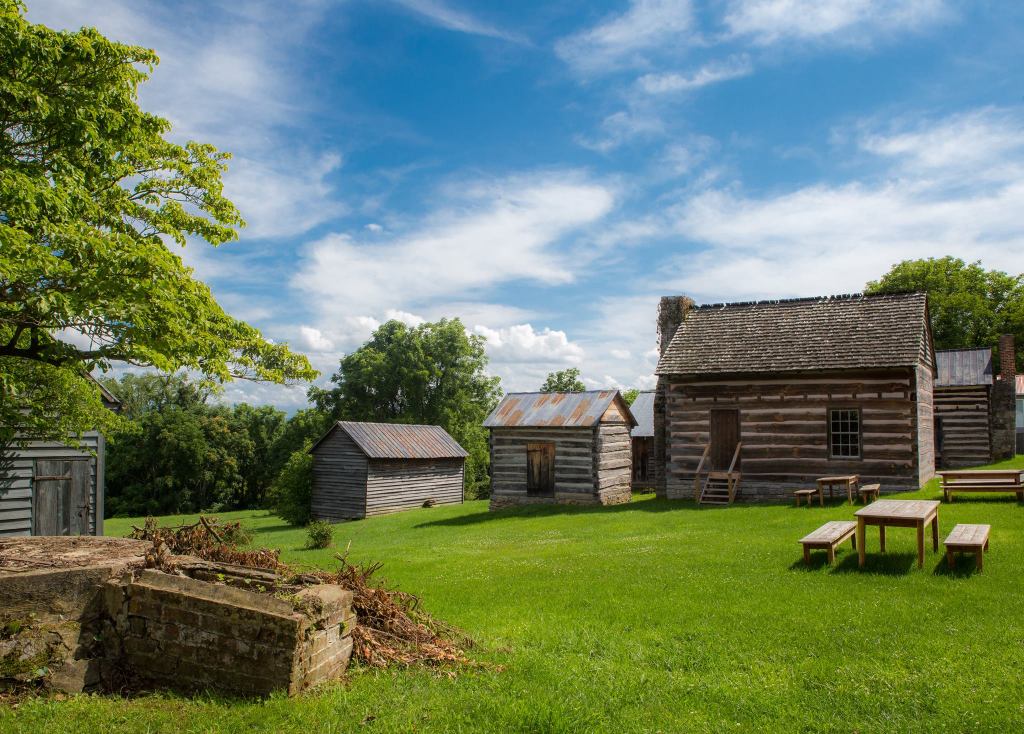
    The week had two living history events with tours from local schools to the museum. We had about 100 sixth graders yesterday and a smaller group of 4th graders, scheduled for tomorrow that has had to be rescheduled due to illness among the teachers of the school. I love these events. For yesterday’s event, I set up in the “loom house” an original log cabin from around 1768. The original Newbern community along Wilderness Road was what today we would call a planned community. The residents were required to build a 16 foot square home with a fireplace and a storage/sleeping loft along the road. Many of these original homes can still be seen by placement of windows, though mostly now covered in siding and all expanded. The museum property also has the original German barn that has been restored, several other original buildings, and a reconstructed summer kitchen with a loft. The loom house is next on the renovation schedule, it will get a new roof and the chinking repaired, the chimney also repaired, though “real” fires are not being burned in any of the fireplaces, many have electric logs to simulate fires. Only about a dozen students and a teacher at a time could be in the house with me as the loom and a bed take up most of the space. The loom has enough space around it for a single file of students to stand and still leave enough room for me to set up the small quill wheel. Though not a lot of spinning gets done in the length of time, because each class had to be split in half to fit them inside, history of where and how the fiber to make their clothing was obtained and processed, lessons on fiber preparation, spinning, weaving of tapes and fabric and how family members were all involved in this process. Types of fabric made and how it was used, why certain fabrics were used for particular items. And personal grooming during the period. Kids are either fascinated or repelled by some of the information, and they are all left with the question of whether they would like to return to that lifestyle.

  • Signs of Fall – 8/16/2019

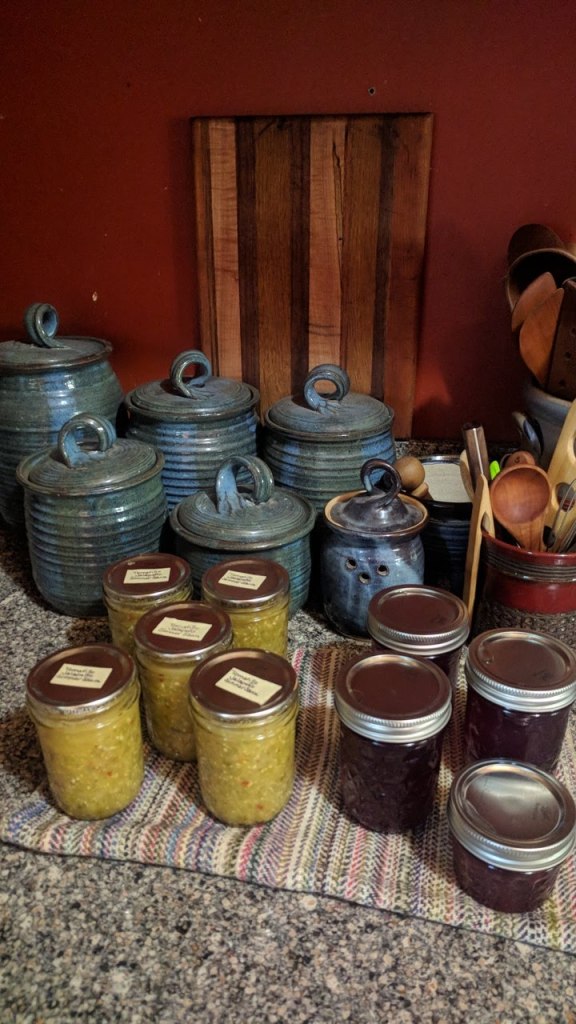
    The vivid emerald green of spring is fading to a drab green with highlights of yellow and red leaves mostly on the weedy shrub and weed trees, but the Sycamores are yellowing, several trees are shedding leaves already. Putting by is also a sign of impending Autumn season and that has been a task multiple days a week for the past several weeks. Some days it takes many hours and produces quantities of goodies to be enjoyed over the cold, non productive months. Some days a small batch or two of a sauce or jam are made. This morning, the Tomatillos gathered over a couple of days were made into 5 half pints of simmer sauce with the recipe from Canning by the Pint, one of Mellisa McClellan’s books. Some of those recipes are followed to the letter, others are a jumping off point for me as was today when I added several ground Jalapenos to the recipe to kick up the spice level of the sauce.

    After lunch, more grapes were picked, giving me enough for another batch of grape jelly from our grapes. That recipe is from Food in Jars, another of her books. It is a low sugar recipe compared to the one on the pectin box, using 3 cups of sugar to 4 cups of juice and requiring about 20 minutes to cook, rather than the 7 cups of sugar to 5 cups of juice and the couple of minutes of cook time. I would rather spend the time and have jelly that tastes like grape, not sugar. The remaining grapes will be left for the resident critters that roam our farm at night.

    It is very satisfying to hear the lids pop to seal after they are set on the towel to cool.

    The pollinators are busy today, a very hot, uncomfortable day to be out. Native bees on the sunflowers and bumblebees on the Autumn Joy.

    The sunflowers are Hopi Dye Seed and I hope to harvest a flower or two to try dying some wool with them. Behind them and on the edge of the Tomatillo bed are mixed sunflowers, some Mammoth, some Bronze, and one smaller flowered variety that produces masses of 6″ flowers per stalk. They are great for cut flowers for the table. Most are the typical golden yellow but one yellow variety produced lemon yellow blooms.

    Most of the sunflower heads will be cut off when mature and some given to the chickens to peck the seed, others hung from the wild bird feeder pole for them to enjoy this winter. This year was a good year for sunflowers.

    Unless I purchase a box of tomatoes, canning season is drawing to a close for me. I will make a couple of small batches of Asian Pear Orange Marmalade and will can the remaining Tomatillos whole as they mature. The apples are too small to make applesauce but will be pressed for cider and maybe a batch of cider vinegar made. Maybe when apples start appearing fresh at the Farmers’ Market, I will make one canning of applesauce.

  • The Good and the Bad of Spring

    IMG_0028[1] IMG_0029[1] IMG_0031[1] IMG_0032[1]

    IMG_0033[1]

    IMG_0035[1]

    Forsythia blooming, Lilac leaves unfurling.  Frightful and her sisters have found the perches in the chicken tractor and instead of being Frightful, she should be Frightened as they won’t come out and play in the yard.  Apples, Asian Pears and Peaches are blooming.  The Buffys are being generous.  The Maples are all lime green with flowers and oh the pollen.

    The dogs are shedding fiercely requiring daily vacuuming.  The garden is going to require some sort of major rework to keep the Buffys and Romeo from scratching up every seedling that is emerging.

    I am in a fog.  Though I was never allergic to things growing up, I seem to be developing more and more allergies as I age.  It started about a dozen years ago with my first and major case of poison ivy, followed by more and more serious reactions to paper wasp stings and this year my eyes are gritty and my head stuffed full from the indoor and outdoor spring allergens.

    Because of the reactions to stings, our youngest son with funds we fronted has established a bee hive in his yard in Virginia Beach and applied for a grant that will refund part of what was invested and with that he hopes to get a second hive.  He will maintain the hives and we will enjoy our share of the honey they produce.  That is a win/win as far that they and we are concerned.  I wish the hives could be here to benefit our garden and flowers, but it is not a risk I am willing to take with the nearest medical facility at least 20 minutes away.  The same son is a Paramedic and he said that most Doctors won’t prescribe an Epi Pen to seniors due to other risks.  I guess I should visit our Doc and inquire.