Category: Homesteading

  • The Harvest

    wpid-20140621_202355.jpg

    Yesterday just as they finished mowing the lower field, it started to rain.  We probably got two inches yesterday evening and last night.  This morning dawned thick and gray and it didn’t look good for finishing the hay.  Jeff unhooked the baler and added a second fork to the back of the tractor and started moving the already baled hay into trailer size loads around the fields.  The sun finally came out and the wind picked up, so they tettered the mowed field twice and let it sit for a couple of hours, raked it and finished baling it about an hour ago.  The total hay harvest this year is 96 big round bales.

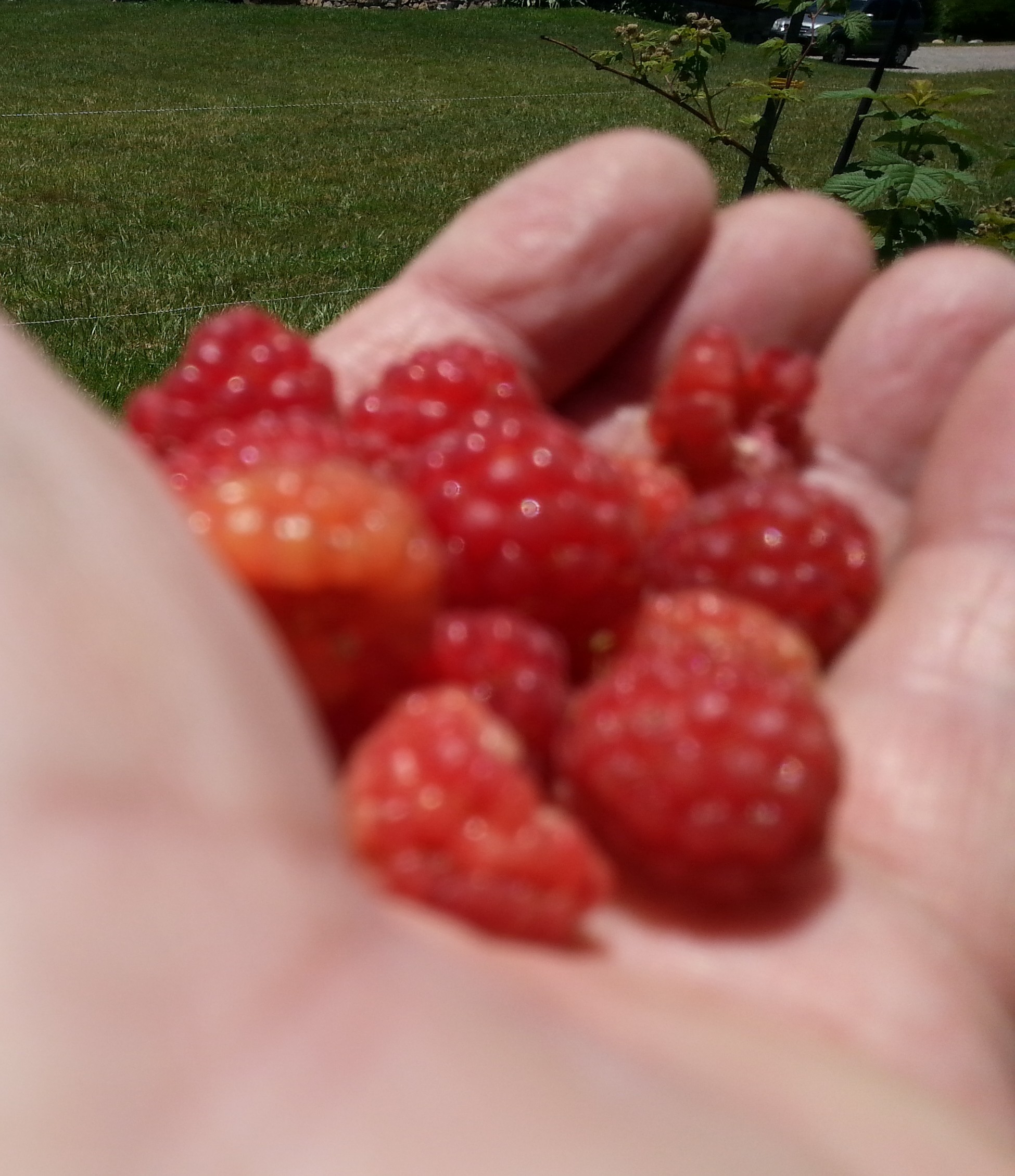
    While they were baling, I picked more raspberries.  I need less than a cup to make a batch of pure raspberry jam.  Another day or two and I will be set.  The peas are filling out faster than I can pick them and certainly faster than we can eat them, so tomorrow I will pick, shell and freeze at least a few packages for the winter.  There are tiny peppers on some of the plants, blossoms on the tomatillos, the cucumbers, squash and beans are continuing to grow.  I think there will be a handful of blueberries soon too.  The chickens are enjoying the over matured kale leaves.  I think a big armful of kale and chard will accompany me to Northern Virginia in a week when I babysit for 4 days and then bring our oldest grandson here for a few weeks of the summer to help his Mom and Dad out.

    The 3 jars of mustard finished their ferment time yesterday and today and were completed and packaged in 8 oz jars for summer enjoyment and to share with our kids.

    We started our morning at the Farmers’ Market and came home with radishes, turnips, carrots, spring onions, flowers, beef and pork.  We are set for a week of good eating.

    Lovin’ life on our mountain farm.

  • Farm Life as Summer Approaches

    wpid-20140619_152843.jpg

    The 90 hp behemoth at work.  There are 47 bales done and they are working to beat the rain on the lower field.  He will bale by headlights tonight.  The hay is beautiful and thick.  That tractor always amazes me, our little tractor is only 28 hp.  It would pull the tetter or the hayrake, but the sickle bar and round baler require too much power.  We can easily mow with a 5 foot brush hog, power a post hole auger and if we could figure out how to use it, pull the small plow we store in the barn. I am not a short woman and my chin would rest on the top of the back tires of that beast.

    wpid-img_20140619_092606.jpg

    Bales in the morning sun.

    Jeff has equipment that is modern with CD players and A/C and equipment that is older than my kids.  It is always fun when he is working here as he brings one tractor, then another, a hayrake, a tetter, generally he doesn’t trade out the equipment, he just changes tractors for the next job.

    wpid-img_20140619_092248.jpg

    In the midst of the chaos, today I found a new wildflower/weed in the front yard which is green, but seems to be more wildflowers/weeds than grass.

    wpid-20140619_111715.jpg

    This afternoon when I went to pick peas for dinner, I realized that there were still garlic scapes in the garden.  I harvested as many as I could hold with the egg basket full of eggs and peas.  I was able to make 7 half cup jars of garlic scape pesto and blended the other half of the scapes with olive oil to make a garlicky paste that I dropped in 2 Tbs. plops on foil to freeze for use as fresh garlic in sauces.

    I was hoping to get some peas in the freezer for winter, but we are enjoying them fresh so much it is hard to put any away.  Peas picked, shelled and cooked within half an hour are a whole different vegetable than even “fresh” peas from the Farmers’ Market.

    It has been a productive day on our mountain farm.


  • Olio – June 18, 2014

    Olio: a miscellaneous collection of things

    Pet peeves of the day;

    • the trend of semi fast food restaurants to shout out across the dining area “Welcome to …” each time a patron enters any door of the establishment.  Do they really think that is appealing and welcoming?
    • also in a semi fast food restaurant or even a real restaurant for an employee to walk up to your table and grab the tray/plate before asking if you are finished with it and say, “May I take your …”  One literally tried to take the tray with my husband’s fries on it today while he was still eating them.
    • along the same vein, to be in an establishment and have not only your own server ask how your meal is, but anyone else that works there.  We have been asked at one steak place we patronize as many as 4 or 5 times by that many different people about how our meal/visit was while we are still seated and eating.  Let us enjoy our food in peace.

    Today was resupply all the critters feed.  We managed to run out of dog food, cat food, chicken layer and chick starter grower all at the same time.  That was a car full.

    On our way home, we stopped at a local greenhouse and bought 4 new Day-lily plants, different from the two that I have and also bought 3 more pepper plants as some of my heirloom starts didn’t grow once put in the garden.  Of course that mean garden work when we got home and it is HOT, HOT, and humid out there today.  Two of the Day-lily plants went in the perennial bed in the front of the house.  The garage wall bed had gotten grossly overgrown with grape iris, the purple ones that smell like grape Kool-aid.

    cropped-wpid-20140509_0908341.jpg

    That is one of 4 huge clusters when they were blooming.  They haven’t been thinned in a few years, they were overrunning the English Daisies, and the bed had gotten weedy as well.  I dug them all out!  I hate to throw them away, but there are too many to replant.  I am going to load them in the tractor bucket and dump them where we don’t mow.  I bet some of them will come up next year and bloom there.  A few of them were moved to a bed by the deck.  The rest of the bed now has the other two Day-lily plants, two lavender plants, some English Daisies, a yellow poppy, three clusters of Dutch Iris plants that I divided from the deck area and on the opposite side of the walkway out of the garage side door, the Bronze fennel.  The bed is weeded, watered, and mulched with spoiled hay until I can get some more shredded mulch to apply to the bed.

    wpid-20140618_164353.jpg

    It looks sparse now, but will fill in quickly and have more variety.

    wpid-20140618_164247.jpg

    The haying is not going as quickly as we had hoped.  Jeff is trying to do too much at the same time.  They tettered the upper fields yesterday then came back and raked it into rows for baling, but the first bale was too green so they left it to mow the lower field and ran out of fuel. This afternoon the have turned the hay and

    hopefully will get it baled this evening as we are due for rain for a few days.

    The first batch of mustard is so good, there are 3 batches fermenting now to share. Two are Bavarian style and one is a repeat of the horseradish recipe.
    image

    I think I am going to have to buy some sausages to grill soon.

    Raspberries are ripening.  Tonight I harvested about a cup of them and resisted eating them as I picked.  They went into the freezer.  As soon as I have a quart, there will be a raspberry jam making session.

    wpid-20140618_193310.jpg

    Life is good on our mountain farm.

  • It is Hay Time

    wpid-20140616_194750.jpg

    wpid-20140616_194744.jpg

    wpid-20140616_194810.jpg

    It is that time of year.  We have been watching the fields mowed and baled around us for days.  Jeff has been waiting for hot dry days to do ours as we have really good hay this year and he didn’t want to spoil it.  There are currently two tractors with sickle bars mowing the upper fields.  Tomorrow they will be tettered and tomorrow evening probably baled.  The lower field will follow.

    For the first bit they were here, both dogs were going nuts in the house, barking and looking out first one window, then the next.  They have gotten used to the noise now, but we wouldn’t dare let them outside right now.

    The plus side of this is that we will be able to walk our entire property for a few weeks after they are done, and we will be able to see deer and turkey.  The negative side is that this will disrupt habitats and we will see more bunnies near the house and mice in the house for a few days.  It usually brings out a snake or two.

    Life is good on our mountain farm.

  • A Week on and off the Farm – June 14, 2014

    This week, two of our grandchildren celebrated birthdays.  Our eldest, son of our eldest turned 9, our first granddaughter, daughter of our youngest, turned 3.  Though we didn’t actually get to spend their birthday with either of them, they are special.

    The garden is growing.  The garlic looks like it is ready to harvest and cure.  Agree?

    wpid-20140614_135223.jpg

    I never did make garlic scape pesto.   Oh well, there is always next year as it is a crop we plant annually in quantity to share with our kids.  The peas are or so close to being ready for the first batch of lightly steamed or sauteed fresh peas.  My mouth is watering at the thought.  The raspberry patch is starting to ripen.  It is really going to be a challenge to bring enough in to make jam or smoothies with as I graze as I am in the garden, they are so delicious fresh.

    wpid-20140614_134846.jpg


    A few weeks ago, while in Lowes, I purchased two new garden implements, a hoe with a two tine rake on the other end and a loop hoe.  The loop hoe is an okay tool in bare soil.  The other implement bent the very first time I used it and it will be returned to Lowes along with a wire brush they sold us for our new grill that has coated cast iron grates and specifically says DO NOT USE A WIRE BRUSH ON THE GRILL PLATES.  A few days after I purchased them, I received a copy of one of the only two magazines to which I subscribe and they had an article on must have garden tools, one of which is a new Rogue Tool Hoe that has a tapered, sharpened end, flat at the end and a 3 tine rake on the other end.  It is American made, forged and solid.  I ordered one and was notified that they were backordered and it would be several weeks.  I okayed that and two days later, was notified that it shipped.  It is a great tool, well worth the money and the wait.  Used on its side, it cuts right through the weeds.  The end cuts deeper for heavier rooted weeds and the rake grabs even young tap rooted plants and pulls them right up.  The wooden handle is thick and well balanced.  They aren’t paying me or giving me anything, but I highly endorse their products.

    wpid-20140614_135331.jpg

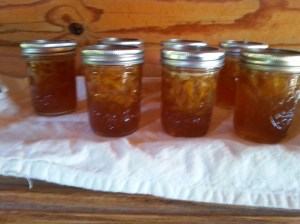
    This is the first week of the summer that we have had house guests.  Jim’s cousin and his wife spend Thursday night with us on the way to Pennsylvania to pick up his youngest son from college and will spend tonight with us on their way home to Georgia.  They brought us two bags of Georgia peaches to enjoy along with pecans and a lovely loaf of bread.  Some of the peaches were very ripe and after they left yesterday morning to finish their trip north, I prepared about half of them for peach jam.
    wpid-20140614_150923.jpg

    In 25 or more years of making jam and jelly, this was my first experience with peaches and it didn’t set up properly.  Last evening, we went to town to purchase more fresh pectic, new lids and while there, I bought another case of 1 cup jelly jars and reprocessed it last night with a bit more lemon juice and a new package of pectin.  It turned out perfectly and they will get to take a jar home with them tomorrow along with a couple of jars of berry jams from last season, some of the cured garlic still left from last year and a dozen of my fresh eggs to enjoy once they are home.

    I subscribe to a delightful magazine called taproot.  It comes out 4 times a year, contains no advertisements, often contains a gift, such as a small notebook or some notecards with artwork from one of their many artist contributors.  It always has wonderful recipes, craft ideas and generally a knit, crochet or sewing pattern in it.  This issue has infused vinegars and three fermented mustard recipes that I want to try.  Today while making a vinaigrette from it for our salad tonight, since I already had the small blender out, I made the Horseradish mustard to sit and ferment for three days before adding in the last two ingredients.  Once it is completed, I will divide it into 4 oz jars and share the finished product with our kids that want to try it. (It tasted delicious even without the fermentation and last two ingredients, so I bet it is going to be great.)

    wpid-20140614_145952.jpg

    There are two more recipes for other mustards in the magazine, but I bet it will be hard to beat this one.

    I must have been born in the wrong century.  I love preserving, growing a garden, spinning yarn, knitting, and cooking from fresh ingredients.  As we await their return for the night, I am preparing a meal of roasted radishes, turnips, yellow squash, garlic, spring onions, rosemary from our garden and the Farmers’ Market.  Local grass finished beef kabobs with Monterey seasoning that I make.  Shrimp with mustard basil marinade.  Salad with local vegetables added and the vinaigrette from taproot magazine with fresh from my garden thyme.

    Life is good here on our mountain farm.


  • Let Us Preserve

    Tis the season to start putting by for the long cold, unproductive months of winter.  We have cousins in Georgia and he has a son in college in Pennsylvania.  We are slightly more than half way in between for them and love to have them for the overnight visit as they drive up and back.  Yesterday afternoon they arrived bearing gifts of fresh Georgia peaches, pecans, and a loaf of a wonderful Artisan bread.  Some of the peaches are at a stage of ripeness where we can enjoy them fresh out of hand or as breakfast fruit, some needed quick attention.  Since our peach trees still are young and not really producing fruit, they are a treasure to enjoy.

    wpid-20140613_141139.jpg

    This morning they left to complete their trip north with a southbound return tomorrow and another night with us, so I pulled out the jam making supplies and set to work peeling, deseeding, chopping, measuring and making a batch of peach jam.  That is one jam I have never made before and not wanting to make too much, I first bought the ebook, The Complete Book of Small Batch Preserving.  As I started collecting jars, I realized that most of my jelly jars have been given away full of jams and jellies and my stock was low.  The recipe said it made 6 cups, I had 5 1/2 cups worth of smaller jars, but figured that any surplus would go in a jar in the refrigerator to be used first.

    wpid-20140613_141148.jpg

    wpid-20140613_143305.jpgwpid-20140613_153032.jpg

    Enough made to get us through the winter and still send a couple of jars home with them Sunday morning.  My taste test is that it is sweeter than the berry, plum and pomegranate jams I have made in the past, but a bit on toast or stirred into yogurt or oatmeal will be nice.   The black cherry tree at the top of our road is ripe and my raspberries are ripening enough to sample a couple when in the garden, but if I’m going to do anything with them, I need more jam jars.

    Jim’s comment when he came through the kitchen was that I sure was industrious.  I smiled and said it kept me out of trouble.

    I love this time of year with new good things to eat appearing nearly daily from the garden or in this case, as a gift.

    Next up is to try one or all three of the fermented mustard recipes from the current issue of taproot Issue 10::Seed magazine.  But wait, I don’t have jars!


  • Olio – June 10, 2014

    Olio: a miscellaneous collection of things

    Nine years ago today, we received a call from Asheville, NC, a tired, satisfied and obviously in love voice announced that we had our first grandchild, a boy.  It hardly seems possible that he is now 9 years old.  The young man that I visit several times a year to provide day care for when his Mom’s and Dad’s school/work schedules require someone else to step in.  He will be spending 7 weeks with us this summer, in the house where he spent his first few years as they moved here when he was only 9 weeks old to supervise and do all of the stone masonry and finish carpentry in our home and then we all moved into it together for several year.

    wpid-20140414_140120.jpg

    Taking a break at the zoo in April.  Happy Birthday, Loakum.

    It seems that the teenage pullets think I am the Pied Piper.  Each morning after I open their coop and let them loose in the pen with fresh food and water, at least half of them then follow me back down the run to the gate.  I don’t know if they think there will be a special treat for them if they do or if I’m just Mama as they came to me as tiny chicks and were raised in a brooder in my care until old enough for the coop.

    20140610_093107[1]

    The garden is starting to brim full of good things to eat and other things to dream about.

    20140610_093154[1] 20140610_093319[1] 20140610_093313[1] 20140610_093142[1]

    Chard and kale, peas with plumping pods, bushes of raspberries and blueberries slowly ripening in the sun.  Peppers, tomatoes, tomatillos, beans, cucumbers, pumpkins, winter squash, summer squash and sweet potatoes getting larger with each rain storm and sunny day.  Garlic almost ready to harvest and cure.

    Yesterday was a busy afternoon.  After having a skin cancer removed a few years ago, I make an annual visit to the dermatologist for a full body check, that visit was in February, but a few spots appeared that caused me some concern, so a return visit started the afternoon.  Everything is fine.  Once home, Jim and I finally tackled the cleanup of the burn pile from a few weeks ago.  We were concerned that it would start filling with weeds, making the task more onerous than it already was.  Upon burning the wood that was there, we discovered a significant pile of large rocks.  I remember than eldest son had discussed putting the chicken coop there when the garden was much larger than it is now and he hauled that rock in his pick up truck from remnants of building the retaining wall, to use as a foundation for the coop.  With much grunting and groaning, the use of the tractor bucket, we moved the largest flattest of those stone to the culvert on one side of the driveway.

    20140610_093818[1]

    Where it will be turned into a guardian/warning wall like this one on the other side of the driveway.

    20140610_093822[1]

    These are to warn folks that there are car and tractor eating holes on either side of the drive that feed and drain the large culvert under the driveway and prevent it from washing down into our garage.

    20140610_093541[1]

    Once the rocks were removed, several tractor buckets of charcoal, nails and screws that had been in the wood, and rocks too small for the wall were scooped up and dumped where unsuspecting tractor or truck tires haying or hauling hay won’t meet with a flat.  The area was then leveled as well as it could with the edge of the tractor bucket and the surviving rake.  Once eldest and family settle into their own house after degrees are complete, I guess I will have to buy myself a new rake as the surviving one is his that I am storing.  Mine did not survive the burn pile control as it proved to have a plastic fitting.

    20140610_093506[1]

    On each pass from the burn pile to the culvert, I mowed a swipe through the orchard and back on the return trip.  Once the burn pile cleanup was complete, I just had to finish the job I had started and mowed the yard and orchard as close as I could with the tractor.  After a quick late dinner from the grill and a salad, the lawn mower was hauled out and the finish work around the fruit trees, chicken pen, garden and close to the house was done, just as the sky was darkening with the chickens settling in for the night.  With them closed up for the night, personal cleanup of bodies and laundry and a rest were in order.

    Life is an adventure on our mountain farm.

  • Native or not

    This is haying season and the grass surrounding our “yard,” the acre or so that we regularly mow around the house, garden, chickens and orchard, is quite tall and thick.  One neighbor mows, rakes and bales all of the fields around us including ours for a split of the hay.  In our case, he takes all but what I need for the chickens and the gardens and in exchange he grades our driveway, plows us out in the snow and provides occasional emergency help like the day I got a 30 foot piece of black plastic conduit wrapped so tightly around the bush hog blade that Jim and I couldn’t free it. That is another story from another day.

    Watching the uncut hay blow in waves in the wind reminds me of the song “America The Beautiful,” with the line amber waves of grain.

    wpid-20140608_130959.jpg

    Jim is tall and his beast, the mastiff is in that grass, standing.

    The yard is cut in three levels right now, the area closest to the house is mowed with a lawnmower, from there to the edge of the fields around the trees that we have planted was bush hogged a couple of weeks ago and the fields are awaiting their first seasonal mowing as it is cut into hay.  Each level has its own display of wildflowers and as I look them up, I realize that almost none of them are native plants.  Some more invasive than others such as the multiflora rose, autumn olive, Ailanthus altissima (Tree of Heaven), kudzu (fortunately we aren’t dealing with this one on our land) and stickweed.  The Autumn Olive was actually introduced and encouraged by the Department of Agriculture as a yard ornamental and though we have never planted one, we spend our time pulling and mowing them to keep them from taking over.  Tree of Heaven is one of those you see in Parade Magazine as a quick growing tree for your yard, “buy it now for shade in 3 years” spiels.  They also are invasive, though I have recently seen an article that it may be dying out on it’s own, we can only hope.

    20140608_101930

    This is Moth Mullein, not native Mullein and though pretty, it is also an import and is so prevalent in some states that it is considered a noxious weed.

    Daisies like the yellow ones above and these from the edge of the driveway were introduced from Europe and are now found in most states.

    wpid-20140607_161356.jpg

    Red and white clover are also European imports and it is difficult to buy pasture grass seed that doesn’t contain one or the other, they are good nitrogen fixers along with Hairy Vetch which is used as fodder and is also European.

    wpid-20140607_161527.jpg

    As we look at our trees on the mountain, few are native species.  Nearly all of the native grasses have been replaced by grasses from other countries.  It isn’t just the flora that has been affected, also the fauna.  We live with invasions of Nutria, stink bugs, gypsy moths, ladybugs, Hemlock wooly adelgid that is killing the hemlocks.  Insects killing the ash trees, blights that killed off and nearly made the American Chestnut extinct.  At the time of the European settlers, the American Chestnut was a predominate species in these mountains.  Many of the old farm houses are built with Chestnut wood beams and if you have ever had the pleasure to stay at Big Meadows Lodge on the Skyline Drive, it is built of American Chestnut.  The woods we see now would look alien to the settlers and the Native Americans that lived and roamed these mountains.

    Some of these species have been deliberately introduced for a specific purpose and it has back fired.  Others have crept in; in or on the hulls of ships or in their water ballast, carried by migratory birds, accidentally brought in imported produce and plants or released from research facilities.

    The prairies of the west have suffered similar fate and few if any stands of native prairie grass still exist, grasses that were taller than the men that cut it.  The wetlands are host to non native grasses such as Phragmites australis  that is choking out the native marsh grasses and the oyster beds, changing the ecosystem; and snakehead, zebra mussels and catfish overwhelming the animal populations.

    The environment has changed, but we don’t have to continue to contribute to the destruction of it.  Research landscaping and flowering plants before you use them.  Buy from nurseries that specialize in native species.  Pull and destroy non native invasive plants before they choke out the native ones.  Support efforts to restore some of the majestic native species such as Chestnuts and Hemlocks.  We each need to do our part.  We can’t return to the past, but we can each do our part to halt further degradation of the ecosystem.


  • Chooks and cooks

    The middles are now 13 weeks old and the injured one seems to be recovering and was returned to the coop today with supervision to see if the others would leave her alone and they accepted her right back into the flock.  Her injuries are healing and her feathers cover the injuries, so I think all will be well.

    Since I lost one and have decided that the Olive egger will be culled in July, I returned to the farm where the rest of my Buffs have come from and purchased 3 pullets that are 15 weeks old.  That hopefully will give me 14 egg layers by late July.  If I keep Cogburn, my flock will be 15 Buff Orpingtons and will be a self sustaining flock as broody hens will be allowed to raise chicks for replacements and meat in future years.

    20140606_193634

    All of my Buffs have come from the same farm, a year ago, 13 weeks ago and tonight.  After talking with the breeder, I think that I can put the new girls in the coop tonight and let them all wake up together tomorrow.  There are only two adults in the coop and they are as docile as the middles.

    The Breeder lives in Floyd County, and the town of the Floyd has the best pizza restaurant around.  The Dogtown Roadhouse has specialty wood fired thin crust pizza and many choices of microbrews.  We left in time to enjoy our dinner there first with their Kitchen sink pizza and each having a different microbrew.  The perfect end to a great week.

    Life is an adventure on our mountain farm.

  • The King, the Queen, and the Evil Keeper

    wpid-2014-06-05-10.08.43.png.png

    “I am the King of all Buff Orpingtons,” says he as he struts around his farm yard, bold and proud.  “I would protect my subjects with my life.”

    In reality, he is kind of a “chicken” so to speak.  When trouble threatens, he is generally one of the first to flee the scene.  He has even been known to dart into the garage and hide behind the ladders, while his ladies fend for themselves in the yard.  He generally tolerates the Evil Keeper, as he must perceive her.  She does bring his court food and water, but also, she separated his kingdom with a tall wall that he can see through, but can’t breech.  When his kingdom was divided, the Evil Keeper put him on one side of the wall and left his Queen on the other side.  How cruel could she be?

    wpid-2014-06-05-10.11.43.png.png

    “I am the self proclaimed Queen,” says she.  “No one in the kingdom lays such beautiful eggs as I.  When the Evil Keeper erected the wall to divide our kingdom, she placed me in charge of half and my King in charge of the other half.  Though I adore being in charge of all of the other Buff Orpingtons, including those terrible teenagers, who I must spend too much of my time putting in their place, I missed my King.”

    wpid-20140605_100102.jpg

    “The Evil Keeper does not realize how sly and cunning I am.  Each day when she would check on us and bring us treats, I would be visiting the other side of the wall with my King.  Some nights I would fly back to bed with my subjects and to torment the teenagers, other nights I would choose to stay in the smaller Palace with King Cogburn and his ladies in waiting.  My behavior baffles the Evil Keeper as she never knows where she may find me or where I may lay my beautiful olive eggs.  Sometimes I hide them from her in odd places.  One night recently, when I decided to spend the night in his half of the kingdom, she grabbed me from my throne, took a sharp implement and sheared my flight feathers from one of my wings.  She is such a horrible keeper.  Then she put me in the castle with my two grown subjects and all of those noisy teenagers.  They are so annoying as their voices change and they are growing so fast that they take up so much more space in the castle.  For the next several days, I was distraught as was my king.  I paced the wall and he crowed until he was nearly voiceless.  He still has 6 subjects to rule, but we want to be together.  When the Evil Keeper isn’t watching us from that lush paradise she considers her domain and won’t share with us, I have been scratching in a soft spot near the wall and finally, yesterday my tunnel was large enough to allow my escape back to my King.  My Buff Orpington subjects are too fat or too stupid to realize that they too can escape.  Last night I was able to rejoin my King.  But alas, the Evil Keeper blocked my tunnel and now I am stuck in the smaller Palace and yard and one of my subjects is studying to be the new Queen of the Castle.  I fear my behaviors may result in my being banned to exile in freezer camp soon.”

    What the Queen doesn’t realize, is that as soon as the teenagers are a few weeks older and the Palace hens are exiled, that Cogburn will rejoin his new Queen in the Castle and the Palace will be cleaned and prepared for 15 young subjects destined also for freezer camp.