October brings lots of history activity at the museum or sponsored by the museum. Many opportunities to be a Colonial Pioneer woman in the New River Valley.
On Sunday, we had the annual Spirit Trails, but this year it was held at the restored historic Belle Hampton home and property, 280+ acres with several buildings that have been restored. The General Store is an Air B&B, the main house and additions cleaned up and available by appointment to visit, the cottage in which the owners live, plus the addition of a lovely huge pavillion that was the home base for the mule driven wagon rides through the history of the property and the various people that lived, worked, or fought on the land.
The owner Tom Hoge portraying the Governor.
Unfortunately, a strong line of thunderstorms came through during the third ride and the remaining tours had to be cancelled with one portrayal held in the pavillion for those folks who stayed. There were treats to be had, displays to see. Period dance lessons, cider pressing, and some kids activities as well.
Monday morning brought the first 70 4th graders from Pulaski County for Fall on the Frontier. We had 7 stations for them to visit, history of the town film, cider pressing and corn shelling, slavery talk, cooking, bobbin lace making, spinning and weaving, and militia with flintlocks fired.
We will host more classes tomorrow and Friday. The classes are always interesting as the students learn more about the history of the region in which they live and how it differed over 200 years ago.
When I began college nearly 60 years ago, I was unsure the direction in which to go careerwise. One of my early classes was a General Biology class with a great professor and having followed a wonderful high school biology teacher, I ended up majoring in Biology Education and adding General Science certification to my teaching license. I started my master’s degree also in science, but later changed to School Counseling. Though much of my career in education was in counseling, the interest in science never moved far from my focus.
As a result, I am ever on the lookout when on our daily walks for animals, and changes in the flora surrounding the trails. One of the interesting quirks of nature are mast years. Those are years when all the nut and oak trees produce more fruit that prior years. The reason for this is debated with several theories, but next year, there will be way more young animals in the fields and woods. This is a mast year. Walking the paths over the abundance of acorns and small nuts feels like walking on pebbles. And several of the areas are shaded by black walnut trees which drop baseball size nuts in green husks that can cause a turned ankle if not looking where your feet fall, or a knot on the head if you are under one when it falls.
The past couple of days walks have been interesting. We saw the first copperhead snake I have seen here since we moved here almost two decades ago. It was leisurely crossing the paved trail on which we were walking. I got close enough to identify it, but not close enough to disturb it, not wanting to make a venomous snake cross with me.
Yesterday while weeding a garden bed, I disturbed this large garden spider with hundreds of her young on her back. I moved away from where she was and weeded elsewhere.
Today’s walk was one that was ripe with nuts. There were Buckeyes (aka Horse Chestnuts) which are toxic to humans and animals, Bitternut Hickory which are edible though very bitter when raw, if roasted they can be substitued for pecans or walnuts, and many Black Walnuts. I failed to pick up a walnut to add to my photograph. The Black Walnut that was on our property before we purchased it had fallen, though we have plenty of Bitternut Hickory trees and Oaks.
The hickory nuts in this photo are in two stages of being shelled, the husk still on one and two still in the shell. All five nuts went back into the wild, not brought home with us.
This is a great time of year for our daily walks. The daytime temperatures are very comfortable, the trees are turning autumn colors and dropping their leaves, fruits, and nuts, and we see more wildlife in the woods and crossing the roads and trails. Soon the geese will land in the pond on their way south, though we haven’t seen or heard any yet. We still have Hummingbirds coming to the feeders, so they are staying full. One beautiful little one got trapped in our garage yesterday and by the time we saw it, it was worn out from trying to escape, allowing me to pick it up and take it back outdoors where it gratefully flew away. The hens have already started into non laying mode, getting only about a dozen a week now from 6 hens instead of enough to share.
Soon the autumn will chill, the garden will close up for the winter, and it will be time to plant next year’s garlic.
Stay safe, enjoy the changing seasons if you live where you get changes.
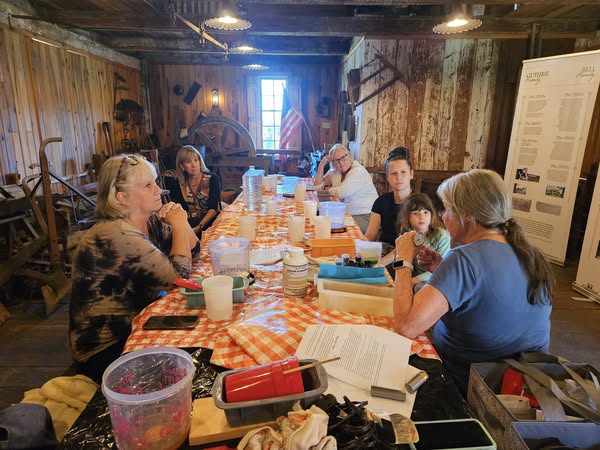
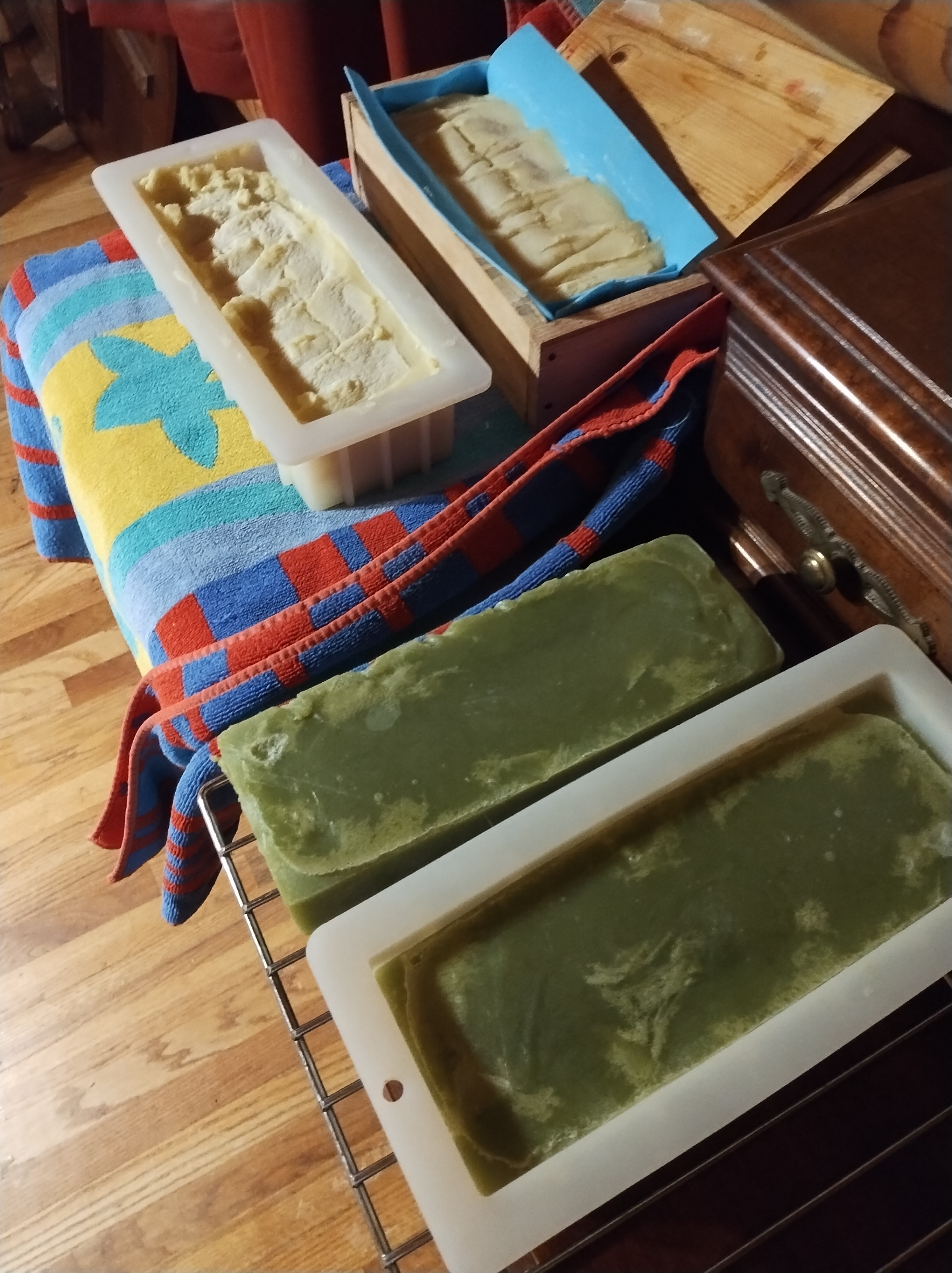
Last Wednesday evening, I trekked over to the museum to teach an old skill. No costume required for this event. We set up 4 stations for 4 ladies + 1 second grader accompanying her Mom and they learned to make basic lard and lye soap. We used a mix of old school and modern skills and equipment so we weren’t there all night stirring the mix. Of course they were given some history of soap and soap making and why we now use a lye calculator and a superfatted recipe to be sure we end up with a body friendly product. I put together kits of a small heat safe plastic bucket, two rigid plastic stadium cups, a spatula, and a silicone loaf pan for each participant that they keep at the end of the session, along with the a three page history, instructions, and two recipes; one for the lard and lye and one for a vegan soap with Shea butter, Coconut Oil, and Olive Oil, and of course, their mold of soap. We “cheat” by stirring with an immersion blender to speed the process up to keep our session within a 90 minute window. As I dug out some of my equipment and essential oils to scent their individual batches of soap, it seemed a good time to go ahead and make soap for 3 friends and our household.
The batches at home were made Tuesday and Wednesday of this week. On Tuesday, a double batch of one scent was made and I won’t do that again as it took forever to get to the consistency to pour it in the molds and is still not as firm as I would like to slice it into bars. The Wednesday batches will be unmolded and cut tomorrow to cure for a month before going to the folks for whom it was made.
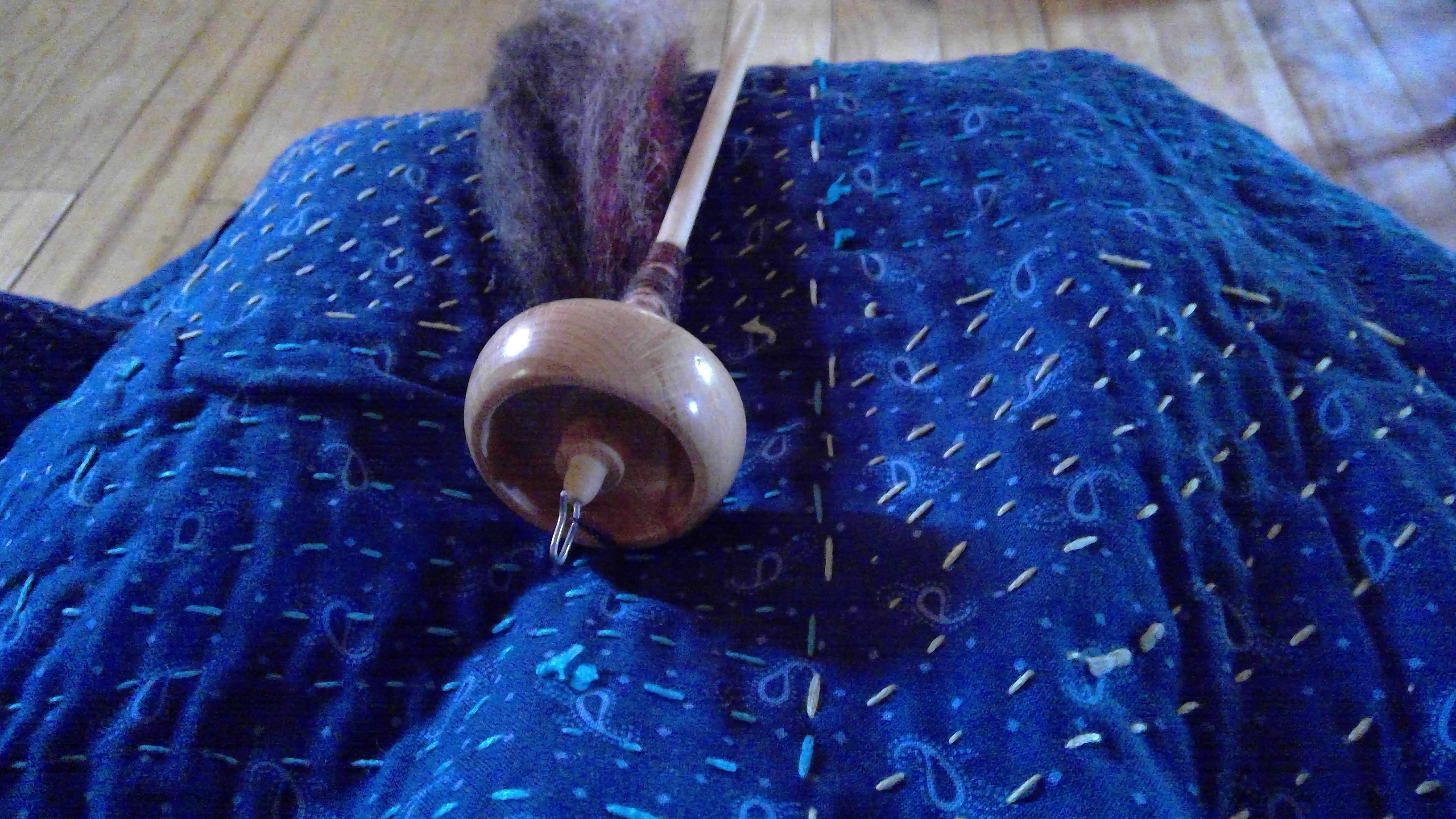
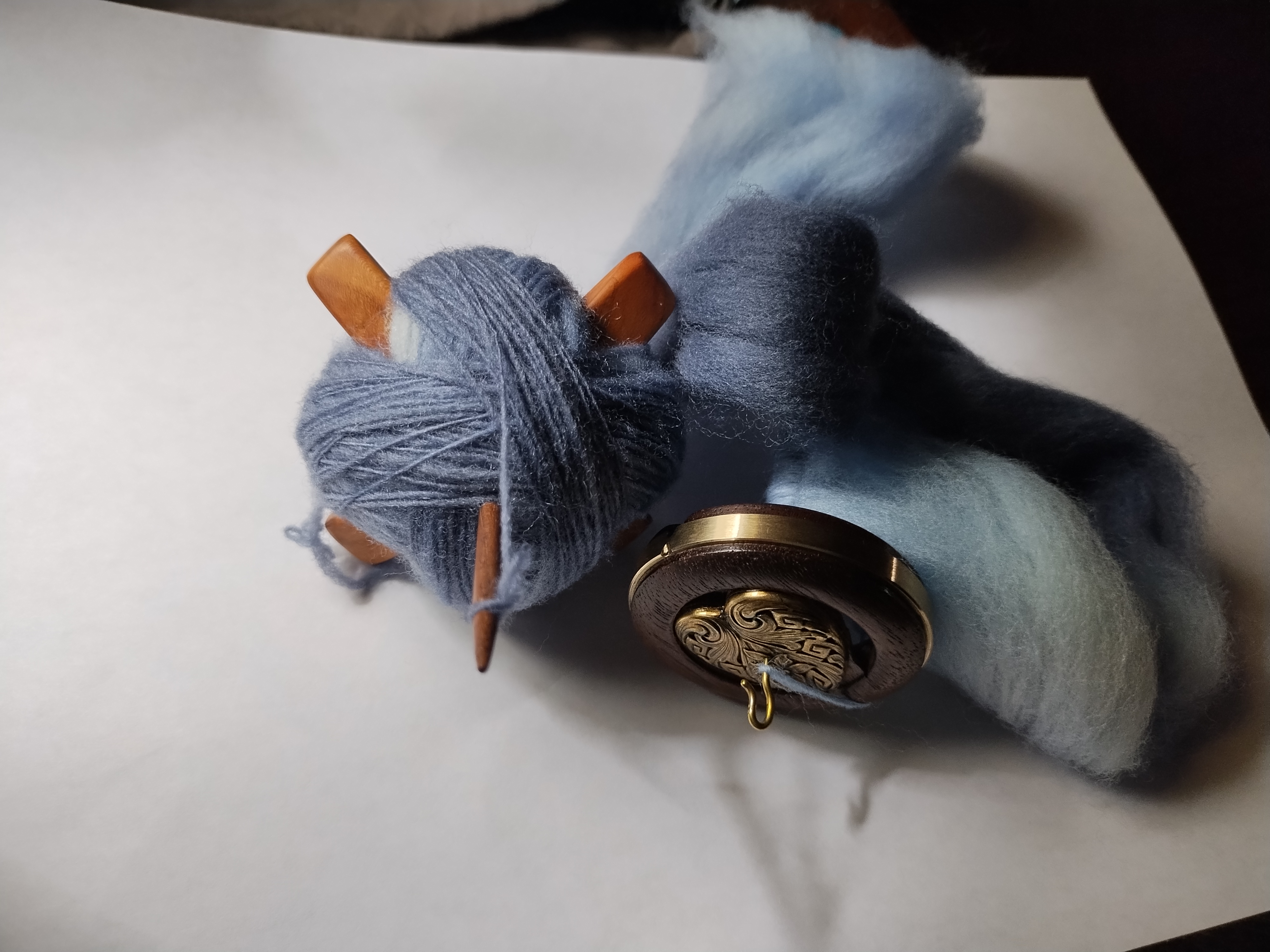
Today as I sat waiting for hubby to have a consultation visit and then I waited for my annual mammogram, I spun. In public, I spin on either a top whorl drop spindle or a Turkish spindle. When doing it, there are surreptitious glances, to out and out staring and occasionally someone will ask what I am doing. Followed by the question of what I then do with the yarn I spin.
The other old skill that really hasn’t been done so far this year is canning and preserving. There have been pickles fermented and stored, but the tomatoes haven’t produced in sufficient quantity to bother canning them. I have frozen a couple of gallon bags, made one big pot of sauce to use one night for pasta and the rest frozen in wide mouth pint jars. There is a basket of Asian pears from the orchard sitting on the dining table with a couple of oranges to make pear/orange marmalade, but I haven’t gotten around to dragging down the canning pot to do it. As there are still many jars of applesauce from last year unopened, I doubt that any will be canned this year. The only other produce that has come in quantity are greenbeans and I freeze some of them, but don’t like canned one at all and barely tolerate them from frozen. I like to buy local, but come midwinter when green vegetables are at a premium if at all available, I do buy from the grocer.
All of these skills have been learned since retirement. You can teach an old dog new tricks. And I truly believe in the each one teach one. I am grateful to the friends who taught me to make soap, spin, and improve my knitting skills. The canning and fermentation, I have learned from books and the internet.
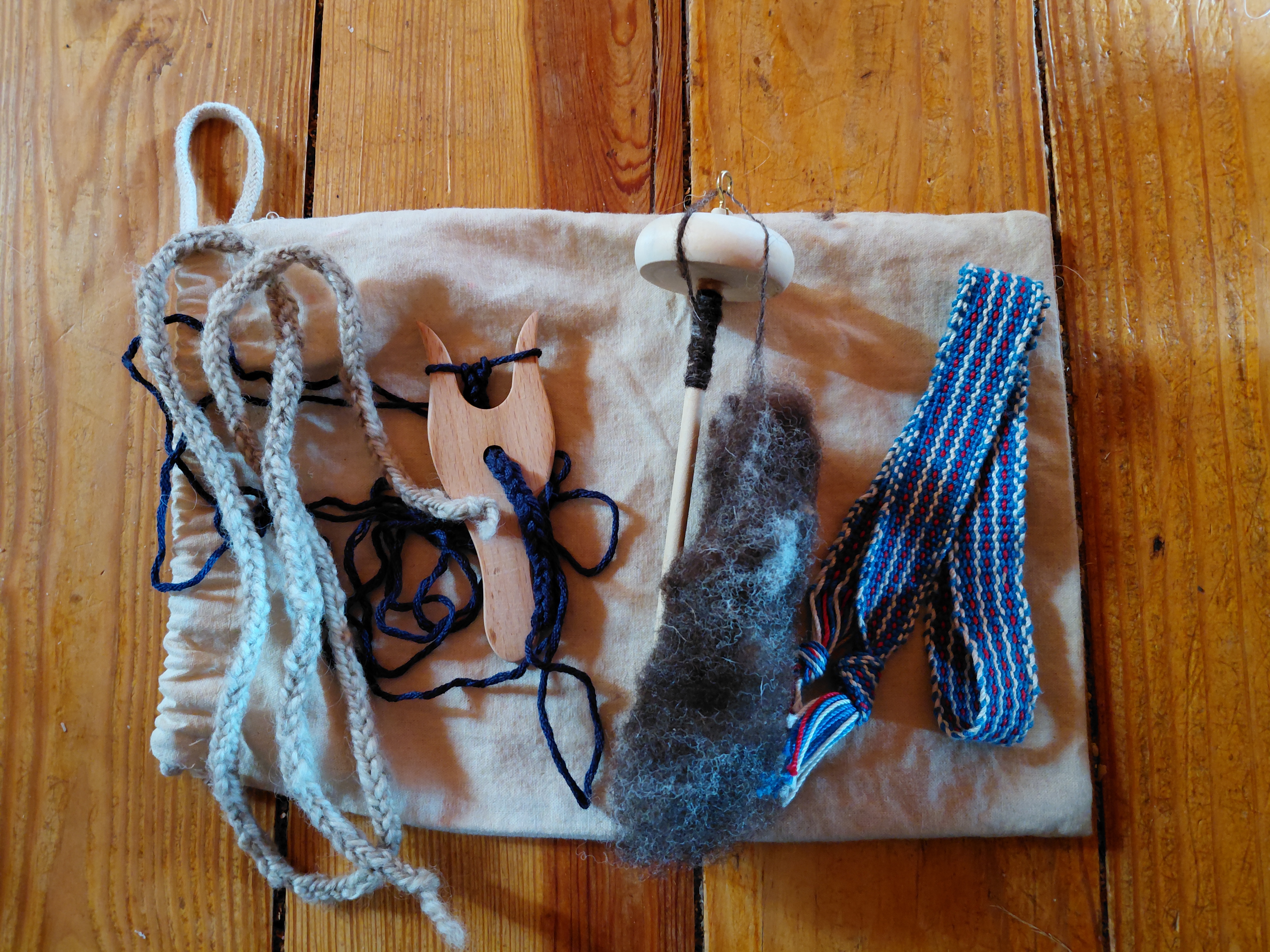
The museum where I volunteer as a spinner and occasional teacher holds a history themed week long day camp each summer. This year’s theme is cultures, representing the melting pot of cultures that dwelt in this region and the crafts they brought. Next week, I will spend one afternoon on fiber and will provide each camper with a small drop spindle to take home and a lesson on how to spin on one.
The spindles are wooden toy wheels on a dowel with a cup hook at the top. Each in a small storage bag that will also have an ounce or so of wool for practice, and each will be given a printed instruction as a reminder when they get home with them.
The weather is going to be hot as it has been for several weeks, but cloudy, so maybe not too uncomfortable in the Colonial outfit. I am following the bagpiper and he will certainly have on more layers than I will.
As my favorite thing to do at the museum is working with children, drawing back on my retired educator skills, this is a perfect afternoon.
The annual scavenger hunt has been fun this week, with easy to find object and encouraging much more spinning time for me. The wool I have been spinning was slightly sidelined as I wanted to spin the gift sample that my friend sent with the spindle she proxy shopped for me. One half was spun Monday, the other half yesterday and the two plyed last evening to create a small 46 yard skein. The pale yellow, I learned from here is caused by a bacteria in the wool in wet or humid conditions and though washing with soap stops the growth and makes the wool safe, the yellow color does not wash out. It will be added to a bag of other small skeins and they will be knit into hats when my current knitting project is complete.
If the weather ever cools off, a couple days of weeding flower beds, dividing Iris and Day Lilies needs to be done. And a couple skeletons of Nandina that the cold killed off two winters ago, need to be dug out. Other than cucumbers and a handful of green beans, the garden is growing but not producing much right now. There will be tomatoes, a few ears of corn, peppers, and hopefully a second round of green beans later in the summer.
Right now, we are sitting out a round of thunderstorms. We got our daily walk in prior to them setting in. It was hot and humid, but done anyway.
We have lived here for about 18 years now, and for 15 of them we had either barn cats or large dogs. All are gone now. Early on, because we have 30 acres of fields and woods, we allowed some hunting on the property, but after an incident when one of the young hunters, invited a friend we did not know and the friend then showed up alone with his 5 year old son, we cancelled hunting privileges for non family and no one in the family has hunted here for years. With no domestic animals in or near the house and no hunters on the land, the wild animal behaviors have changed.
We used to park the cars in the driveway and every spring, we had to cover the side mirrors to keep the male cardinal, that calls the side yard his habitat, from constant attacks against the “intruder.” The cars now get parked in the garage.
The male bird aggression is interesting. This morning a tiny sparrow repeatedly bashed his breast and head against the French doors of the dining room. I tried turning on the inside light, putting a dining room chair against the glass, and finally hung a paper owl from the back of the chair to keep it from a concussion or broken neck.
We have always had deer foraging and crossing the property, but now they rest in the shade of the row of pine trees on the edge of the mowed lawn just to the west of the house and barely flinch when we go outside to water plants, fill hummingbird feeders, or go over to the chicken pen and coop. The hay is still high and unmowed and it is fawning season where the does drop their young. There is a new mom doe (probably a first time as she only has one fawn) that feels safe enough that she had her tiny little one near the house. As their behavior is to hide the fawn and move off from it, coming back to nurse a few times a day, and then moving the fawn to a new location, we have seen her bring the little one in to the mowed yard where it is easier to walk, then take it back into the tall grass to hide. We can tell approximately where the fawn is hidden by where she goes to graze.
I won’t look for the fawn, there is no reason to disturb them, but we look out the south windows to see if we see where the doe is grazing. She is a brown hump in the tall grass when grazing and will look up if she hears a noise. The area she is using is about 2 football fields in size. After the fawn is about 3 weeks old and starting to eat more solid food, it will begin to follow the doe around and the two of them will like form a small herd with other does with fawns or other does that she is related to.
The other wildlife whose behaviors have changed in the absence of cats and dogs are the rabbits and chipmunks that come right up to the house, the chipmunks even up on the deck. And we have a groundhog that seems to prefer the mowed lawn to graze but lives near or under a cedar tree right on the edge of the hayfield. I haven’t caught it out to take a photo lately, it has been rainy for the past 4 days.
Last weekend, our eldest, his wife, and their son came to our local grandson’s high school graduation. His son is city born and city raised and he spent the entire weekend looking for o’possums and groundhogs to no avail. We did see rabbits and deer to show him and warned him about nighttime wandering to look for them due to skunks and coyotes. I haven’t heard the coyotes this spring yet.
Life in a rural area is ever changing. The hen turkeys should be hatching poults soon and we will see them. The toms are in male groups now and if they are in the fields, we can’t see them due to the height and thickness of the hay. Within the next month, weather permitting, the hay will be mowed and baled, hauled off to other farms and the animals will be visible in the mowed fields again. I love the rural mountain life.
There was a lot of living history this week. On Wednesday, we had about 80 fourth graders and 7 rotations with the museum history, slavery in Appalachia, a bit of William Tell fun with suction cup arrows and a plexiglass shield to protect the”victim,” women’s duties on the frontier, blacksmithing, fiber production at home on the frontier, and frontier Militia that includes the presenter firing a flintlock rifle for the students. After we were done, the curator showed them a covered wagon and how it would have been loaded to travel the Wilderness road to the western parts of Virginia (now Kentucky and Ohio).
Thursday we had over 100 sixth graders with some changes in rotations to match the available volunteers. These groups are fun to do and also have some of the frustrations that teachers deal with daily. Some the the youth are very engaged and have great questions. Some would rather be anywhere else and poke and prod their neighbors, or engage in flirting with another student.
The door to the loom house is low, about 5’5″ and most kiddos that age walk in without a thought, but there are a few as tall or taller than me at 5’7+” that have to duck to enter. The space inside is tight to put 15 sixth graders, but we make it work.
Wednesday night threatened cold so the flowers planted in the deck pots were covered for the night, there are no more nights much below 50 f for the next 10 days.
The first Hummingbird was spotted this morning. The single feeder that is currently out will empty quickly and soon additional feeders will be added.
The vegetable, sunflower, and herb seed have sprouted under the grow lights. They will begin to get acclimated to the outdoors in a day or two.
The Amaryllis bud opened with only 2 flowers but is 22″ tall.
After the museum yesterday it was time to mow the lawn for the first time. The riding mower original battery was so dead there wasn’t even a hint of light from the headlights, much less turning over the engine. I edged around the house and pulled out the gas push mower and it wouldn’t start either. Our once a year pushing the heavy riding mower up on to the trailer and trip two towns over to drop it off wit the repair guy was done. Once it is repaired, the grass will be so tall it will be difficult to mow, but that is all I can do for now.
We are looking forward to warm days and mild nights. Tomorrow, grandson will come help me get the rest of the garden ready to plant soon.