Author: Cabincrafted1

  • Sunday Thankfullness

    A beautiful day.

    A visit with a friend at her shop with another cloud of Tunis to spin.  When I am done there will be enough to make a rib warmer vest for this fall.

    wpid-20140518_172245.jpg

    Cloud shadows on the mountains.

    wpid-20140518_165244.jpg

    A motorcycle upright in a ditch thanks to VDOT’s lousy maintenance that was resolved with no harm thanks to the aid and ingenuity of neighbors and friends.

    Glad I haven’t planted the peppers and tomatoes in the garden, we have a frost warning for tonight.

  • First Harvest

    wpid-20140517_164707.jpg

    The first harvest from this year’s garden, a mess of curly kale cooking with some of last year’s garlic. Yum.

  • Critters and Weeds

    We had almost 2″ of rain yesterday.  The creeks are roaring and the low spots are soggy.  After a few hours of dry out this morning, I attacked more of the garden, prepping it for seed and baby plants within the next couple of days.  It amazes me how quickly the weeds grow.  Just a few weeks ago, I dumped a tractor bucket of compost into one of the beds to spread it around and build up the bed where it was dumped.  This is what it looked like today.

    20140516_145052

    Lambs quarter, jimsonweed, oxalis, wild geraniums, Bermuda grass and these two I can’t identify but they are generous contributors to the disarray.

    wpid-20140516_151630.jpg20140516_151024

    This is what a couple of hours of work have accomplished with muddy knees and grubby nails.

    20140516_145055

    Ready for an assortment of hot and sweet peppers.  A bed that wintered covered in straw wasn’t as bad and the few weeds that did emerge were dispatched and will be planted with carrots, bush beans, cucumbers and summer squash tomorrow.  The tomato bed was also covered over the winter and needs only a little work, but there are still 2 1/2 paths that need effort.  In another few days, the garden will be cleaned up, planted and just maintenance required until harvest.  I have pumpkins and winter squash seed, but can’t figure out a place to put them.  Maybe they can be planted on the edge of the grape bed and trained into the adjacent path.

    My efforts kept Mr.and Mrs. Bluebird upset and I had to keep moving away so they could feed their littles,

    20140516_141717(0)

    but I did sneak a peek before I left the garden.  I can’t tell how many are in there, it is too high to peek in.  One time when I walked away to let them feed, I went over to collect eggs and stumbled on this fellow.

    20140516_142750 1

    I encouraged him to move on.  I like them in the yard, but not quite so close to the coops.

    Life is an adventure on our mountain farm.


  • Progress and memories

    Today we had summer time with heavy rain and cooler temperatures tomorrow.  We will then have a series of cooler, more seasonable days and not much rain.  We trekked off to my favorite local nursery and bought 2 blueberry bushes.  The first batch I bought several years ago were purchased from a website.  They were tiny, bare rooted and have been a very poor purchase.  Last year I replaced three of the originals with bushes from this nursery and over the winter another of the originals died.  That one was replaced and the second one today went on the end of the row, making a nice collection of early, mid and late season varieties.  Before they could be planted, however, the berry beds needed significant attention. The rainy spring has encouraged a plethora of wildflowers where they aren’t wanted (aka weeds); chickweed, dandelion, burdock, thistles, fleabane and several I can’t remember.  The berry beds make up about 40% of the garden.  The weeds had to be pulled, the volunteer raspberries that had escaped from their bed had to be removed, the two new bushes planted in the warm rich soil and watered in well and finally, a hefty layer of old hay spread over the areas of the bed where it was needed.

    wpid-20140514_164926.jpg

    After tomorrow’s rain, while the soil is soft, the south end of the bed is going to be terraced with logs and stones to make maintaining the steep two foot slope easier.  Then the young peppers, tomatoes, basil and tomatillo plants will be planted along with seed for bush beans, carrots, cucumbers, sunflowers and squash and the rest of the weeds pulled and aisles deeply mulched with more old hay.  The hay is too moldy to use in the hen house, so it is perfect to use as mulch.

    The cabbages, kale and chard plants that were planted a couple of weeks ago are thriving.  The garlic is beginning to form scapes, so some garlic scape pesto is in order.  The grapes need a better trellis.  I can’t decide whether to try to build one or see if I can find a commercial one that appeals to me.  In my weeding today, I carefully left every volunteer sunflower plant I saw.  I love their look, the birds and chickens love their seed.  I think sunflowers may be my favorite summer flower.

    Within the garden are two birdhouses.  My efforts today kept disturbing the bluebird that has occupied one of the boxes as she does each spring.  Her young have hatched but not yet fledged as she flew in repeatedly with food for them.  The other box seems to be housing a tree sparrow which seems odd to me as a nesting box is generally not their preferred spot, but I love watching them dart and fly over the garden catching insects on the wing.

    After my efforts and a thorough clean up, there were some errands needed in town and as I was out and about, I saw this

    wpid-20140514_191702.jpg

    As my first car was a 1958 VW convertible, this really amused me.  I asked permission to take the photo and told the owner, a couple near my age that I loved their car.

    Life is good on our mountain farm.  I continue to love the changing seasons, the beautiful views and of course the mountains.


  • Mother’s Wonders

    As spring began and I set out to refill the deck pots with flowers and herbs, I discovered two Preying Mantis egg cases on a spent Geranium in one of the pots.  I carefully cut the cases off and placed one in the new Rosemary plant and the other in a pot of parsley that overwintered in the house.

    I have been watching them for the past couple of weeks, knowing that they would soon hatch.  This morning, the one in the parsley rewarded me with this glimpse into the life cycle.

    20140512_093454

    One of the cases with emerging nymphs.

    20140512_093446

    A few of the tiny creatures, making their way to the sun.

    20140512_093750

    There are hundreds of them on the plant and working their way to the outside of the deck.

    20140512_093743 1

    Two that have made their way to the sunny side of a deck post.

    I am glad that I saw this miracle occur today.  The Preying Mantis are welcome on our farm, one of the more interesting and voracious predators of unwanted pests.


  • For Mother’s Day, We Went to War

    War, West Virginia that is.  As spring broke and Jim brought out his motorcycle, he set off one day to follow a route that had been given him at one of the dealerships while looking for a bigger bike.  Somehow, he zigged when he should have zagged and missed the correct turn to do the ride and after thinking he had somehow gotten a bit out of his way, he found himself in War, West Virginia.  After many hours, he finally returned home and we Goggled it to find out more about it and in doing so, I discovered a new to me, local author.  Michael Abraham has written a number of fiction and non fiction books all set in the Appalachian region in which we live.  His topics covering the heritage of this region.

    The Appalachian region is rich in music culture and includes the Crooked Road, a music trail of venues that feature the local bluegrass and folk music of the area.  This part of Southwest Virginia and Southern West Virginia are also areas from which a glut of coal is extracted.  The industrial rise and increased use of electric power in homes caused an influx of population as miners worked in factory towns to extract the mineral at the expense of their health and often their lives.  As mechanization was improved and fewer miners were needed, most of these towns began to fail.  As you drive through the regions, abject poverty is evident.  Homes that were built by the mine owners and rented to the miners are run down, many abandoned, stores boarded up and Main Streets vacant.

    20140511_164240[1]

    20140511_164447[1]

    Each of these coal towns has a still functioning or abandoned tipple, the structure is used to clean the coal then load it into rail cars by the hundreds that rumble across Virginia to the coast to be loaded into ships and exported overseas, much of it to China.

    20140511_165319[1]


    This is the tipple at a deep mine, though mechanized, the mining crew still works underground.  Coal developed in seams of varying thickness thousands of years ago.  The seams are like icing in a layer cake and in deep mines, the miners dig down into a seam, reinforcing the tunnel as they go, extracting the coal and sending it to the surface.  When the mine is spent and they are worked back out, the layers were often collapsed to prevent accidental cave ins.  This is dangerous work, but causes less impact on the ground level environment.

    mountaintopremoval

    Mountain top removal or strip mining is also prevalent in this region.  It came about as a means to use fewer miners, more mechanization and caused a devastation to the area’s environment.  The trees are stripped off the top of a mountain and the soil and rock are blasted out and dumped into the valleys to reach the coal which is then trucked in dumpers too large for traditional roads to the tipples.  These mountain top removal mines have dams that hold huge ponds to clean the coal and there have been many accidents where the retaining dam has failed and in a few cases wiped out a town downstream (http://www.usmra.com/buffalo_creek.htm).  The impact of this type of mining is the eradication of streams, deforestation, devastation of wildlife habitats.

    Few of the young people in these towns stay.  Those that do are in one of the most impoverished areas of the United States.  After reading the novel War, WV by Abraham and doing more research about mining, I wanted to see the results.  Today we took a road trip after our brunch and drove the loop that my husband rode so that I could see it for myself.  There are many more pictures taken today, the mountain top removal photo used is from the internet as the only one of those mines we could see from the road was from a steep mountain road with a series of hairpin turns and no place to stop and take a picture.  Today was quite a learning experience and makes me thankful all the good that I have been given.

  • Olio

    Olio: a miscellaneous collection of things

    Today the post is all over the place.  First, chickens are mean.  This is the result of the hens establishing pecking order.

    OLYMPUS DIGITAL CAMERA

    One of the hens has pecked the upper wing of several of the others, plucking their feathers, but not drawing blood.  The shake up has allowed the feathers to begin growing back in.

    OLYMPUS DIGITAL CAMERA

    Her bare back is the result of the over zealous rooster.  He is picking on the hens in the cull pen now and this gals feathers are coming back out as well.

    OLYMPUS DIGITAL CAMERA

    Go away and give me some privacy!  I’m trying to lay an egg.

    The lace on the shawl on which I was working, did not win!  I did.  The shawl was completed this afternoon as Jim watched the last rounds of the football draft.  I am pleased with the finished product.  It is fairly generous in proportion, the color is rich, and the leaf lace border is interesting.  It is currently being blocked with hopes that it will be dry to wear with a skirt to Mother’s Day Brunch at Mountain Lake Lodge tomorrow.

    20140510_192210 20140510_204059


    It is pinned to a double bed to give you an idea of it’s size.

    This afternoon, our daughter sent an adorable picture of her daughter and she gave me permission to share.  I particularly enjoyed the photo because when our daughter, our second child was born, I was excited to have a little girl to dress up.  I took a smocking class and made dresses and bonnets.  As soon as she was old enough to assert her opinion, which was quite early, she always wanted pants, sweaters or t shirts and mismatched socks.  I would buy her skirts for school and she would pull out pants instead.  She was an athlete, playing soccer for years and softball in middle school.  When she found out she was pregnant for the second time, she told everyone that if she had a girl, she would not put her in pink.  She decorated the nursery with a musical theme in greens, blues, teal and brown.  Now that this little princess is old enough to assert her opinion, she chooses skirts and dresses.  This is her afternoon outfit.

    IMG_4100


    Life and good, I love being a Mom and a Grandmom.


  • A Spinning Lesson

    Several days ago, I blogged about my crafty hobbies and got several responses about how great the photos were, but they didn’t have any idea what the terms were.  This will be a short lesson with photos about how thread, yarn, string or even the huge rope that tie up a ship are made.  Spinning is a very ancient art that involved twisting fiber by hand, spindle, spinning wheel or machine into strands or singles and then taking two or more of those singles and spin them together in the opposite direction, allowing the twist you created to hold the strands together, called plying.

    Many fibers can be spun.  Wools from dozens of varieties of sheep, llama, alpaca, cashmere goat, angora rabbit, yak, buffalo, whatever has hair of sufficient fiber length to twist together.  Silk cocoons, cotton, hemp, flax, and synthetic fibers such as acrylics to name a few can also be spun.

    I am currently working with wool processed two different ways.  The red on the left is called a batt.  The wool is combed out to line up the fibers and left in big clouds or sheets.  The dark on the right is pencil roving.  It is also combed out to line up the fibers but the fibers are then rolled into long loose ropes with no strength.  These are two of the more convenient ways to process the fiber for spinning.  A chunk of the batt or the roving is pulled off, fluffed apart to make it looser, called predrafting, then spun.  The single that you make is much stronger that the product at the start, but even stronger if it is then plied to another single.

    OLYMPUS DIGITAL CAMERA


    The red batt is Tunis wool and the dark pencil roving is a blend of Finn and Jacob wool, so three different sheep breeds represented.  All of these are fairly soft and have a long fiber, making spinning very easy.

    OLYMPUS DIGITAL CAMERA

    Once the spools, called bobbins are full or you run out of fiber, it can be plied.

    OLYMPUS DIGITAL CAMERA

    My spinning wheel is equipped with a built in bar with two pegs that fit through the center of the bobbins to hold the full bobbins for plying.  This is called a Lazy Kate.  You can see in the photo, the two singles being fed back up to the top bobbin for plying.


    OLYMPUS DIGITAL CAMERA

    This is a two ply yarn for knitting, crocheting, or weaving.  You can see the twist because of the use of the two colors in my effort to make a tweed like yarn.  The coin is an American dime to give you some reference to the thickness of the finished product.

    Once it has all be plied onto the bobbin, it will be wound off and measured then washed and hung to dry before it will be ready for use.  We will save knitting terms for another lesson.

    For you curious or scientific minds, go grab a few inches of kitchen twine and you can reverse the process to see how it works.  The plies will pull apart and you can see the twist, then if you take a ply and start unraveling it, you will see that it twists the opposite direction.  It is really quite an interesting product.

    Long ago, our ancestors would start with the raw fiber, wash it, comb it, spin it, then knit or weave it into a garment for warmth.  My end goal is to reach the point where I can do a process called sheep to shawl where I will do everything except sheer the sheep.  Last year I did help with an alpaca shearing http://wp.me/p3JVVn-mU but that is another story.


  • Growin’ Up

    The chicks are fully integrated into the coop.  The barrier has been removed, the food and water are outside, the chicks leave the coop during the day and return to perch at night.  The first day they all went outdoors, 6 of them perched in the smaller part of the then divided coop with the big girls and only 4 isolated themselves.  Now they mix it up on the perches, so fun to see with big and littles all scrunched together.

    I was still having some concerns about the king and queen of the coop as the Olive Egger was picking on the chicks and Cogburn without most of his harem was beating up on the two Buff Orpingtons hens.  Tonight after coop up time, Jim and I went out and shook up the pecking order a bit.  We moved the 3 red sex link laying hens back into the coop and removed the king and queen to the cull pen and chicken tractor.  Cogburn will have 4 hens and the coop has 5 hens and the 10  nine week old pullets.  Once the pullets are laying and son comes to run freezer camp, Cogburn will likely be returned to the coop and the red sex links may be removed.  The Olive Egger only gives us about 3 to 4 eggs a week and though it is fun to find the green eggs, she may go to camp.  Maybe by removing her and the roo for a while to allow the Buff Orpington hens some rest and the chicks some time to grow some more, they may both be returned to the coop.  That will have stirred up the pecking order and may drop her down a peg or two.

    It is still exciting to check the nesting boxes in the evening and bring in 7 to 9 varied eggs.  The sale of the extras to my knitting group generally funds my dinner at coffee shop where we gather.

    Life is an adventure on our mountain farm.

  • New Friend

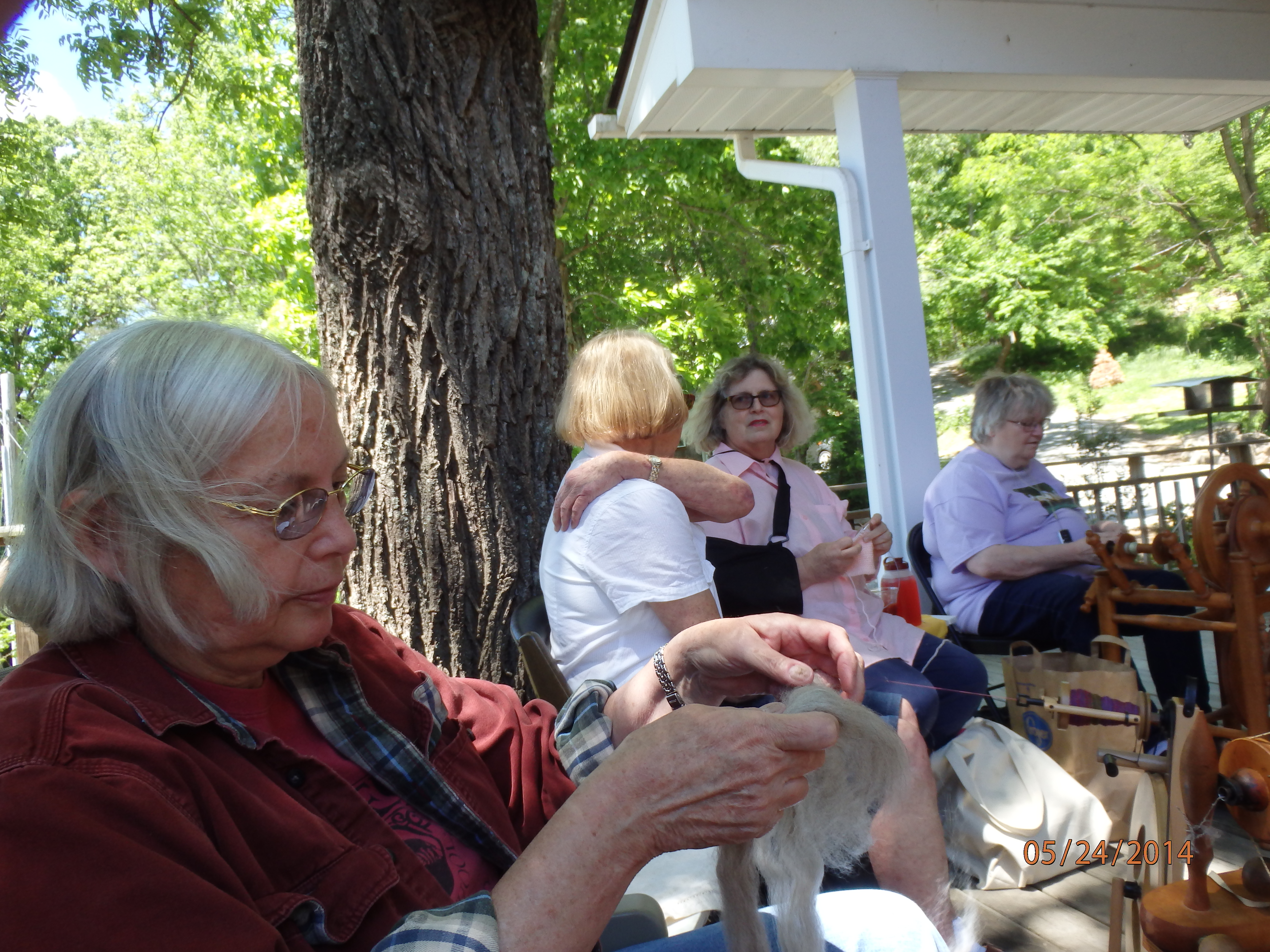
    Upon my move to the mountains, I quickly met a group of knitters who became my new local friends.  After I had been here for a few years, I took a drop spindle class and thus began a love of spinning.  One day, leaving the public library with my husband, I saw a group of folks in one of the community rooms spinning and socializing, as I looked in they invited me to watch and join them as they meet there every Thursday that the room is available and I began attending not regularly, but met some new people.

    Last Friday, one of those ladies that I did not know every well, fell down a slope behind her house and crushed her shoulder.  Fortunately she had her cell phone on her and had the foresight to call a friend who is also in the group and was gotten to the hospital where she had 3 hours of surgery to repair the damage.  This accident showed just what a tragedy can do within a group.  Quickly a group email was sent out letting everyone know and the two friends that got her to the hospital and stayed with her while there, coordinated efforts to assist her as it was her dominate hand and she will be severely restricted for the next 8 weeks.  None of her adult children live in the area, but have made arrangements to be here next week.  I volunteered to help as I could with transportation, making a meal or two, or sitting with her.  Today I was given the opportunity to take her lunch and stay with her for 5 hours this afternoon and she is delightful.  It turns out that we were both raised in Virginia Beach, attended the same high school, though she was several years behind me.  Both have 3 adult children and grandchildren.  One of each of our children live in Florida and one in Northern Virginia.  We both moved from the beach to the mountains as we aren’t fans of the beach and love the mountains and small towns.  We are both knitters, crocheters, and spinners.

    While I was there, another spinner brought two prepared evening meals for her and her nighttime helper.

    She was so grateful to have someone to visit and talk to as she heals and I am grateful to have gotten to know her.  Having watched my husband heal from a humerus break two years ago, I know that she was not comfortable, but she never complained.  I think that I benefited from the afternoon just as much as she and know I have joined a caring group of friends.